
Reviewed · KATHMANDU UNESCO HERITAGE TOURS
UNESCO Seven World Heritage Tour in Kathmandu
Kathmandu’s seven UNESCO heritage zones are scattered across the valley, so seeing them all in one day takes careful timing, a good driver, and stamina. This tour gives you all three, with a private car and guide moving you between temples, palace squares, stupas, and shrines.
I like two things right away: entry fees are included, and the guide can adjust the pace for your interests. Guides such as Shanti, Pankaj, Kabita, and Sarita have been praised for clear explanations, helpful photography, and flexibility with shopping or extra time at a site.
The tradeoff is simple: this is a long, demanding day. The schedule gives you a broad introduction rather than a leisurely study of each monument. You will walk many steps, absorb a lot of information, and spend time in Kathmandu traffic.
In This Review
- At a glance: what makes this tour useful
- Why seeing all seven UNESCO sites in one day works
- Swayambhunath and Amideva Buddha Park: Kathmandu from the hill
- Kathmandu Durbar Square and Kumari Chowk: royal power and living tradition
- Patan Durbar Square: Newar design at its finest
- Golden Temple and Patan Museum
- Bhaktapur: the best place to slow down, if time allows
- Changu Narayan: an older temple on the hill
- Pashupatinath: Nepal’s great Hindu temple complex
- Boudhanath: finish by walking the great Buddhist circle
- The private car, pace, and physical demands
- Is $180 per person a fair price?
- Who should book this Kathmandu heritage day?
- Practical details before you book
- Should you book the seven-site tour?
- FAQ
- How long does the UNESCO Seven World Heritage Tour last?
- What sites are included?
- Are all seven UNESCO heritage sites covered?
- Is transportation included?
- Is a guide included?
- Are entrance fees included?
- Is lunch included?
- Is this a private tour?
- What should I wear and bring?
At a glance: what makes this tour useful
- Seven UNESCO heritage zones in one day: Swayambhunath, Kathmandu Durbar Square, Patan, Bhaktapur, Changu Narayan, Pashupatinath, and Boudhanath all fit into one ambitious route.
- A private vehicle saves valuable time: You avoid arranging separate taxis and can leave bags in the car while exploring.
- Cultural context comes with every stop: Your English-speaking guide explains Hindu and Buddhist beliefs, architecture, legends, and Nepalese history.
- The route includes both famous and less central sights: Changu Narayan, on a hilltop outside the main city center, is easy to miss without a car.
- Hotel pickup and entry fees are included: That makes the $180 per-person price easier to judge, especially for a private group.
- Plan for a full day on foot: Wear comfortable shoes, carry water and sun protection, and expect the tour to last about 12 hours.
Why seeing all seven UNESCO sites in one day works
Kathmandu Valley is not one compact historic center. Its major monuments are spread across Kathmandu, Lalitpur, Bhaktapur, and the surrounding valley. Public transport can be slow and confusing, while arranging taxis at every stop takes time and attention away from the sights.
This tour solves that problem with a private vehicle and hotel pickup and drop-off. Your driver handles the busy roads while your guide handles the historic and religious setting. That division of labor matters in Kathmandu, where short distances can take much longer than a map suggests.
The day is best viewed as a first look at the valley. You will see major temples and palace courtyards, learn how Hindu and Buddhist traditions overlap, and identify the places where you may want to return for a slower visit.
The guide is a major part of the value. Pankaj has been praised for explaining both Hinduism and Buddhism, while Shanti is noted for adjusting the schedule, helping with photographs, and answering questions beyond the formal route. Kabita has also been praised for explaining mythology and culture while letting visitors set the pace. Your assigned guide may be someone else, but the tour depends heavily on that person’s ability to make a packed day feel manageable.
More of the valley’s UNESCO heritage sites:
- Private Kathmandu Sightseeing Tour | UNESCO World Heritage sites
★ 5.0 · 756 reviews - Kathmandu: Full Day 7 UNESCO Tour with Lunch – Private/Group
★ 5.0 · 415 reviews - Kathmandu: Full Day Top 4 UNESCO Tour with Lunch – Private/Group
★ 5.0 · 269 reviews
Swayambhunath and Amideva Buddha Park: Kathmandu from the hill
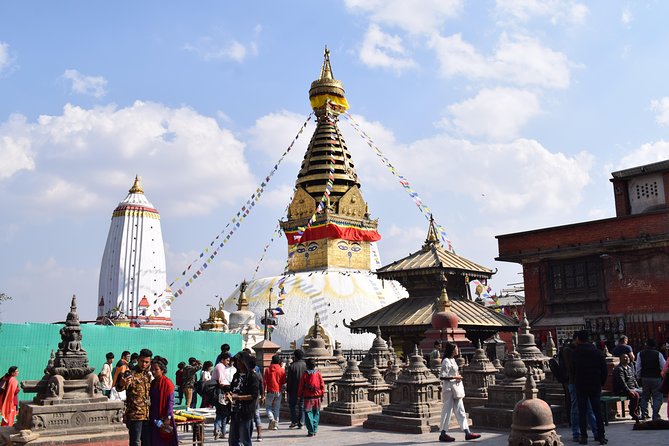
The day begins at Swayambhunath, often called the Monkey Temple. The stupa sits on a hill above Kathmandu, reached by a staircase of about 365 steps. The climb is part of the experience, but it can be tiring early in a day that includes several more temple compounds.
At the top, you can walk around the stupa and turn the prayer wheels. Hindu shrines and Buddhist symbols share the hill, a useful introduction to the way religious traditions meet throughout Nepal. The elevated position also gives you a broad view over Kathmandu.
The listed visit at Swayambhunath is short, about 15 minutes, so do not expect a long, quiet meditation here. Your guide will point out the key features, but the schedule favors coverage over lingering.
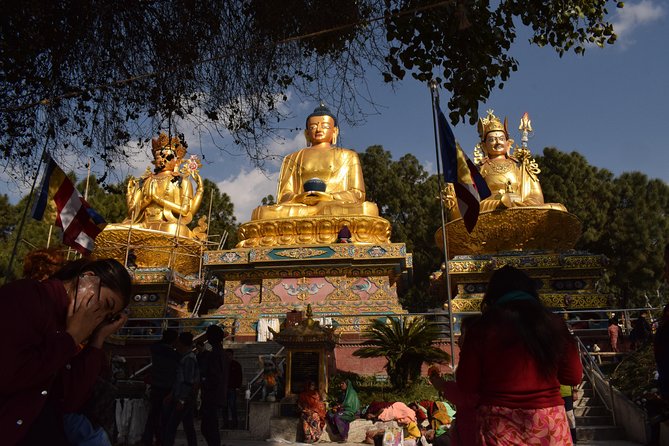
Amideva Buddha Park is visited at the far side of the hill. Three large Buddha statues make a strong visual contrast with the older shrine complex above. The stop is brief, around 10 minutes, and is easy to miss if you visit Swayambhunath alone without knowing the route.
Kathmandu Durbar Square and Kumari Chowk: royal power and living tradition
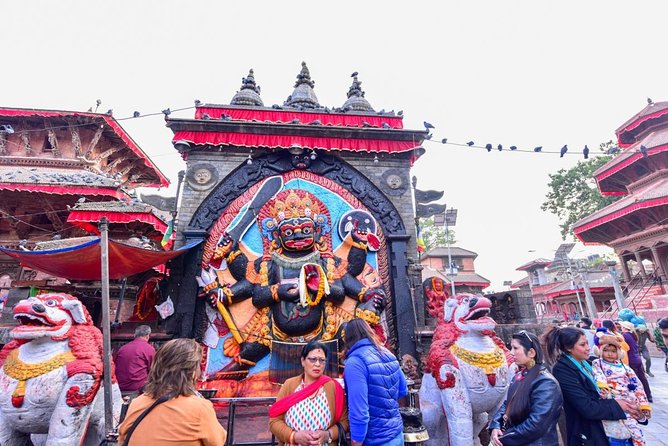
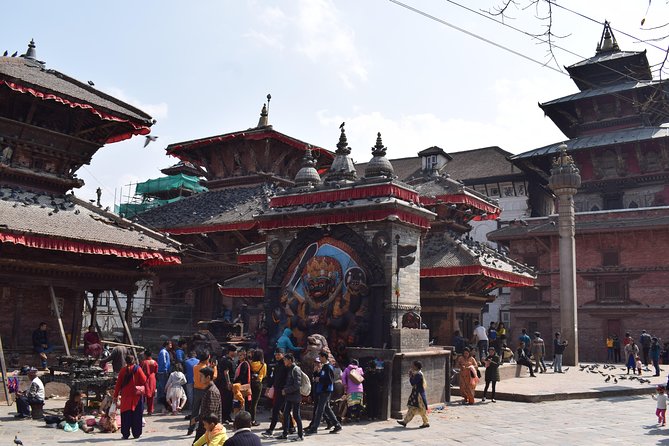
Kathmandu Durbar Square brings you into the old royal center of the city. The square contains historic and religious buildings, though some structures remain under repair or reconstruction. That is important context: Kathmandu’s monuments have suffered damage, and you may see scaffolding, repaired facades, or unfinished work.
The Kumari Chowk is one of the most memorable stops. This red-brick, three-level courtyard was once home to the Kumari, a girl selected to serve as the city’s living goddess until puberty. The visit offers a glimpse into a tradition that links royal history, Hindu worship, and everyday urban life.
The tour does not promise that you will see the Kumari herself. It does include the courtyard, and one detailed account describes seeing the Royal Kumari, but that should be treated as a possibility rather than a guaranteed part of the schedule.
This is also a good place to ask questions. A well-prepared guide can explain the difference between a sacred space, a palace courtyard, and an active religious site. That background helps you look past the carved windows and brickwork.
Patan Durbar Square: Newar design at its finest
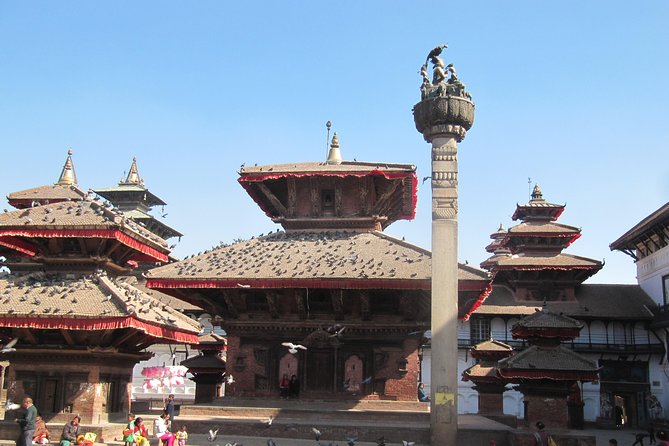
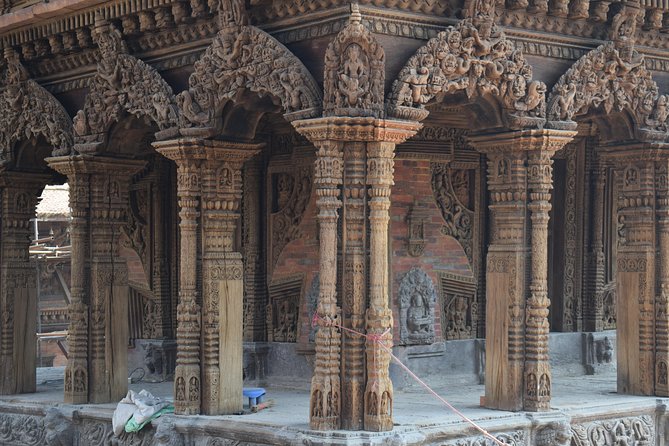
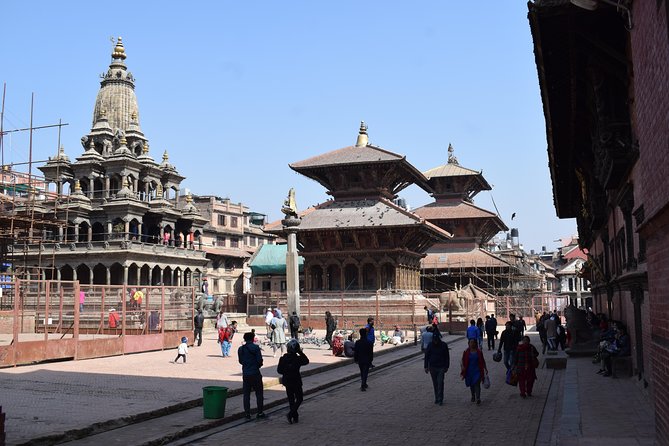
Patan Durbar Square, in Lalitpur, was the courtyard of the old Malla palace. It is one of the day’s strongest stops for architecture, with red brick buildings, carved wood, stone temples, and a close connection to the local Newar community.
The central square includes Krishna Temple, a stone-built temple with 21 shrines. Its form differs from the pagoda temples you see elsewhere in the valley, so the guide’s explanation is useful here. You will also see a blend of Hindu and Buddhist design traditions, a recurring theme across the route.
The listed time at the central square is about 25 minutes. That is enough to get oriented and hear the main explanation, but not enough for every courtyard, carving, and museum display. If architecture is your main interest, Patan may be one of the places you want to revisit.
More history walks in Kathmandu:
- Kathmandu Private Sightseeing Tour | UNESCO World Heritage Sites
★ 5.0 · 109 reviews - Kathmandu: Full Day Private Top 4 UNESCO Heritage Tour W/Lunch.
★ 5.0 · 86 reviews - Kathmandu World Heritage Tour
★ 5.0 · 74 reviews - Nagarkot Sunrise & Bhaktapur UNESCO Heritage Private Tour
★ 5.0 · 66 reviews
Golden Temple and Patan Museum
The Golden Temple, formally Hiranya Varna Mahavihar, is a 12th-century pagoda-style temple in the northern part of Patan. Bronze statues, silver details, and the compact temple setting make it feel different from the large open palace squares.
The stop lasts about 10 minutes. Watch your footing and take time to look at the smaller details, since the compound is more intimate than the main square.
Patan Museum occupies Keshav Narayan Chowk and presents objects tied to Nepalese tradition and history. The scheduled visit is around 15 minutes, so you will receive an overview rather than a full museum visit. If you enjoy museum collections, the short stop may leave you wanting more time.
Bhaktapur: the best place to slow down, if time allows
Bhaktapur, known as the City of Devotees, is often the most atmospheric part of the route. Many traditional houses and older buildings remain intact, and the city’s brick lanes and courtyards give you a stronger sense of a historic town than the larger capital does.
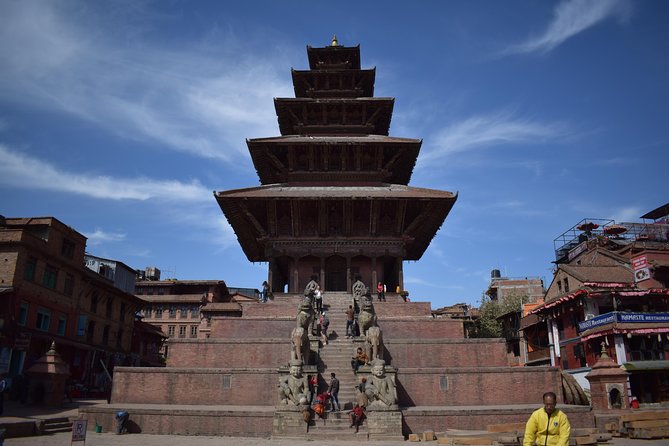
Nyatapola Temple is the first major stop listed here. This five-level pagoda is one of the tallest in Nepal and is reached by a stairway lined with sculpted guardian figures. The visit is scheduled for about 10 minutes, so the main reward is the view of the temple and its carefully arranged vertical design.
Dattatreya Temple, in Dattatreya Square, is linked to a striking origin story. It is believed to have been built from the trunk of a single tree. The temple’s setting also gives you another look at Bhaktapur’s wood carving and traditional urban design.
The Palace of Fifty-Five Windows is one of the square’s signature buildings. Its carved windows explain the name, and the palace helps show how the Malla rulers used architecture to express status and power. The scheduled time is about 10 minutes.
Siddha Pokhari is a man-made pond near Bhaktapur’s first town gate. It is listed as 171 meters long and three meters deep, and it provides a quieter change from the temples and palace buildings. The stop is only five minutes, so consider it a quick look rather than a restful break.
Lunch in Bhaktapur is not included, but the town offers many eateries. This is the natural place to pause for a meal, and you choose where to eat. Since the schedule is already tight, ask your guide how much time is available before ordering.
Changu Narayan: an older temple on the hill
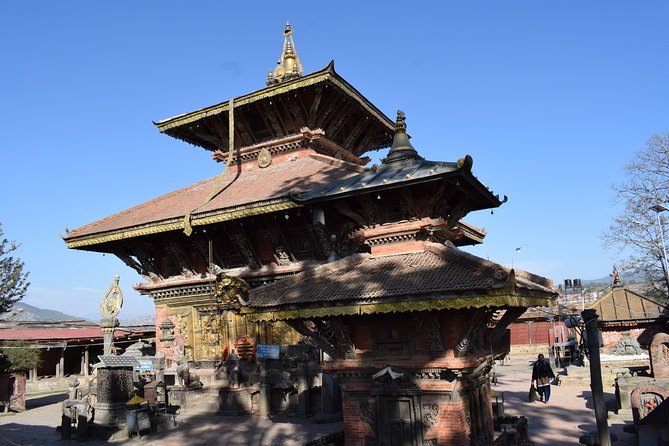
Changu Narayan is one of the day’s most distinctive stops because it sits away from the main urban centers on a hilltop. The temple dates to the Licchavi period and is regarded as one of the oldest temples in Kathmandu Valley.
Stone and wood carvings are the main attraction. The setting also changes the feel of the tour. After palace squares and dense city streets, you reach a more remote religious site with a longer scheduled visit of about one hour.
This is precisely the sort of place that is hard to fit into an independent one-day plan. You might reach it by arranging transport, but the private car makes it practical to include with Bhaktapur and the rest of the valley.
Pashupatinath: Nepal’s great Hindu temple complex
Pashupatinath is one of Nepal’s largest temple complexes, covering about 0.64 hectares and containing more than 500 temples and shrines. It is a major Hindu pilgrimage center and one of the most important religious sites in Kathmandu.
The tour allows about one hour here. That gives you time to understand the scale of the complex and see its riverside setting, shrines, and religious activity. Access to individual areas can depend on religious rules, so your guide will help you understand what you may enter and what should be viewed from outside.
Some accounts of the day include seeing Hindu cremation activity in the evening. This is a serious, active religious setting, not a staged performance. Approach respectfully, follow your guide’s instructions, and do not treat ceremonies or grieving families as photo opportunities.
The site can be emotionally intense. I consider it valuable for understanding present-day Nepal, but it may not suit you if you prefer your sightseeing to remain purely architectural.
Boudhanath: finish by walking the great Buddhist circle
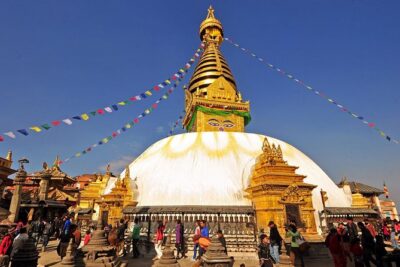
Boudhanath Stupa is a major Buddhist pilgrimage site and one of the visual highlights of the day. The stupa rises about 36 meters and is surrounded by more than 50 gompas, or Tibetan Buddhist monasteries.
The usual way to experience it is to walk around the stupa, following the flow of pilgrims and turning prayer wheels along the way. Your one-hour visit gives you more room here than at some of the smaller stops, which is welcome at the end of a long day.
Boudhanath also provides a useful counterpoint to Pashupatinath. The two sites represent different religious traditions, yet both are active places of worship rather than museum pieces. A guide who can explain both Hindu and Buddhist practice adds real value at this point.
The private car, pace, and physical demands
The private vehicle is not a luxury extra on this route. It is the mechanism that makes seven heritage zones possible in one day. The driver also deals with Kathmandu’s difficult traffic, something repeatedly praised in the feedback, while you can focus on the guide and the views.
The tour is private, so only your own group participates. That gives you more control than a large coach excursion. You can ask for extra time at a favorite site, request shopping, or end early if the day becomes too much. Several people have used that flexibility to adjust the schedule.
Still, private does not mean relaxed. The itinerary lists many short visits, and the full day lasts about 12 hours. You will climb the stairs at Swayambhunath, walk temple courtyards and palace squares, and make repeated stops in and out of the vehicle.
Wear supportive walking shoes. Bring water, sun protection, and clothing suitable for religious sites. The dress guidance is smart casual, which is a useful middle ground: look neat, cover appropriately, and be ready for a great deal of walking.
Is $180 per person a fair price?
At $180 per person, this is not the cheapest way to see Kathmandu. It is also not simply a sightseeing taxi. The price includes a private vehicle, an English-speaking guide, hotel pickup and drop-off, and entry fees at all seven heritage sites.
That bundle matters. If you tried to arrange transport, admission, and explanations separately, you would spend more time managing the day and might skip Changu Narayan or another outlying stop. The value is strongest for a first visit, a short stay, or a small private group that wants one carefully organized overview.
Lunch is extra, as are tips and gratuities. Since Bhaktapur has many restaurants, leaving lunch to your choice is reasonable, but remember to budget both time and money for it.
Group discounts are offered, so the per-person cost may make more sense for couples, families, or friends traveling together. If you have several days in Kathmandu and prefer slow exploration, you may get more from separate half-day visits.
Who should book this Kathmandu heritage day?
I would choose this tour if you have limited time, are visiting Kathmandu for the first time, or want help understanding both Hindu and Buddhist sites. It is also a good fit if city traffic, taxi negotiation, and route planning sound like unnecessary work.
Solo visitors can benefit from the private format, particularly if they want help with photographs or practical errands. One person even used the day to rent traditional clothing and ask for assistance with essentials and shopping.
I would not choose it if your priority is quiet photography, long museum visits, or sitting with one monument for an hour. The route gives you a wide view of the valley, but some stops are brief and the information can come quickly.
The tour receives a five-star rating from 253 reviews, with 100 percent recommending it. The strongest praise centers on the guides, safe and capable drivers, punctual pickup, clean comfortable cars, and the ability to adjust the schedule. Those are exactly the elements that determine whether a 12-hour route feels rewarding or exhausting.
Practical details before you book
Confirmation is provided at booking, and pickup and drop-off are available at your hotel. The activity is near public transportation, although the included private car is the sensible choice for this route.
Most people can participate, but expect stairs, uneven temple areas, and extended walking. If you have mobility concerns, ask before booking because the supplied information does not give detailed accessibility guidance.
Free cancellation applies when you cancel at least 24 hours before the start time. Cancellations or changes made within 24 hours are not accepted and are not refunded.
Should you book the seven-site tour?
Book it if you want to get your bearings fast and see the full range of Kathmandu Valley heritage in one day. The private transport, included admissions, flexible guide, and access to Changu Narayan make the price reasonable for a time-limited visit.
Skip it if you have plenty of time and prefer a slower pace. For everyone else, this is a demanding but efficient introduction. Wear good shoes, protect yourself from the sun, save some energy for Boudhanath, and treat the day as a detailed first chapter rather than the whole story of Kathmandu.
FAQ
How long does the UNESCO Seven World Heritage Tour last?
The tour lasts about 12 hours. It is a full-day activity that begins in the morning and continues through multiple heritage sites across Kathmandu Valley.
What sites are included?
The route includes Swayambhunath Stupa, Amideva Buddha Park, Kathmandu Durbar Square and Kumari Chowk, Patan Durbar Square, the Golden Temple, Patan Museum, Bhaktapur, Nyatapola Temple, Dattatreya Temple, the Palace of Fifty-Five Windows, Siddha Pokhari, Changu Narayan Temple, Pashupatinath Temple, and Boudhanath Stupa.
Are all seven UNESCO heritage sites covered?
Yes. The tour is designed to visit the seven UNESCO-listed heritage zones of Kathmandu Valley in one day.
Is transportation included?
Yes. A private vehicle, hotel pickup, and hotel drop-off are included.
Is a guide included?
Yes. An English-speaking guide is included. Guides named in the supplied tour information include Shanti, Pankaj, Kabita, Sarita, Som, and Pankaz, though a specific guide assignment is not guaranteed.
Are entrance fees included?
Yes. Entry fees for the seven heritage sites are included in the tour price.
Is lunch included?
No. Lunch in Bhaktapur is not included. You can choose from the available eateries there.
Is this a private tour?
Yes. Only your own group participates in the activity. Group discounts are offered.
What should I wear and bring?
The stated dress code is smart casual. Bring comfortable walking shoes, water, and sun protection, and dress respectfully for visits to religious sites.
Recently added around Kathmandu
- Kathmandu : Swambhunath & Durbar Square Guided Half Day Tour★ 3.3 · 3 reviews
- Private Day Tour in Kathmandu Valley Rim with Bhaktapur Sightseeing★ 5.0 · 3 reviews
- From Kathmandu / Pokhara / Chitwan: River Rafting – 1 Day★ 4.6 · 3 reviews
- Nepali Cooking training & Cultural Homestay Experience★ 5.0 · 3 reviews
- Private 3-Hour Nagarkot Sunset Tour from Kathmandu★ 3.5 · 3 reviews
- From Kathmandu: Everest Base Camp Landing Helicopter Tour★ 5.0 · 3 reviews
- 4 UNESSCO World heritage sites of Kathmandu-private tour★ 5.0 · 3 reviews
- Everest Helicopter Tour★ 5.0 · 3 reviews
Kathmandu UNESCO Heritage Tours, compared.
Private Kathmandu Sightseeing Tour | UNESCO World Heritage sites
Read our review →
Full Day 7 UNESCO Tour with Lunch – Private/Group
Read our review →
Full Day Top 4 UNESCO Tour with Lunch – Private/Group
Read our review →Full-Day 7 UNESCO Tour with Lunch – Private/Group
Read our review →
Kathmandu Private Sightseeing Tour | UNESCO World Heritage Sites
Read our review →Full Day 7 UNESCO Tour with Lunch – Private/Group
Read our review →Browse the lists this tour appears in