
Reviewed · KATHMANDU
Discover Ranjana Lipi the Traditional Newari Script
The most unusual part of this three-hour Kirtipur workshop is that you do not just look at Newari culture. You practice its script by hand, using a customary bamboo pen and ink, while traditional food and drink fill the pauses. Your finished Ranjana Lipi piece is framed for you to take home.
I like two things right away: the hands-on format gives you something to do, and the included sagun and Samay Baji turn a writing lesson into a social Newari meal. The small maximum of 15 people should also make it easier to follow the instructor’s stroke-by-stroke guidance.
The main consideration is that the program is held in Kirtipur, not central Kathmandu, and private transportation is not included. Also, the timetable offers either an early morning session from 8 to 11 or an evening session from 5 to 8, so you will need to fit it around your day.
In This Review
- Key points at a glance
- Why Ranjana Lipi makes this more than a craft class
- Starting with sagun and a Newari welcome
- Learning each Ranjana Lipi stroke
- Eating Samay Baji between writing exercises
- Morning or evening: choosing the better session
- What the framed memento adds
- Is $42 a fair price?
- Who will get the most from this workshop?
- Practical details before you book
- Should you book Discover Ranjana Lipi?
- FAQ
- Where does the Ranjana Lipi workshop begin?
- How long does the experience last?
- What food and drinks are included?
- Do I need previous experience with Ranjana Lipi?
- What do I take home?
- How many people can join the activity?
- Can I cancel for a full refund?
Key points at a glance
- Write Ranjana Lipi by hand: Use a traditional bamboo pen, ink, and canvas paper under local instruction.
- Taste Newari food during the lesson: Sagun is served as a welcome snack, followed by a Samay Baji platter and an alcoholic or nonalcoholic drink.
- Take home a framed keepsake: Your own Ranjana script becomes the final souvenir.
- Choose a morning or evening workshop: Sessions run from 8 to 11 am and 5 to 8 pm.
- Expect a small group: The activity accepts a maximum of 15 people, with group discounts available.
- Meet at Jatra Restaurant in Kirtipur: The experience begins and ends at Chithu Road, near public transportation.
Why Ranjana Lipi makes this more than a craft class
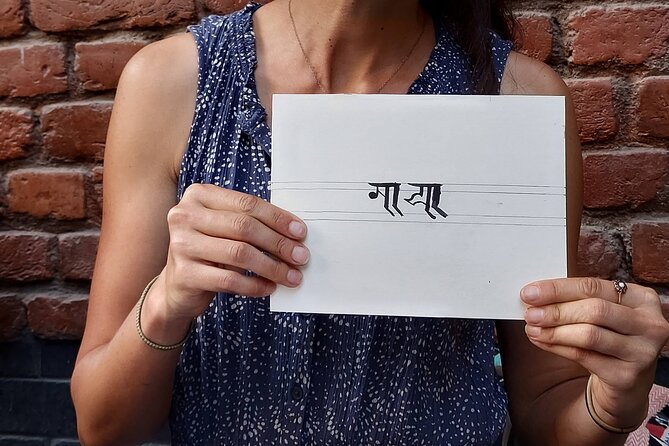
Ranjana Lipi is an ancient Newari script with links to Buddhist writing and art. One participant came to the workshop after seeing the script used for the Buddhist mantra Om Mani Padme Hum in scriptures and thangka paintings. That detail helps explain its appeal: you may already have seen these graceful characters in Nepal without knowing what they were.
The workshop gives you a way to slow down and look at the script properly. Instead of treating it as decoration, you learn how its letters and strokes are formed. That makes the experience useful for anyone curious about Buddhist art, Newar culture, calligraphy, or the written traditions of the Kathmandu Valley.
You do not need prior experience. The activity is designed for people with little or no background in Ranjana Lipi, and the instructor guides you through the strokes. The information provided does not name the individual teachers, but it does describe them as local Ranjana Lipi instructors and script experts.
I like this kind of cultural activity because the souvenir is not a mass-produced object. You make it during the class. It may not be perfect, but that is part of its value. The framed sheet records your first attempt and gives you a personal reminder of time spent learning rather than simply shopping.
Other Kathmandu days people book alongside this one:
- Everest Base Camp Trek – 14 Days
★ 5.0 · 1,499 reviews - Private Kathmandu Sightseeing Tour | UNESCO World Heritage sites
★ 5.0 · 756 reviews - Everest Base Camp Helicopter Tour landing at Everest View Hotel
★ 5.0 · 668 reviews
Starting with sagun and a Newari welcome
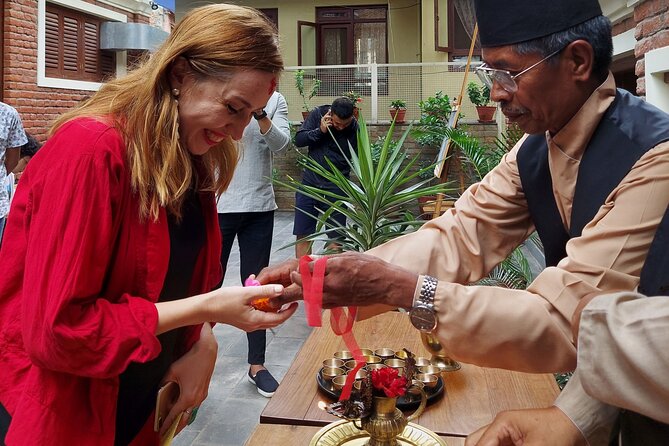
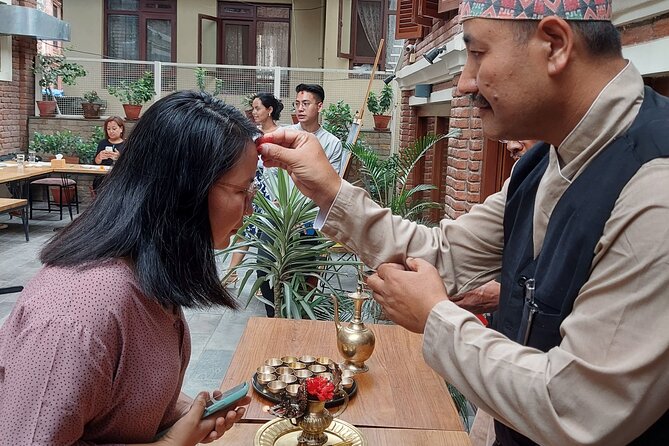
The program begins at Jatra Restaurant on Chithu Road in Kirtipur. The exact opening ritual is part of the Newari character of the experience: you receive tika, sagun, and a welcome drink before the writing begins.
Sagun is a traditional Newari offering of food and drink. Here it is served as a welcome snack, with an alcoholic or nonalcoholic drink included. The food is not an extra purchase, so you can settle into the workshop without worrying about ordering a separate meal at the start.
This opening matters because it sets a social tone. You are not being rushed from one photo stop to another. You sit down, share food, and begin with a small taste of local custom. One participant specifically praised the traditional welcome, including the tika, sagun, and drink.
If you do not drink alcohol, the nonalcoholic option is available. Coffee and tea are not included, so plan on paying separately if you want either one. That is a minor point, but useful to know before you arrive.
Learning each Ranjana Lipi stroke
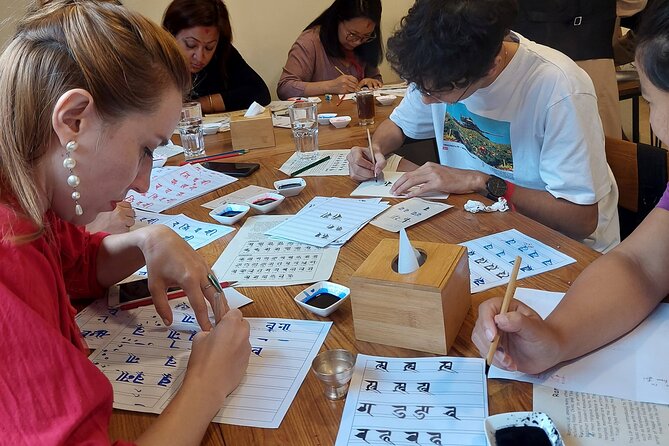
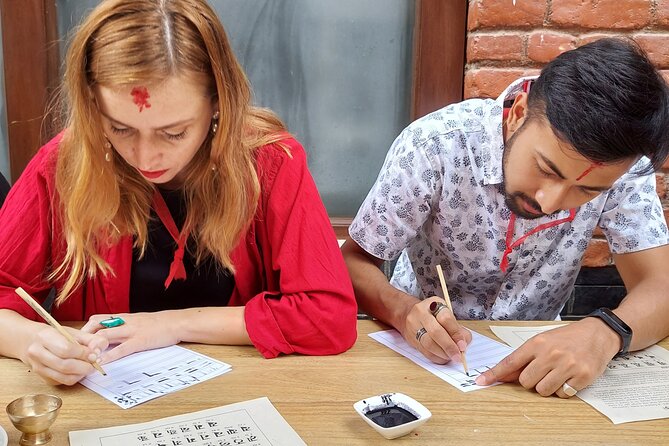
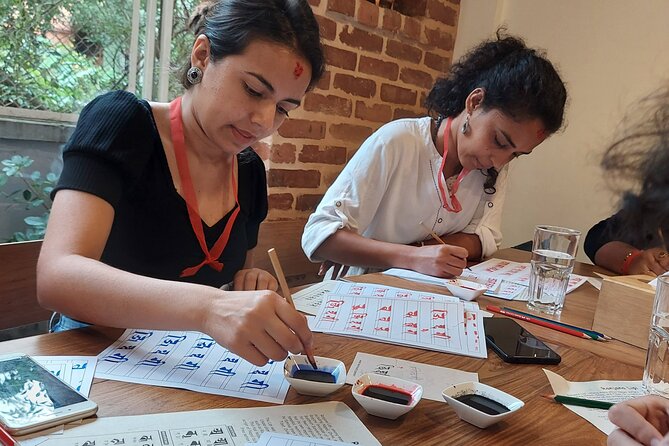
The central part of the experience is the writing session. You receive bamboo pens, ink, and canvas paper, then work under the direction of the Ranjana Lipi instructor.
The bamboo pen is an important detail. It connects the activity to customary writing methods and gives the lesson a different feel from using a modern calligraphy pen. You will need to pay attention to the angle, pressure, and movement of each stroke. The aim is not to produce a finished manuscript in three hours. It is to understand the basic form and rhythm of the script.
The class is suitable for beginners, including people who do not know much about Ranjana Lipi beforehand. The instruction is described as supportive, with guidance through every stroke. That should help if you are worried about making mistakes or have no previous calligraphy experience.
Language may require patience. One account noted that the teachers did not speak English, although the teaching still worked through demonstration and practice. You should be prepared to watch closely and follow visual instruction rather than expect a long English lecture.
That can actually suit a script workshop. You learn by seeing the form, copying it, and correcting your hand. Still, if detailed verbal explanation is important to you, this is worth considering before booking.
The group limit of 15 is another practical advantage. It is not a private lesson, but the number is modest enough that you should have room to practice. For a family, friend group, or small social outing, the class format makes sense. Group discounts may also improve the price for several people booking together.
Eating Samay Baji between writing exercises
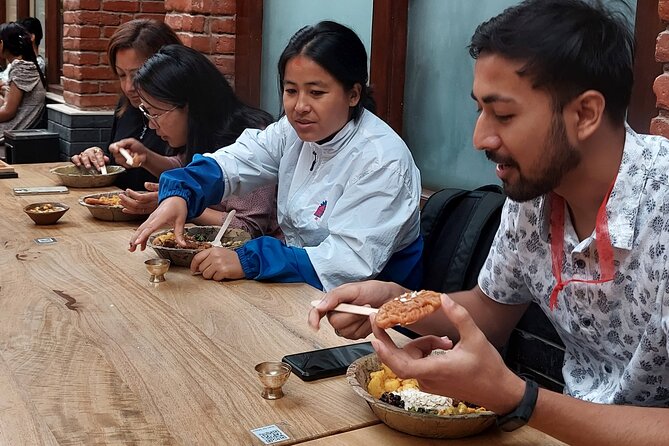
The food is not simply an afterthought. Newari cuisine is woven into the workshop, with breaks for traditional dishes and drinks. The main meal is a Newari Samay Baji platter.
Samay Baji is a well-known Newari assortment rather than one single dish. The supplied details do not list every item on the platter, so you should not book expecting a precise menu. What you can count on is a traditional Newari meal included in the $42 price, along with an alcoholic or nonalcoholic drink.
This pairing of food and calligraphy is one of the activity’s strongest features. Writing for several hours can become tiring, especially when you are learning an unfamiliar script. Food creates a natural pause, and the meal gives you another way to connect with Newari culture.
I also like that the eating is part of the planned experience instead of an optional restaurant stop afterward. You do not have to spend the workshop worrying about where to find a suitable local meal. The food, setting, and lesson belong to the same program.
Keep your expectations sensible. This is not presented as a full cooking class or a food tour with several restaurant visits. The meal supports the cultural workshop. If your main interest is food, a dedicated Newari food experience may offer more variety. If you want a cultural lesson with a substantial meal, this combination is much better suited.
A completely different sort of day in Kathmandu:
- Half day cooking class in Thamel kathmandu
★ 5.0 · 607 reviews - Everest Base Camp Trekking
★ 5.0 · 485 reviews - Nagarkot Sunrise View and Day Hiking from Kathmandu
★ 5.0 · 471 reviews - Kathmandu: Full Day 7 UNESCO Tour with Lunch – Private/Group
★ 5.0 · 415 reviews
Morning or evening: choosing the better session
You can select a morning workshop from 8 to 11 am or an evening workshop from 5 to 8 pm. Both last about three hours and begin and end at the same meeting point.
The morning option leaves the rest of your day open. It may work well if you want to combine the workshop with other sightseeing afterward. The evening option gives you a slower start and finishes around dinner time, though the included meal means you will already have eaten as part of the activity.
The schedule is fixed enough that you should arrive ready to begin. Since the workshop includes an opening welcome, writing practice, food, and the final framed piece, arriving late could mean missing part of the experience.
The activity is listed as requiring good weather. If poor weather causes cancellation, you will be offered another date or a full refund. This is especially relevant when planning around a tightly packed Nepal itinerary.
What the framed memento adds
At the end, your Ranjana script is framed as a special memento. This is more useful than a generic certificate because it shows the actual script you practiced.
Do not expect a museum-quality piece. You are learning, not commissioning a professional calligrapher. The value is personal: you can remember the pen, ink, food, and careful repetition every time you look at it.
For families, this gives children and adults the same shared project. For people with a connection to Newar identity, the framed script may carry added meaning. One participant who identified as Newar described learning the writing system as a proud moment connected to their roots.
The keepsake also makes the workshop easier to remember after the trip. Nepal offers no shortage of things to photograph, but a framed piece made by your own hand tells a more specific story.
Is $42 a fair price?
At $42 per person, the price includes much more than the instruction alone. You receive the Ranjana Lipi lesson, bamboo pens, ink, canvas paper, sagun, a traditional drink, a Samay Baji meal, and the framed memento.
That is solid value if you would otherwise pay separately for a cultural class and a substantial Newari meal. The small group size adds to the appeal, since personalized guidance is more likely with 15 people or fewer.
The price does not include coffee or tea, private transportation, personal expenses, or tips. You will need to arrange your own way to Jatra Restaurant and back. The meeting point is near public transportation, which helps, but the experience does not provide a pickup service.
Group discounts are available. If you are traveling with family or friends, check the price for your full party before booking. The social format is part of the appeal, and a group rate may make this a better choice than booking alone.
I would not choose it solely for the meal. The best value comes from combining three elements: a guided script lesson, a traditional food experience, and a handmade souvenir. If you want only a quick cultural demonstration, three hours may feel long. If you enjoy learning by doing, the time is easier to justify.
Who will get the most from this workshop?
This experience suits you if you like cultural activities with a clear task. You will practice, eat, ask questions, and leave with something you made. It is a good choice for couples, families, small groups, and solo visitors who enjoy meeting people in a class setting.
It also suits anyone interested in Newar identity, Buddhist writing, calligraphy, or traditional arts. You do not need to be an expert. In fact, the class is especially useful if you have seen Ranjana Lipi in Nepal but never understood how it was written.
The workshop may be less suitable if you dislike structured activities or want to spend your time moving between sights. It is also not the best fit if you need extensive instruction in English, since the teaching may rely heavily on demonstration.
Most people can participate, and the activity is near public transportation. The supplied details do not provide specific accessibility information, so you should ask the provider directly if you have mobility or other access needs.
Practical details before you book
You receive confirmation at the time of booking, and mobile tickets are accepted. The activity starts and ends at Jatra Restaurant, Chithu Road, Kirtipur 44618, Nepal.
The maximum group size is 15. That limit is worth noting because it shapes the lesson: you get a shared class rather than a private appointment, but the room should not be packed with a large tour group.
Free cancellation is available if you cancel at least 24 hours before the local start time. Cancellations made within 24 hours are not refunded, and late changes are not accepted. If weather forces the provider to cancel, you can choose another date or receive a full refund.
Tips and personal expenses are separate. Bring an open mind, allow the full three hours, and do not schedule another appointment too tightly afterward. The food and writing practice are both part of the planned pace.
Should you book Discover Ranjana Lipi?
I would book this if you want a personal introduction to Newari culture rather than a quick explanation from a guide. The strongest reasons are the hands-on use of a bamboo pen, the included sagun and Samay Baji, the small group limit, and the framed script you create yourself.
The $42 price is reasonable when you use all those inclusions. Just remember that you must reach Kirtipur independently, coffee and tea cost extra, and English instruction may be limited to demonstration and simple guidance.
Choose the morning session if you want the rest of the day free. Choose the evening session if you prefer a later start and a meal-centered cultural outing. For curious beginners, families, and anyone drawn to Buddhist or Newari script, this is a thoughtful way to spend three hours.
FAQ
Where does the Ranjana Lipi workshop begin?
The workshop begins at Jatra Restaurant on Chithu Road, Kirtipur 44618, Nepal. The activity ends back at the same meeting point.
How long does the experience last?
The workshop lasts approximately three hours. The morning session runs from 8 to 11 am, and the evening session runs from 5 to 8 pm.
What food and drinks are included?
The experience includes a Newari Samay Baji platter, sagun as a welcome snack, and an alcoholic or nonalcoholic drink. Coffee and tea are not included.
Do I need previous experience with Ranjana Lipi?
No previous experience is stated as a requirement. The workshop is designed to teach you the script through guided practice with a bamboo pen, ink, and paper.
What do I take home?
You take home your own Ranjana script, framed as a memento. Bamboo pens, ink, and paper are provided during the workshop.
How many people can join the activity?
The workshop has a maximum of 15 participants. Group discounts are available.
Can I cancel for a full refund?
Yes, if you cancel at least 24 hours before the experience start time. Cancellations made less than 24 hours in advance are not refunded. If poor weather causes the provider to cancel, you can receive a full refund or choose another date.
Recently added around Kathmandu
- Kathmandu : Swambhunath & Durbar Square Guided Half Day Tour★ 3.3 · 3 reviews
- Private Day Tour in Kathmandu Valley Rim with Bhaktapur Sightseeing★ 5.0 · 3 reviews
- From Kathmandu / Pokhara / Chitwan: River Rafting – 1 Day★ 4.6 · 3 reviews
- Nepali Cooking training & Cultural Homestay Experience★ 5.0 · 3 reviews
- Private 3-Hour Nagarkot Sunset Tour from Kathmandu★ 3.5 · 3 reviews
- From Kathmandu: Everest Base Camp Landing Helicopter Tour★ 5.0 · 3 reviews
- 4 UNESSCO World heritage sites of Kathmandu-private tour★ 5.0 · 3 reviews
- From Kathmandu Budget: 15 Day Everest Base Camp Trek★ 5.0 · 3 reviews