
Reviewed · KATHMANDU UNESCO HERITAGE TOURS
Kathmandu 4-Heritage Sites Tour
Kathmandu’s four major sacred sites tell four very different stories in a single day. You’ll meet the Living Goddess Kumari at Durbar Square, climb to Swayambhunath for broad views of the capital, circle Boudhanath’s great stupa, and finish beside the Bagmati River at Pashupatinath.
I like the private vehicle, which saves you from sorting out Kathmandu transport between widely separated sights. I also like the mix of royal courtyards, Buddhist worship, and Hindu ritual. The main caution is time: six hours gives you a useful first look, but not much room for a slow visit, long photo stops, or a guide who takes a winding route.
- Kumari Ghar: Look for the Living Goddess at Kathmandu Durbar Square, though her appearance is not guaranteed.
- Swayambhunath views: The hilltop stupa offers one of the best wide views of Kathmandu included on this tour.
- Boudhanath calm: Walk around the huge spherical stupa with prayer flags and a strong sense of Buddhist devotion.
- Pashupatinath rituals: See one of Nepal’s most important Hindu sites and the cremation ghats beside the Bagmati River.
- Private six-hour format: Hotel pickup, a private air-conditioned vehicle, bottled water, and return transfer keep the day simple.
- Guide quality matters: The only available written assessment gave the experience four out of five and noted that the day depended greatly on the guide’s attitude and use of time.
In This Review
- Four Kathmandu sites, four different moods
- Kathmandu Durbar Square and the Kumari Ghar
- Swayambhunath, the Monkey Temple on the hill
- Boudhanath and the great Buddhist stupa
- Pashupatinath and the Bagmati River
- Why the private vehicle helps
- What the $3.94 price really covers
- Who should book this Kathmandu tour?
- Final decision: a strong first look at Kathmandu
- FAQ
- How long does the Kathmandu 4-Heritage Sites Tour last?
- Which sites are included?
- Is hotel pickup included?
- Is an English-speaking guide provided?
- Are monument entrance fees included?
- Is the tour suitable for wheelchair users?
Four Kathmandu sites, four different moods
This is a compact introduction to Kathmandu’s religious and royal past. The route covers four UNESCO World Heritage sites, each with its own character, so you are not spending the whole day looking at similar temples.
The order moves from royal Kathmandu to hilltop Buddhism, then to the large Buddhist stupa at Boudhanath, and finally to the Hindu sanctuary of Pashupatinath. That progression gives the tour a useful rhythm. You begin with architecture and political history, shift to Buddhist symbols and city views, find a quieter pause at Boudhanath, and end with active Hindu rites along the river.
The tour lasts six hours, including hotel pickup and drop-off. I would treat it as a focused half-day sightseeing program rather than a leisurely full-day outing. You will see the main sites, but the pace may feel brisk, especially if traffic slows the private car or you want extra time at one location.
The listed price is $3.94 per person, an unusually low figure for private transport, a guide, bottled water, and four major sites. Entrance fees are not included, so the final cost will be higher once you pay monument charges. Even so, the basic price offers strong value if your priority is covering the major sights without arranging transport yourself.
Kathmandu Durbar Square and the Kumari Ghar
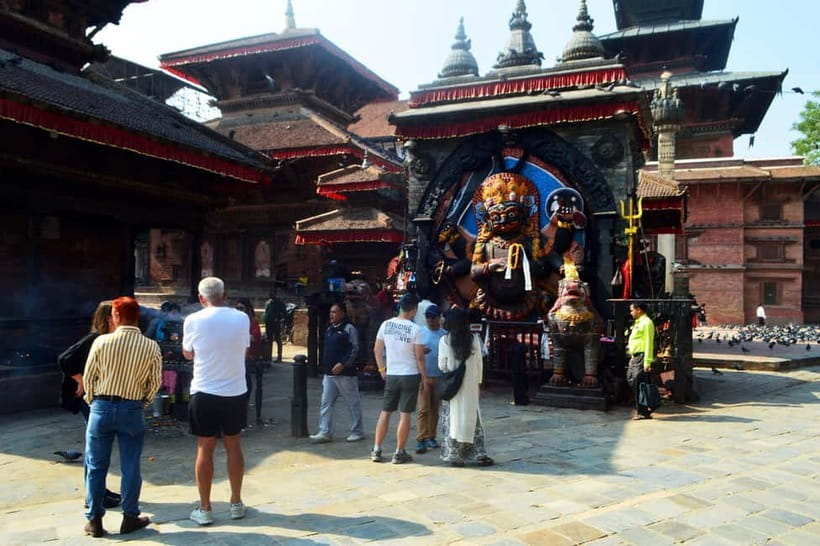
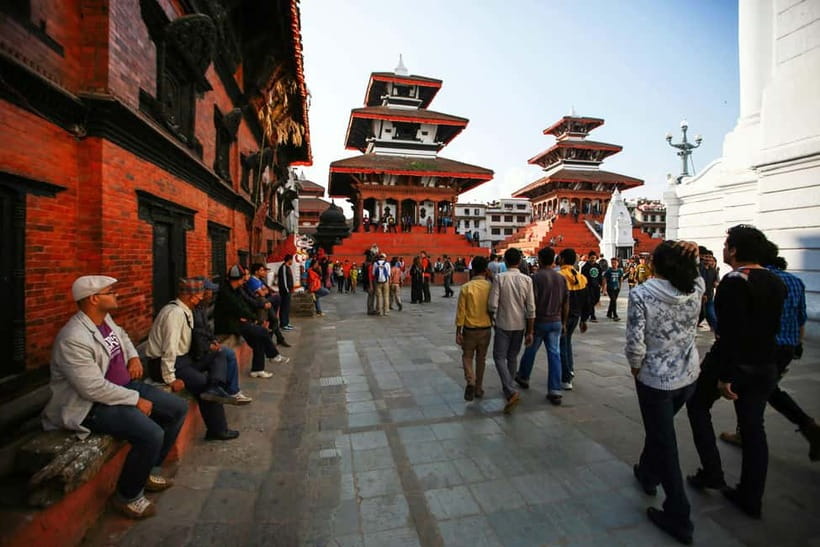
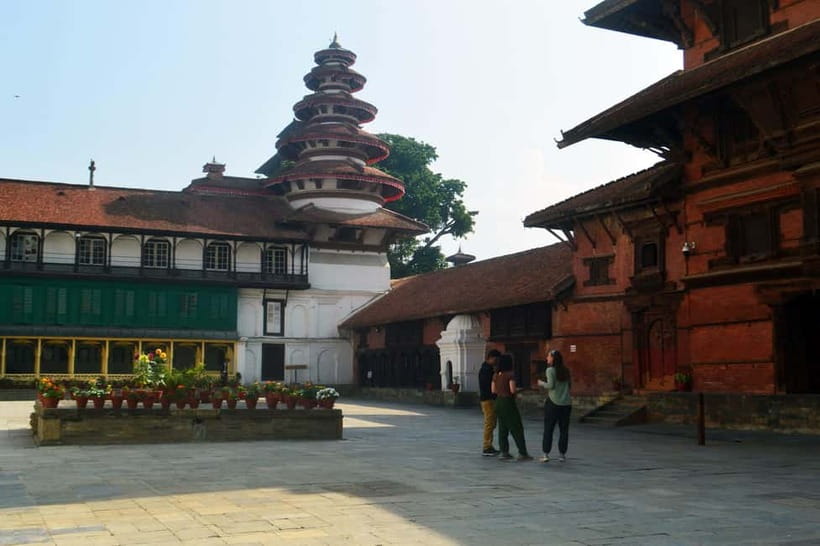
Your first stop is Kathmandu Durbar Square, the old royal center in the city. The visit includes the palace area, courtyards, and Kumari Ghar, the residence of Nepal’s Living Goddess.
This is the place to slow down for a moment and look closely. The square brings together carved timber windows, brick buildings, shrines, and enclosed courtyards linked to Kathmandu’s Newar culture. Your guide can help explain how the palace precinct worked and why the Kumari remains such a revered figure.
The Living Goddess Kumari is a young girl selected according to strict religious traditions and worshipped as a living form of the goddess Taleju. The tour offers a rare opportunity to see Kumari Ghar, and you might glimpse the Kumari if she appears at the window. Do not treat this like a scheduled stage performance. Her appearance is not something the supplied details guarantee, and respectful silence is appropriate.
Plan your clothing with the whole day in mind. You will visit active religious sites, so modest dress is the sensible choice. Bring your passport, camera, cash, and a small daypack, as advised for the activity. The camera is useful, but ask before photographing people or religious ceremonies.
One hour is allocated here. That is enough for a guided introduction, but it will not let you examine every courtyard at length. If Kathmandu Durbar Square is your main interest, you may prefer a longer dedicated visit. If you want a broad city overview, the short stop works well.
More of the valley’s UNESCO heritage sites:
- Private Kathmandu Sightseeing Tour | UNESCO World Heritage sites
★ 5.0 · 756 reviews - Kathmandu: Full Day 7 UNESCO Tour with Lunch – Private/Group
★ 5.0 · 415 reviews - Kathmandu: Full Day Top 4 UNESCO Tour with Lunch – Private/Group
★ 5.0 · 269 reviews
Swayambhunath, the Monkey Temple on the hill
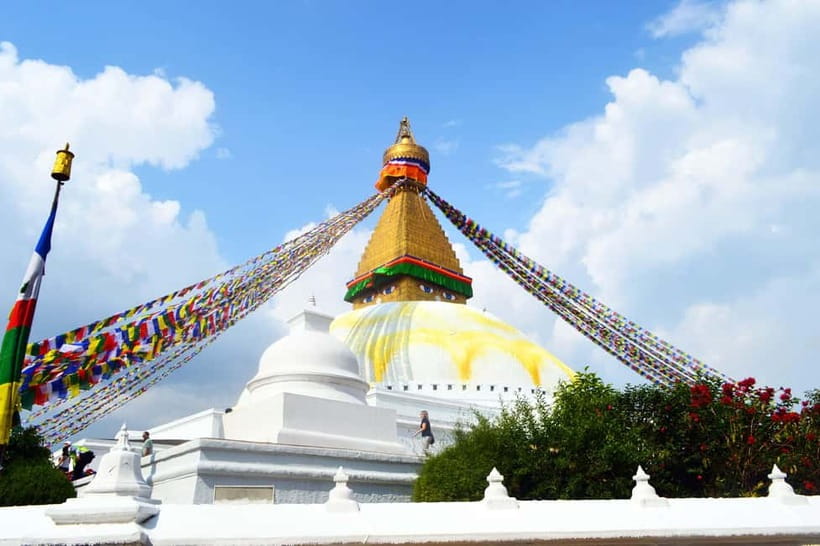
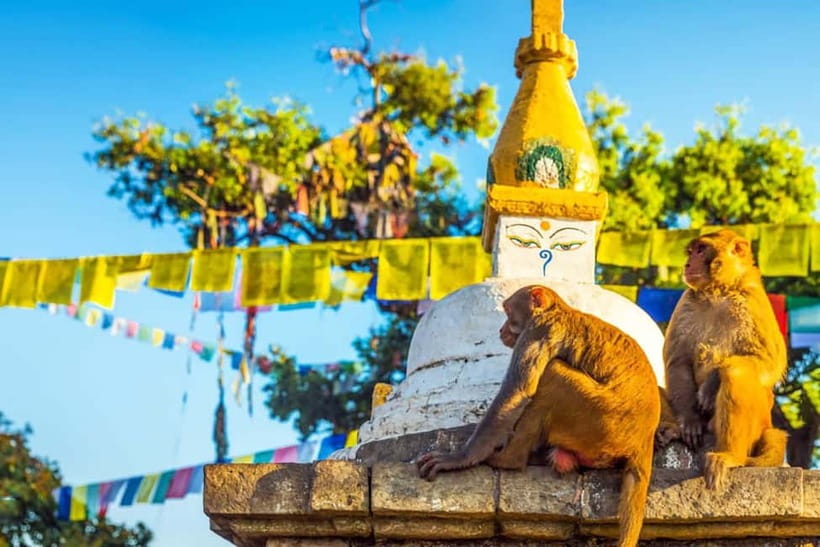
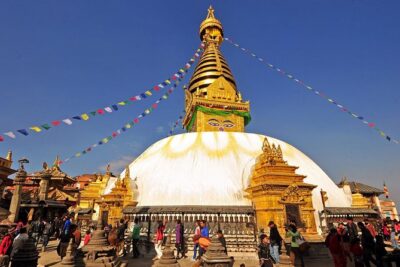
Next comes Swayambhunath, often called the Monkey Temple. The stop combines an ancient stupa, smaller shrines, prayer flags, and a high position above the capital.
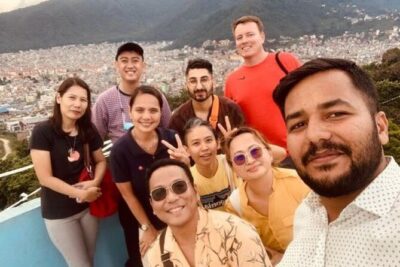
The biggest reward here is the view. From the hill, you can look across Kathmandu and understand the size and setting of the capital far better than you can from street level. Bring your camera, but keep it secure and stay alert around the monkeys associated with the site.
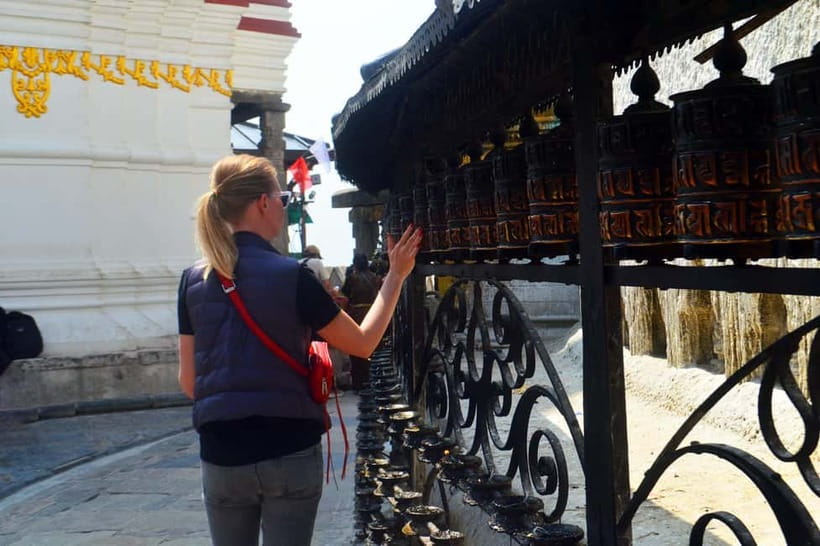
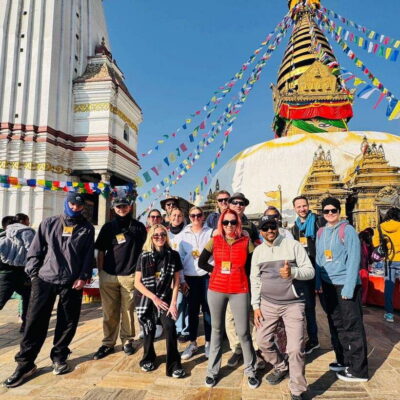
The stupa itself carries the familiar Buddhist design of a white dome, a central cube with the Buddha’s eyes, and a tall spire. Prayer flags add color and movement around the hilltop. You will also find shrines and other religious features, so this is not simply a viewpoint with a temple attached.
The supplied accessibility information matters here. The experience is not suitable for people with mobility impairments or wheelchair users. A hilltop religious complex, uneven approaches, and walking between sites can make the day demanding, even though the program does not provide a detailed step count.
Your guide leads a one-hour visit. Use that time for the main stupa, the shrines, and the city view. If you want quiet contemplation, try to claim a few minutes for yourself rather than following every explanation continuously. The site can be visually busy, and a little personal space helps you take it in.
Boudhanath and the great Buddhist stupa
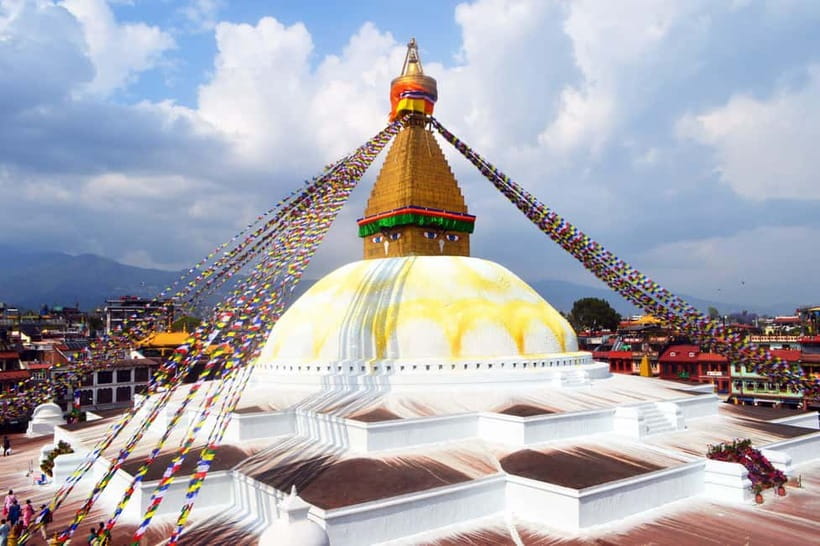
Boudhanath brings a different mood. Its enormous spherical stupa is one of the world’s largest, and the open space around it gives you room to pause after the hilltop stop.
The key activity is walking around the stupa and observing the prayer flags and devotional activity. You will likely find this stop more spacious in feeling than the palace square. The repeated circular movement around the monument encourages a slower pace, even when the overall tour schedule does not.
Look upward as you walk. The stupa’s white dome, layered structure, and central tower create a powerful shape from every angle. Prayer flags add movement, while the surrounding Buddhist setting makes Boudhanath a good place to think about the living role of worship in Kathmandu.
The tour allows about one hour here. That gives you time for a guided explanation and a circuit around the stupa, with some opportunity for photographs. It may not be enough if you want to sit for a long period or explore every nearby religious space.
I especially like Boudhanath’s place in the route. After the visual density of Durbar Square and the climb at Swayambhunath, this stop can act as a breathing space. If your guide is rushing, say clearly that you would like a few quiet minutes to walk around the stupa. The one available four-out-of-five assessment pointed to guide attitude and time management as important factors, so polite, direct requests can help you use the visit well.
Pashupatinath and the Bagmati River
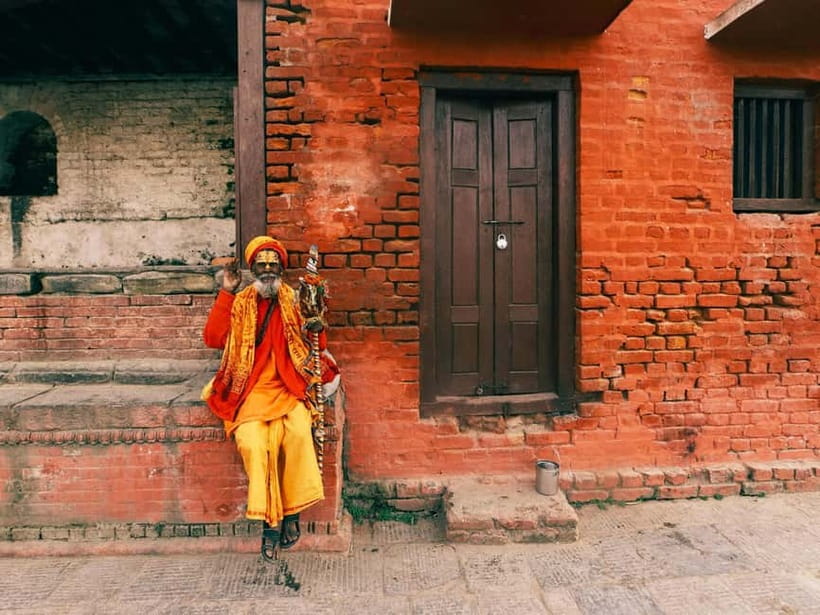
The final stop is Pashupatinath Temple, one of Nepal’s most sacred Hindu sites. Here you will encounter temples, religious activity, the Bagmati River, and cremation rituals at the ghats.
This is the most sensitive part of the day. Cremation is a real religious rite, not a staged attraction. You may witness Hindu rituals taking place beside the river, and that can be a profound experience, but it also calls for restraint. Follow your guide’s instructions, avoid intrusive photographs, and remember that families may be present during one of the most serious moments of their lives.
The temple complex has major spiritual importance, but access within religious sites can vary. The tour description promises a visit to Pashupatinath Temple and the sacred area, but it does not state that every interior space is open to every visitor. Ask your guide where you may walk and what you may photograph.
One hour is assigned to Pashupatinath. That is enough to understand the site’s role and see the river area, but the emotional weight of the stop may make it feel shorter than the others. You are not simply checking off another monument. You are observing a living tradition, and the best approach is patient and respectful.
Ending here gives the tour its strongest cultural contrast. Durbar Square presents royal and Newar architecture. Boudhanath shows Buddhist devotion. Pashupatinath brings you close to Hindu ritual in a way that is more direct and confronting than a museum visit.
More history walks in Kathmandu:
- UNESCO Seven World Heritage Tour in Kathmandu
★ 5.0 · 253 reviews - Kathmandu Private Sightseeing Tour | UNESCO World Heritage Sites
★ 5.0 · 109 reviews - Kathmandu: Full Day Private Top 4 UNESCO Heritage Tour W/Lunch.
★ 5.0 · 86 reviews - Kathmandu World Heritage Tour
★ 5.0 · 74 reviews
Why the private vehicle helps
The private air-conditioned vehicle is one of the practical strengths of this experience. Pickup is available from Thamel, and the return transfer goes back to Kathmandu or Thamel. You wait in your hotel lobby or at your apartment entrance five minutes before the scheduled pickup.
A private car means you do not need to piece together transport between four separate sites. That matters in a six-hour program, since wasted time between stops cuts into your visits. It also gives your group a place to regroup, carry water, and leave extra items while walking around the monuments.
The activity includes bottled drinking water and an English-speaking live guide. It is described as a private group, so you are not sharing the guide’s attention with a large mixed party. That can make explanations and timing more flexible, although the quality of the day still depends on the individual guide.
No guide’s name is provided, and the available written assessment specifically noted that the guide’s attitude affected the experience. I would ask questions early, confirm how long you have at each stop, and say which site interests you most. A good guide can turn a fast route into a clear story. A less engaged guide may simply move you from gate to gate.
What the $3.94 price really covers
At $3.94 per person, the base price is hard to ignore. You receive hotel pickup and drop-off, a private air-conditioned vehicle, an English-speaking guide, bottled water, and visits to four major heritage sites.
The important qualification is that monument entrance fees are not included. You should also budget for food and personal expenses. No meal is provided, so eat before departure or carry something suitable for the road. The activity specifically recommends cash, which is useful for entrance charges and small purchases.
The low price makes the tour especially useful if you have limited time in Kathmandu, are traveling on a tight budget, or do not want to negotiate transport. It is less suitable if you prefer long visits, independent wandering, or a specialist guide focused on architecture, Hinduism, Buddhism, or Newar culture.
The tour also offers free cancellation up to 24 hours before departure and a reserve-now, pay-later option. Those policies make it easier to fit the experience into a changing Nepal schedule, but the main decision remains the pace and guide quality.
Who should book this Kathmandu tour?
I would choose this tour for a first visit when I wanted a clear overview of Kathmandu’s four major sacred and historic places in one outing. It suits couples, families with older children, and small private groups who value included transport and a guide over total independence.
It is also a good choice if you are staying in Thamel and want a simple pickup arrangement. You can leave the driving and route planning to someone else, then focus on the sights.
I would hesitate if you use a wheelchair or have limited mobility. The activity is specifically marked as unsuitable for wheelchair users and people with mobility impairments. I would also think twice if one site is your main reason for visiting. An hour at each stop gives you breadth, not depth.
The only available rating is 4.1 out of 5 from five assessments, with a four-out-of-five account praising the beauty and interest of the sites but noting that the guide did not make full use of the day. That is a fair warning, not a reason to reject the tour. The monuments themselves are the draw, while the guide determines how much context and care you receive.
Final decision: a strong first look at Kathmandu
Book this tour if you want to see four major UNESCO sites, prefer private transport, and can accept a brisk six-hour schedule. The route gives you royal architecture, the Living Goddess tradition, hilltop views, Buddhist worship, and Hindu cremation rites in one well-packed day.
Do not book it expecting a slow, specialist-led study of each place. Bring cash for entrance fees, wear comfortable and respectful clothing, carry water and a camera, and tell the guide what matters most to you. With realistic expectations, this is a low-cost and practical way to get your bearings in Kathmandu.
FAQ
How long does the Kathmandu 4-Heritage Sites Tour last?
The tour lasts six hours, including hotel pickup and the return transfer.
Which sites are included?
The tour visits Kathmandu Durbar Square, Swayambhunath Temple, Boudhanath Stupa, and Pashupatinath Temple.
Is hotel pickup included?
Yes. Pickup is available from hotels or apartments in the stated pickup area. You should wait in the hotel lobby or at the apartment entrance five minutes before the scheduled pickup time.
Is an English-speaking guide provided?
Yes. The activity includes a live English-speaking tour guide, and the tour is arranged as a private group.
Are monument entrance fees included?
No. Entrance fees are not included in the base price, though an add-on option is available.
Is the tour suitable for wheelchair users?
No. The activity is not suitable for wheelchair users or people with mobility impairments.
Recently added around Kathmandu
- Kathmandu : Swambhunath & Durbar Square Guided Half Day Tour★ 3.3 · 3 reviews
- Private Day Tour in Kathmandu Valley Rim with Bhaktapur Sightseeing★ 5.0 · 3 reviews
- From Kathmandu / Pokhara / Chitwan: River Rafting – 1 Day★ 4.6 · 3 reviews
- Nepali Cooking training & Cultural Homestay Experience★ 5.0 · 3 reviews
- Private 3-Hour Nagarkot Sunset Tour from Kathmandu★ 3.5 · 3 reviews
- 4 UNESSCO World heritage sites of Kathmandu-private tour★ 5.0 · 3 reviews
- From Kathmandu: Everest Base Camp Landing Helicopter Tour★ 5.0 · 3 reviews
- From Kathmandu Budget: 15 Day Everest Base Camp Trek★ 5.0 · 3 reviews
Kathmandu UNESCO Heritage Tours, compared.
Private Kathmandu Sightseeing Tour | UNESCO World Heritage sites
Read our review →
Full Day 7 UNESCO Tour with Lunch – Private/Group
Read our review →
Full Day Top 4 UNESCO Tour with Lunch – Private/Group
Read our review →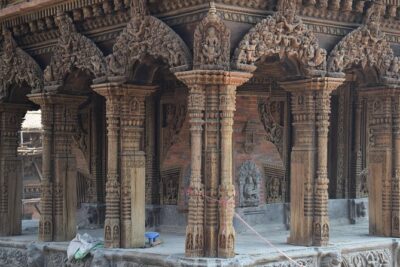
Full-Day 7 UNESCO Tour with Lunch – Private/Group
Read our review →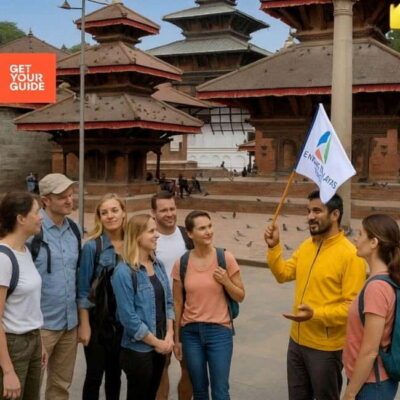
Kathmandu Private Sightseeing Tour | UNESCO World Heritage Sites
Read our review →Browse the lists this tour appears in