
Reviewed · KATHMANDU
Kathmandu Full Day Tour
Kathmandu packs four major religious and historic sites into one busy day: Kathmandu Durbar Square, Swayambhunath, Pashupatinath, and Boudhanath. You move from royal courtyards to Buddhist stupas and one of Asia’s most important Hindu temples, with a local guide to explain what you are seeing.
I like the hotel pickup and drop-off, especially in a city where finding a meeting point can waste time. I also like the cultural range: this is not four versions of the same temple, but a useful introduction to Hinduism, Nepali Buddhism, and Tibetan Buddhism. The main drawback is the pace. Four sites in roughly six hours leaves little room for lingering, and traffic or a vehicle problem can cut into your sightseeing time.
In This Review
- Key points to know before booking
- Four sides of Kathmandu in six hours
- Kathmandu Durbar Square: royal courtyards and earthquake scars
- Swayambhunath: the hilltop Buddhist view
- Pashupatinath: Kathmandu’s most important Hindu shrine
- Boudhanath: the wide circle around the stupa
- Why the guide can make or break the day
- Transport, timing, and the real pace
- Is $70 a fair price?
- Who should book this Kathmandu tour?
- Practical ways to get more from the day
- Should you book it?
- FAQ
- How long does the Kathmandu Full Day Tour last?
- Which sights are included?
- Is hotel pickup included?
- Are entrance fees included in the $70 price?
- Is lunch included?
- How many people can join the group?
- Can I cancel for a full refund?
Key points to know before booking
- Four major sites in one half-day: You visit Kathmandu’s old royal center, two important Buddhist sites, and the Pashupatinath temple complex.
- Hotel transfers are included: Pickup and return transport remove the need to find an unfamiliar meeting point.
- Guiding is the real value: Guides such as Birodh Burlakoti are praised for clear English, cultural context, and a friendly approach.
- Budget extra for admission: Entrance fees are not included and are listed at approximately 2,600 NPR per person, with lunch also separate.
- Expect a small-group outing: Departure is shared, with a maximum of 30 people, though the actual feel may vary.
- Allow for a quick pace: Each listed stop is planned for about one hour, and traffic can affect the schedule.
Four sides of Kathmandu in six hours
This tour works best as an introduction. In a single outing, you see the old center of Kathmandu, a hilltop Buddhist shrine, a major Hindu pilgrimage site, and the great stupa of Boudhanath.
That range matters. Kathmandu can feel confusing at first because temples, shrines, courtyards, monasteries, shops, and ordinary homes often sit close together. A guide helps sort out what you are looking at and why it matters. The strongest praise for this experience centers on the guides, particularly Birodh, whose easygoing manner, English, local knowledge, and eye for good photo spots made the day easier for first-time visitors.
The tour lasts about six hours. That is enough to see the main features at all four stops, but not enough for a leisurely study of every courtyard, shrine, and museum. I would treat it as a smart orientation tour, not a complete study of Kathmandu’s religious art and history.
The order can vary in practice, and the published stop descriptions list the sites in an imperfect sequence. The important point is that all four headline sights are included. Hotel pickup, private transportation, a local guide, and a return transfer are part of the price.
A few more Kathmandu tours worth comparing
- Kathmandu: Full Day 7 UNESCO Tour with Lunch – Private/Group
★ 5.0 · 415 reviews - Kathmandu: Full Day Top 4 UNESCO Tour with Lunch – Private/Group
★ 5.0 · 269 reviews - Kathmandu: Full-Day 7 UNESCO Tour with Lunch – Private/Group
★ 4.9 · 247 reviews
Kathmandu Durbar Square: royal courtyards and earthquake scars
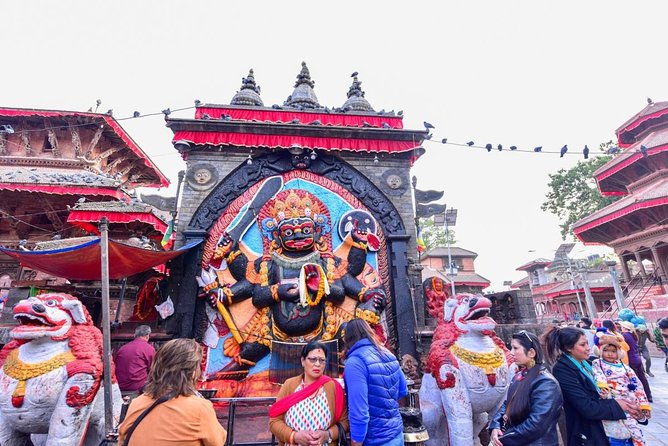
Kathmandu Durbar Square, also called Hanuman Dhoka Square or Basantapur, sits in the heart of the old city. This was the royal center, and its collection of palaces, courtyards, and temples gives you a quick lesson in how Kathmandu’s political and religious life once overlapped.
Plan on about an hour here. Your guide can help you read the site rather than simply count temples. Look for the relationship between the old palace buildings, open courtyards, carved woodwork, and the shrines that still draw worshippers. Without context, it is easy to see a row of ornate buildings and miss the larger story.
This is also the place to keep expectations realistic. The 2015 earthquakes caused significant damage to some sites on this tour, including parts of Kathmandu Durbar Square. Restoration and visible damage are part of the present-day setting. That does not make the square less important, but it means photographs and older guidebooks may show a different scene.
Admission is not included. The total entrance cost for the UNESCO sites is listed at approximately 2,600 NPR per person, so add that amount to the advertised $70 price when judging the final cost. Exact fees can change, but the key point is simple: this is not an all-inclusive ticket.
Swayambhunath: the hilltop Buddhist view
Swayambhunath is the Tibetan Buddhist stupa commonly known as the Monkey Temple. The tour allows about an hour here, giving you time to see the main religious features and take in the setting above Kathmandu.
The site is useful early in your visit because it introduces Buddhist symbols and practice in a place that is still active, not just preserved for sightseeing. Your guide can explain the stupa, its religious meaning, and the connections between Nepali and Tibetan Buddhist traditions.
You should also expect some physical effort. The site is reached by steps, and the experience involves walking around a hilltop religious complex. The supplied information says most people can participate, but it does not promise step-free access. If stairs or uneven ground are a concern, ask the operator about current conditions before booking.
This stop can feel rushed if the group arrives late or traffic has eaten into the schedule. Still, an hour is enough for a first look. I would use the time to focus on the central stupa, the prayer activity, the city view, and the guide’s explanation rather than trying to see every corner.
Pashupatinath: Kathmandu’s most important Hindu shrine
Pashupatinath is dedicated to Lord Shiva and is one of the four key religious sites in Asia for Shiva devotees. The complex dates back to the fifth century, with later rebuilding and additions under the Malla rulers.
This is the tour’s most important Hindu site, and it gives the day a different rhythm from the Buddhist stops. The value of a guide is especially clear here. A good explanation helps you understand the role of Shiva, the layout of the temple complex, and why the site matters to practicing Hindus.
As with all four stops, the planned visit is about an hour. That is enough for an introduction, but Pashupatinath is a large and significant religious area. You may find that the guide needs to keep the group moving so the remaining stops fit into the day.
Be respectful with photography and follow any local instructions. The tour description identifies Pashupatinath as a Hindu temple, not simply a monument, so treat it as a living place of worship. The entrance fee is extra, and the published total of approximately 2,600 NPR covers admission to the UNESCO sites rather than lunch or shopping.
A completely different sort of day in Kathmandu:
- Everest Base Camp Trek – 14 Days
★ 5.0 · 1,499 reviews - Private Kathmandu Sightseeing Tour | UNESCO World Heritage sites
★ 5.0 · 756 reviews - Everest Base Camp Helicopter Tour landing at Everest View Hotel
★ 5.0 · 668 reviews - Half day cooking class in Thamel kathmandu
★ 5.0 · 607 reviews
Boudhanath: the wide circle around the stupa
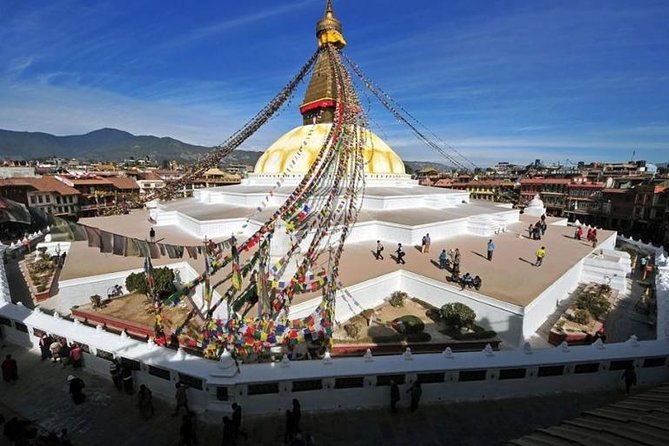
Boudhanath, also spelled Bouddhanath, lies about eight kilometers east of central Kathmandu. Its enormous white stupa rises about 36 meters and is one of the largest in the Kathmandu Valley.
The usual visit lasts about an hour. The large circular base gives you room to walk around the stupa and observe the religious activity from different angles. This is one of the most visually striking stops, but its value is not only photographic. The site is a major center of Tibetan Buddhist life, and your guide can connect its symbols and rituals to the wider Buddhist traditions introduced earlier at Swayambhunath.
One useful detail comes from the way the tour has worked for past bookings: lunch may be taken above the stupa, but lunch is not included in the price. That can be a convenient place to pause, though you should budget separately and remember that a meal will use part of the already tight schedule.
Boudhanath often makes a strong final stop because it gives you time to process the day. After royal history, a hilltop shrine, and a major Hindu temple, the broad stupa and its surrounding religious life offer a fitting close.
Why the guide can make or break the day
The tour’s main product is not just transport between four addresses. It is interpretation. The sites are impressive, but the differences between Hindu worship, Nepali Buddhism, and Tibetan Buddhism are not always obvious when you are seeing them for the first time.
Several guide names appear in the available feedback. Birodh Burlakoti received especially strong praise for his English, humor, kindness, historical explanations, planning, and photography help. Another guide was described as having very clear English and a gift for bringing the sights to life. That suggests the operator has provided strong guiding on many departures, but guide assignments can change, so you should not assume a specific person is guaranteed unless the company confirms it.
The experience is not entirely dependent on personality. A good guide should also control the clock, help the group move through traffic, explain local customs, and point out details you might miss. One account describes a guide who walked too quickly for the group. That is a useful warning if you have children, limited mobility, or simply prefer a slow look at each site.
Ask questions during the day. A private guide can sometimes adapt more easily, but this is a small-group departure with a maximum of 30 people. That is still more personal than a large coach outing, yet it may not feel intimate if the group fills.
Transport, timing, and the real pace
Hotel pickup and return are practical advantages. You do not need to work out a central meeting point, and you can begin the day from your own accommodation. The tour also includes private transportation, which is important because the four sites are spread across Kathmandu rather than gathered in one walkable district.
Do not read six hours as six full hours of sightseeing. Pickup can involve collecting other participants, and Kathmandu traffic can be slow. The schedule assigns roughly one hour to each site, leaving limited spare time for delays, meals, or extended shopping.
A vehicle breakdown has caused a serious problem on at least one outing, with passengers reportedly walking along a dusty, traffic-heavy street for more than 30 minutes in the sun. This appears to be an exception rather than the normal plan, but it is the clearest practical weakness in the available feedback. If reliable transport is vital to your day, ask about the vehicle and what support is provided if a delay occurs.
The tour operates daily from 9:15 AM to 5:15 PM during the stated operating period. The wording gives an operating window rather than a detailed pickup schedule, so confirm your exact hotel pickup time when booking.
Is $70 a fair price?
The advertised price is $70 per person. At first glance, that may seem high for a six-hour city outing, especially because admission fees and lunch are excluded. Add the listed entrance cost of about 2,600 NPR per person, plus food, and your actual spending will be higher.
The value comes from the bundle of services. You receive hotel pickup and return, private transportation, a local guide, and a planned route linking four of Kathmandu’s most important sites. Hiring separate transport and arranging explanations at each stop could take more time and still leave you uncertain about the correct entrance or order.
I think the price makes the most sense if this is your first visit, your stay is short, or you do not want to negotiate transport in Kathmandu. It is less compelling if you are staying for many days, enjoy exploring at your own pace, or already have transport and a guide arranged.
Group discounts may be available, though no discount amount is provided. Ask about the total price for your party, and remember to include entrance fees, lunch, and any shopping in your budget. Shopping is not part of the included service, so do not expect purchases to be covered.
Who should book this Kathmandu tour?
I would choose this tour for a first day in Kathmandu. It gives you a clear map of the city’s major cultural sights and helps you decide which places deserve a longer return visit.
It also suits you if you are visiting on a time crunch. The route covers the major highlights in one outing, and hotel transfers remove a layer of planning. The tour is family-friendly in the sense that children can participate with an adult, but the quick pace, stairs, traffic, and heat may be tiring for younger children.
You should think twice if you want long visits, quiet photography, or detailed time inside every complex. A six-hour group trip cannot offer the freedom of a private full-day guide. You may also prefer another option if you require fully accessible transport or step-free routes, since the available information only says most people can participate.
Practical ways to get more from the day
Wear comfortable shoes and carry water. That advice follows from the amount of walking, the hilltop setting at Swayambhunath, and the possibility of outdoor waits in Kathmandu’s sun.
Keep some flexibility in your expectations. The four sites are fixed highlights, but the order and time at each one can shift because of traffic, group movement, or local conditions. If one place matters most to you, tell the guide early.
Bring a little patience for pickup. The group may collect other people from their hotels before the sightseeing begins. That can cost time, but it also lets you see parts of the city between the headline sites.
Budget for the entrance fees before you leave the hotel. Since admission is not included, having the extra 2,600 NPR per person available keeps the day simpler. Lunch is also separate, and shopping is entirely your own expense.
Finally, ask the guide to slow down if needed. One guide was criticized for walking too quickly, while Birodh was praised for making the day comfortable and enjoyable. Clear communication can help you get more from each stop.
Should you book it?
Book this tour if you want a well-organized first look at Kathmandu’s four major cultural sights, especially with limited time. The guide, hotel transfers, and mix of Hindu and Buddhist landmarks give it real value beyond a simple drive-by city tour.
Skip it if your priority is a slow, self-directed visit or if extra admission and meal costs push the budget too far. Also remember that the tour is compact, group-based, and vulnerable to Kathmandu traffic. For most first-time visitors who want orientation without transport hassles, it is a strong starting point, provided you accept the quick pace and budget for the fees.
FAQ
How long does the Kathmandu Full Day Tour last?
The tour lasts approximately six hours, with about one hour planned at each of the four main stops.
Which sights are included?
The tour visits Swayambhunath, Kathmandu Durbar Square, Boudhanath Stupa, and Pashupatinath Temple.
Is hotel pickup included?
Yes. Pickup from your hotel and drop-off at your hotel after the tour are included.
Are entrance fees included in the $70 price?
No. Entrance fees are separate and are listed at approximately 2,600 NPR per person for the UNESCO sites.
Is lunch included?
No. Lunch is not included. Shopping is also excluded.
How many people can join the group?
The activity has a maximum of 30 participants. It includes a small-group departure and private transportation.
Can I cancel for a full refund?
Yes. You can cancel at least 24 hours before the experience start time for a full refund. Cancellations or changes made within 24 hours are not refunded or accepted.
Recently added around Kathmandu
- Kathmandu : Swambhunath & Durbar Square Guided Half Day Tour★ 3.3 · 3 reviews
- Private Day Tour in Kathmandu Valley Rim with Bhaktapur Sightseeing★ 5.0 · 3 reviews
- From Kathmandu / Pokhara / Chitwan: River Rafting – 1 Day★ 4.6 · 3 reviews
- Nepali Cooking training & Cultural Homestay Experience★ 5.0 · 3 reviews
- Private 3-Hour Nagarkot Sunset Tour from Kathmandu★ 3.5 · 3 reviews
- From Kathmandu: Everest Base Camp Landing Helicopter Tour★ 5.0 · 3 reviews
- 4 UNESSCO World heritage sites of Kathmandu-private tour★ 5.0 · 3 reviews
- From Kathmandu Budget: 15 Day Everest Base Camp Trek★ 5.0 · 3 reviews