
Reviewed · KATHMANDU UNESCO HERITAGE TOURS
Kathmandu UNESCO Heritage Tour with Local Food Tasting
Kathmandu’s best introduction may be found in the contrast between a hilltop stupa, an old royal square, and a food stall serving hot dumplings. This five-hour private tour links those places by car and on foot, giving you both the grand sights and the ordinary streets between them.
I like the way the tour joins heritage with local food, rather than treating temples and meals as separate activities. I also like the access to Asan Market, where spices, grains, brassware, clothing, and daily trade show you how Kathmandu works beyond its monuments.
The main consideration is pace. You cover three important areas in about five hours, with roughly an hour at each main stop, so this is a useful first look rather than a slow study of every shrine and carving. Market crowds and city traffic can also make the day feel busy.
In This Review
- Key points to know before booking
- A smart first morning in Kathmandu
- Swayambhunath, prayer flags, and valley views
- Kathmandu Durbar Square and the Kumari’s window
- Asan Market, where Kathmandu does its daily work
- The food is a major part of the value
- What the guide adds to the day
- Is $64 a fair price?
- Who should book this Kathmandu tour?
- Should you book it?
- FAQ
- How long does the Kathmandu UNESCO Heritage Tour with Local Food Tasting last?
- Where can pickup and drop-off take place?
- Which sites does the tour visit?
- Can I see the Kumari?
- What foods are included?
- Is transportation included?
- Is the tour private?
- Are entrance fees included?
- Can I cancel or pay later?
Key points to know before booking
- Three very different sides of Kathmandu: Visit Swayambhunath, Kathmandu Durbar Square, and Asan Market in one compact outing.
- A full Nepali tasting session: Try momo, Newari samaybaji, yomari, bara, chatamari, gwaramari, and Indrachowk lassi.
- A chance to see the Kumari: The route includes Kathmandu Durbar Square and the window associated with Nepal’s Living Goddess.
- Private guiding: You get an English-speaking guide for your own group, with some flexibility in the schedule.
- Transport and entry fees included: Pickup and drop-off are available in Kathmandu or Thamel, and a bottle of water is provided.
- Good value at $64: The price includes five hours, transport, site admission, food, guide service, taxes, and a private group.
A smart first morning in Kathmandu
This tour is built for the first full day of a Kathmandu visit, especially if you want someone to explain what you are seeing instead of simply pointing at temples. It begins with pickup in Kathmandu or Thamel, then moves between sacred sites, the old center, and a working market.
The route has a useful rhythm. Swayambhunath gives you a view and a quiet start. Kathmandu Durbar Square supplies the major monuments and royal stories. Asan Market brings you down to street level, with commerce, smells, noise, and food.
You should expect a mix of vehicle transfers and walking. The tour lasts five hours, but the sightseeing is concentrated. Each main stop is planned for about one hour, while transport and food stops connect the sections.
If you have only a short stay in the capital, this arrangement saves time. If you already plan a detailed visit to all three areas, it may feel brisk. The private format helps, since the guide can adjust the schedule to some degree. Jessica specifically valued that flexibility, and that matters in Kathmandu, where traffic and crowd levels can affect the timing.
More of the valley’s UNESCO heritage sites:
- Private Kathmandu Sightseeing Tour | UNESCO World Heritage sites
★ 5.0 · 756 reviews - Kathmandu: Full Day 7 UNESCO Tour with Lunch – Private/Group
★ 5.0 · 415 reviews - Kathmandu: Full Day Top 4 UNESCO Tour with Lunch – Private/Group
★ 5.0 · 269 reviews
Swayambhunath, prayer flags, and valley views
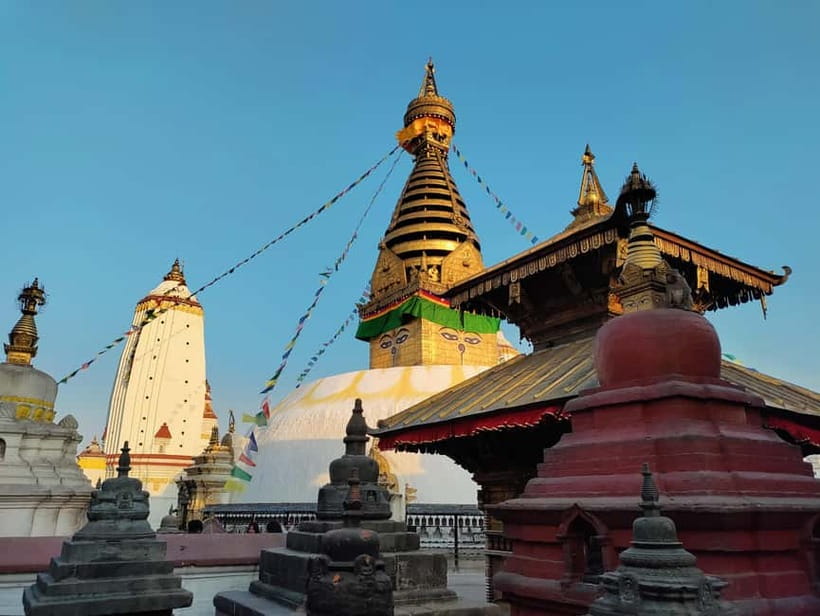
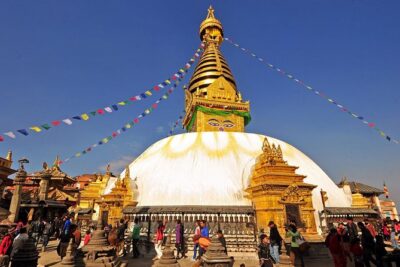
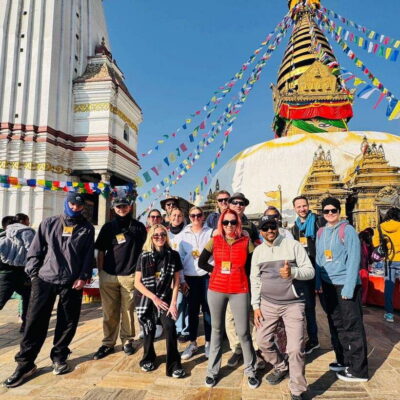
Swayambhunath, also called the Monkey Temple, is the tour’s spiritual high point. The stupa sits above Kathmandu, with prayer flags, Buddhist symbols, shrines, and views across the Kathmandu Valley.
The setting gives you an immediate sense of the city’s religious mix. You may hear monks chanting, see people circling the stupa, and notice how Buddhist practice continues alongside ordinary city life. The guide’s role here is important. Without context, the painted eyes, prayer wheels, and layered architecture can become a collection of striking images. With explanation, they begin to make sense.
Plan on about an hour at the site. That is enough to walk around the central stupa, take in the view, and ask questions, but not enough for a slow examination of every corner. You may also encounter monkeys, which help explain the popular nickname. Keep your belongings close and follow the guide’s advice around them.
The hilltop gives you one of the clearest visual changes of the day. Kathmandu below is busy and crowded, while the stupa feels calmer and more removed. I like this early contrast because it sets up the rest of the outing: you begin above the city, then return to its oldest and busiest streets.
Bring shoes you can walk in comfortably. The tour information does not give a detailed route or stair count, so you should be ready for walking around a hilltop religious site rather than a flat museum visit.
Kathmandu Durbar Square and the Kumari’s window
From Swayambhunath, the tour continues to Kathmandu Durbar Square, the former royal center and one of the city’s major UNESCO sites. This is where you see temples, palace buildings, carved woodwork, and public spaces tied to Nepal’s royal and religious traditions.
An hour here can pass quickly. The square contains several important points of interest, including Kal Bhairav and Swet Bhairav, sacred figures with their own place in Kathmandu’s religious life. Your guide can explain why these images matter instead of leaving you to guess from the crowds gathered around them.
The Kumari is another major draw. The tour gives you a chance to see Nepal’s Living Goddess at her window, though the appearance of the Kumari is not something any city tour can guarantee at a precise moment. Treat it as a possibility, not the sole reason to book.
Look closely at the wood carvings and building details. Kathmandu’s old center rewards attention to small things: a carved doorway, a shrine tucked beside a larger temple, or a ritual taking place in a public square. The guide’s cultural explanations turn these details into part of a larger story about living traditions.
One practical point: Kathmandu Durbar Square is not just a quiet historic site. It remains part of the city, with people moving through it for worship, work, and daily errands. That makes the visit feel more immediate, but it also means you should expect distractions, foot traffic, and a less controlled sightseeing environment.
The entry fee is included, which makes the $64 price easier to assess. You are not paying for transport and food alone. The admission cost, guide, and private arrangement are bundled into the experience.
Asan Market, where Kathmandu does its daily work
Asan Market is perhaps the most useful stop for understanding present-day Kathmandu. Traders sell spices, grains, seasonal produce, brass utensils, saris, handmade jewelry, and traditional goods in narrow streets that have served local commerce for generations.
This is not a polished shopping district designed for sightseeing. It is a working market. You may find yourself sharing the lanes with shoppers, sellers, deliveries, and people moving quickly from one errand to the next. That can make the visit more interesting than a standard souvenir stop, but it can also feel crowded.
The tour allows about an hour for a guided walk, free time, shopping, and snacks. That combination gives you room to look around while still having the guide point out what you might otherwise miss. If you want to buy something, ask about prices and local use before committing. The tour includes food and sightseeing, but personal purchases are your responsibility.
I especially like this part of the route because it balances the monumental sites. Temples tell you about Kathmandu’s past and faith. Asan shows you what people buy, sell, cook, wear, and use today.
Your guide may also help you approach food stalls with more confidence. For many people, the hardest part of eating in a local market is knowing what to order. Here, the tasting is built into the tour, so you can try several foods without having to plan each stop yourself.
More food tours in Kathmandu:
- Kathmandu Food and Drink Walking Tour
★ 5.0 · 266 reviews - Kathmandu: Food and Drink Walking Tour
★ 4.9 · 119 reviews - Walking Street Food Tour in Kathmandu
★ 5.0 · 111 reviews - Secret Food Tour – Food Bites and Sights Kathmandu 14+ Testings
★ 5.0 · 82 reviews
The food is a major part of the value
The food tasting is not a token snack. It is one of the central reasons to choose this outing. You can try a broad range of Nepali and Newari dishes, with the exact order depending on the day and local availability.
Here is what you may taste:
- Momo: Nepali dumplings, a familiar favorite and an easy first taste of local street food.
- Newari samaybaji: A platter that can include beaten rice, marinated meat, fried eggs, and pickles. It gives you several flavors and textures in one serving.
- Yomari: A sweet steamed dumpling filled with jaggery.
- Bara: A savory lentil pancake.
- Chatamari: A rice flour crepe often described as Nepali pizza.
- Gwaramari: Crisp fried bread.
- Indrachowk lassi: A cooling yogurt drink that works well after the savory foods.
The phrase eat as much as you like suggests a generous tasting, and Jacqueline found the amount of food greater than expected. That is worth taking seriously. Do not arrive expecting one small sample at each stop. If you have dietary restrictions, ask before booking or tell the company in advance, since the supplied tour details do not specify vegetarian, vegan, allergy, or gluten-free arrangements.
The food also adds cultural value. A dish such as samaybaji is not just fuel. It connects the meal to Newari food traditions and gives your guide a natural way to explain local customs. Yomari and chatamari also show how rice flour appears in both sweet and savory cooking.
Indrachowk lassi provides a pleasant finish to the tasting. You should still carry the provided bottle of drinking water, especially while walking through the market and old city.
What the guide adds to the day
The tour includes a live English-speaking guide and is offered as a private group. That setup is more personal than joining a large coach excursion, and it can make a real difference at places where religious symbols and local customs need explanation.
Rajan is the guide named in recent tour details. If he is assigned to your group, you can expect a guide who explains history and culture clearly, treats people with care, and can adjust the schedule when needed. A driver is also part of the experience, and the service includes transport between the main areas.
The best use of the guide is not simply asking for dates and names. Ask why a shrine matters, how the Kumari tradition fits into Kathmandu life, and which market foods are common for local people. The tour is strongest when you treat it as a conversation rather than a procession from one photo stop to the next.
Since the group is private, you can also spend more time on the part that interests you most, within the five-hour limit. Food lovers may want to linger at the tasting stops. Shoppers may want more time in Asan. People focused on religious architecture may prefer extra explanation at Swayambhunath or Durbar Square.
Is $64 a fair price?
At $64 per person, the tour offers solid value if you want several services bundled together. The fee includes transportation, entrance fees, local food, an English-speaking guide, bottled water, and government taxes.
You are also paying for time saved. Arranging transport between Swayambhunath, Durbar Square, and Asan Market on your own is possible, but it takes planning and leaves you to handle entrance payments, food choices, and navigation. The private format adds convenience and lets you ask questions throughout the day.
The value is strongest for a first-time visitor with limited time. You see three major parts of Kathmandu and sample many foods in half a day. It is less compelling if you prefer to explore slowly, eat only at places you choose, or spend a full morning at one monument.
Personal expenses are not included. That means shopping and other private purchases cost extra. The food itself is included, so you should not need a separate meal budget for the tasting portion.
Who should book this Kathmandu tour?
I would recommend this tour to a first-time visitor who wants a clear introduction without spending a full day on a single site. It suits people who enjoy walking, street food, markets, religious places, and practical cultural explanation.
It is also a good fit for couples, families, or small private groups who want some control over the pace. The private format means you do not have to follow a large group’s fixed rhythm.
You may want a different plan if your priority is photography at a slow pace, detailed architectural study, or a long shopping session. Five hours covers a lot, but it does not allow unlimited time at each stop.
Food is another deciding factor. If you enjoy trying several dishes in one outing, this is a strong match. If you have strict dietary needs, confirm what can be adapted before you reserve.
You can cancel up to 24 hours in advance for a full refund, and the reserve now, pay later option keeps your plans flexible. Starting times vary, so check availability when booking.
Should you book it?
Book this tour if you want a compact, food-focused introduction to Kathmandu with transport, admission, and a private English-speaking guide included. The mix of Swayambhunath’s calm hilltop setting, Durbar Square’s sacred royal center, and Asan’s working market gives you a useful cross-section of the city.
The strongest reason to choose it is the combination of sights and food. You do not simply look at Kathmandu. You taste it, walk through its trade streets, and get help understanding what you see.
Skip it if you want a slow, self-directed day or already know the city’s major heritage sites. For a first visit, though, $64 is a sensible price for a five-hour route that covers a lot without feeling like a checklist.
FAQ
How long does the Kathmandu UNESCO Heritage Tour with Local Food Tasting last?
The tour lasts five hours. The listed visits to Swayambhunath, Kathmandu Durbar Square, and Asan Market each allow about one hour, with time also used for transport and food tasting.
Where can pickup and drop-off take place?
Pickup is available from Kathmandu or Thamel. Drop-off is also available in Thamel or Kathmandu.
Which sites does the tour visit?
The route includes Swayambhunath Temple, Kathmandu Durbar Square, and Asan Street and Market.
Can I see the Kumari?
The tour includes a chance to see the Kumari, Nepal’s Living Goddess, at Kathmandu Durbar Square. A viewing is possible but is not stated as guaranteed.
What foods are included?
The tasting can include momo, Newari samaybaji, yomari, bara, chatamari, gwaramari, and Indrachowk lassi. Local food is included in the tour price.
Is transportation included?
Yes. Transportation between the tour areas is included, along with a bottle of drinking water.
Is the tour private?
Yes. The activity is offered as a private group tour with a live English-speaking guide.
Are entrance fees included?
Yes. Entrance fees for the included sites are covered, as are government taxes.
Can I cancel or pay later?
You can cancel up to 24 hours in advance for a full refund. The reserve now and pay later option lets you book without paying immediately.
More History Walks in Kathmandu
- UNESCO Seven World Heritage Tour in Kathmandu
★ 5.0 · 253 reviews - Kathmandu Private Sightseeing Tour | UNESCO World Heritage Sites
★ 5.0 · 109 reviews - Kathmandu: Full Day Private Top 4 UNESCO Heritage Tour W/Lunch.
★ 5.0 · 86 reviews - Kathmandu World Heritage Tour
★ 5.0 · 74 reviews
More Food in Kathmandu
- Kathmandu Secret Food Crawl & Local Market Tour
★ 4.7 · 54 reviews - Kathmandu Food & Drink and Shopping Rickshaw Tour
★ 5.0 · 48 reviews - Walking Food Tour in Hidden Local Eateries of Kathmandu
★ 5.0 · 40 reviews - Kathmandu Food Crawl & Market Tour
★ 5.0 · 26 reviews
Recently added around Kathmandu
- Kathmandu : Swambhunath & Durbar Square Guided Half Day Tour★ 3.3 · 3 reviews
- Private Day Tour in Kathmandu Valley Rim with Bhaktapur Sightseeing★ 5.0 · 3 reviews
- From Kathmandu / Pokhara / Chitwan: River Rafting – 1 Day★ 4.6 · 3 reviews
- Nepali Cooking training & Cultural Homestay Experience★ 5.0 · 3 reviews
- Private 3-Hour Nagarkot Sunset Tour from Kathmandu★ 3.5 · 3 reviews
- 4 UNESSCO World heritage sites of Kathmandu-private tour★ 5.0 · 3 reviews
- From Kathmandu: Everest Base Camp Landing Helicopter Tour★ 5.0 · 3 reviews
- From Kathmandu Budget: 15 Day Everest Base Camp Trek★ 5.0 · 3 reviews
Kathmandu UNESCO Heritage Tours, compared.
Private Kathmandu Sightseeing Tour | UNESCO World Heritage sites
Read our review →
Full Day 7 UNESCO Tour with Lunch – Private/Group
Read our review →
Full Day Top 4 UNESCO Tour with Lunch – Private/Group
Read our review →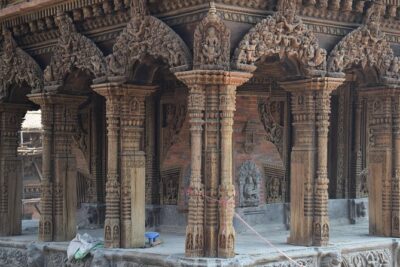
Full-Day 7 UNESCO Tour with Lunch – Private/Group
Read our review →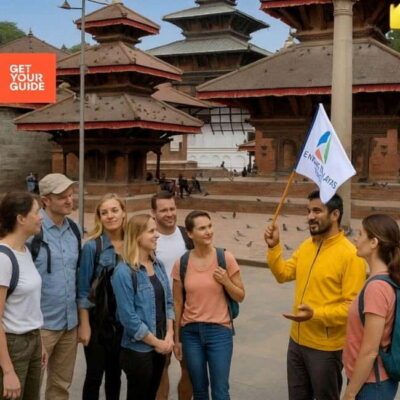
Kathmandu Private Sightseeing Tour | UNESCO World Heritage Sites
Read our review →Browse the lists this tour appears in