
Reviewed · HISTORICAL TOURS
Pick 2-Wonders of Kathmandu: A 3-Hour Heritage Hop
Kathmandu’s biggest sights are spread across the valley, so this three-hour private tour makes a smart first look when your schedule is tight. You choose two sites, then travel between them with a guide and driver instead of trying to piece together the city on your own.
I like the freedom to linger, especially with guides such as Nilakantha Acharya, who has patiently answered questions, adjusted the pace, and even helped a jet-lagged visitor find a rooftop coffee stop. I also like the unusually low price of $3.94 per person. The catch is that entrance fees are extra, and three hours goes quickly, so you need to choose your two stops carefully.
In This Review
- Key points at a glance
- Why two heritage sites can be better than six
- Option 1: Kathmandu Durbar Square and Swayambhunath
- Option 2: Pashupatinath and Boudhanath
- Option 3: Patan and Kathmandu royal squares
- Option 4: Bhaktapur’s old-world square
- What your three hours look like from Thamel
- The guide makes the difference
- What the $3.94 price really means
- Who should book this heritage hop
- Simple choices for different interests
- Should you book it?
- FAQ
- How long is the Kathmandu heritage tour?
- Where does pickup take place?
- Which sites can I choose?
- Is the tour private?
- Which guide languages are available?
- Are entrance fees included?
Key points at a glance
- Choose your own two-site route: Pick from Kathmandu Durbar Square, Swayambhunath, Pashupatinath, Boudhanath, Patan, and Bhaktapur, with the exact pairing selected before booking.
- See the Kumari’s temple: Kathmandu Durbar Square offers a chance to learn about the Kumari, Nepal’s living goddess.
- Get 360-degree valley views: Swayambhunath sits on a hill above Kathmandu and combines a major stupa with broad city views.
- Balance Hindu and Buddhist traditions: Pashupatinath and Boudhanath create a strong contrast between sacred river rituals and Tibetan Buddhist devotion.
- Travel privately from Thamel: Hotel pickup and drop-off, an air-conditioned vehicle, bottled water, and a live English or Hindi guide are included.
- Keep the pace personal: The small private format lets you ask questions, take photographs, or move along when time matters.
Why two heritage sites can be better than six
Kathmandu Valley has seven UNESCO-listed monument zones, but a short visit is not the time to collect them like postage stamps. This tour asks you to choose two. That limit is its main strength.
You can spend proper time looking at carved windows, asking about religious symbols, and understanding why a temple matters. A rushed city tour may show you more gates and courtyards, but it can leave you with a blur of names and photographs. Here, the guide can change the speed to match your curiosity.
That flexibility appears often in the strongest feedback about the experience. Nilakantha Acharya is praised for explaining monuments and local beliefs clearly, taking photographs, and letting people linger at the places that caught their attention. Prakash is also singled out for teaching visitors a great deal during the tour. The guide you receive may vary, but the private format is well suited to conversation.
The three-hour length is also practical on an arrival day. You can see a major slice of Kathmandu without giving up an entire day of sightseeing. Pickup and drop-off at a hotel in Thamel keep the plan simple, though traffic can eat into your sightseeing time. Kathmandu is not a city where every short road journey is truly short.
More history walks in Kathmandu:
- Private Kathmandu Sightseeing Tour | UNESCO World Heritage sites
★ 5.0 · 756 reviews - UNESCO Seven World Heritage Tour in Kathmandu
★ 5.0 · 253 reviews - Kathmandu Private Sightseeing Tour | UNESCO World Heritage Sites
★ 5.0 · 109 reviews
Option 1: Kathmandu Durbar Square and Swayambhunath
This is the best pairing if you want royal buildings, local legends, temples, and a city view in one compact outing.
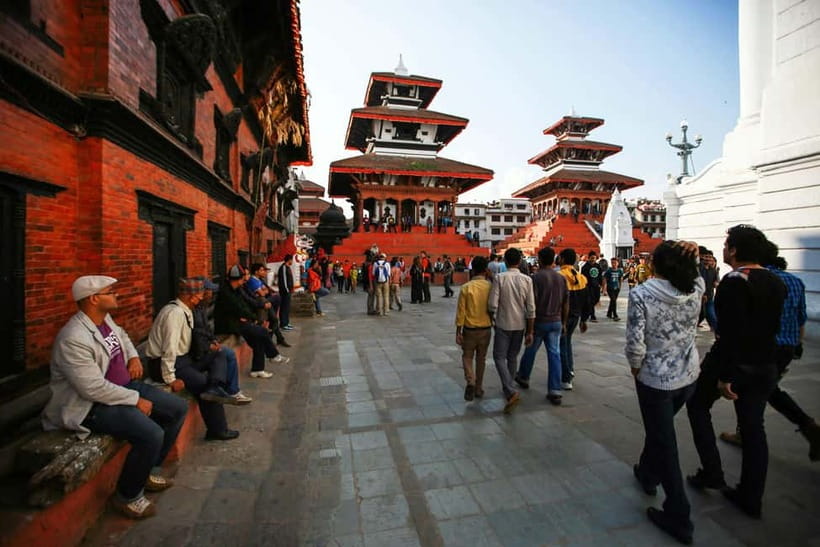
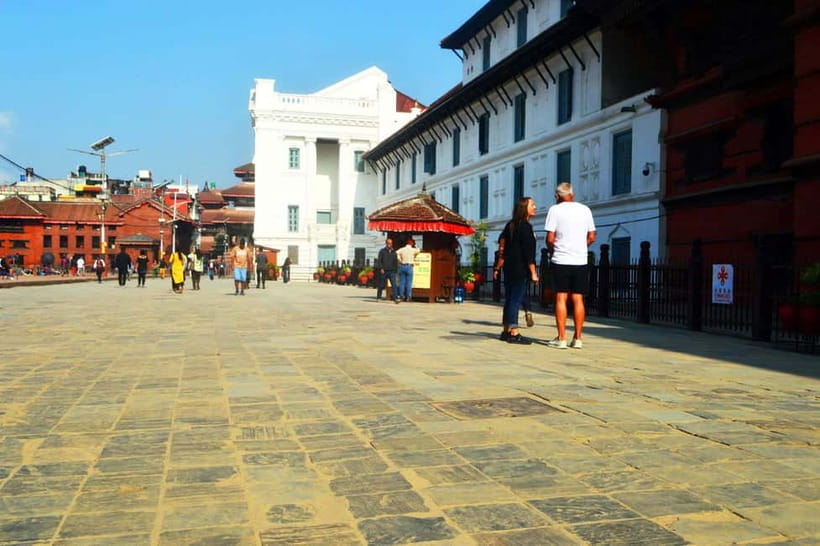
Kathmandu Durbar Square was once the center of royal life. You will see palaces and temples linked with the Malla and Shah dynasties, including the nine-story Nautale Durbar. The square is not a single building or a single viewpoint. It is a collection of courtyards, shrines, carved details, and palace spaces, so a guide makes the setting much easier to read.
The Kumari tradition is the special draw. The Kumari is regarded as a living goddess and resides in a temple in the square. You may have the rare chance to see her, but this should be treated as a possibility, not a promise. Customs and timing matter, and respectful behavior is essential. Your guide can explain the practice and help you understand what you are seeing without turning a sacred moment into a photo hunt.
This stop suits anyone who wants the city’s social and political past. It also gives you a close look at Newari design, with brickwork, timber carving, layered roofs, and tightly arranged courtyards. The buildings carry the marks of age and disaster, so do not expect a polished museum complex. Part of the appeal is seeing a living urban center where worship, daily movement, and heritage share the same space.
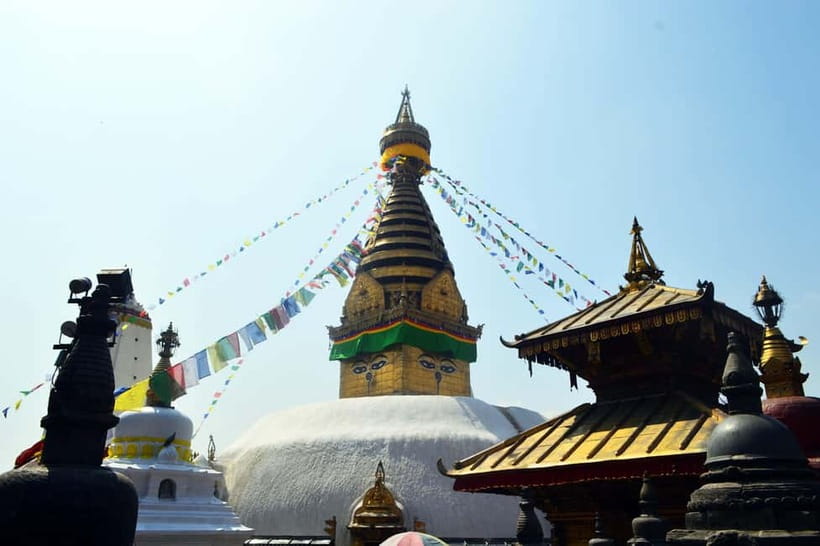
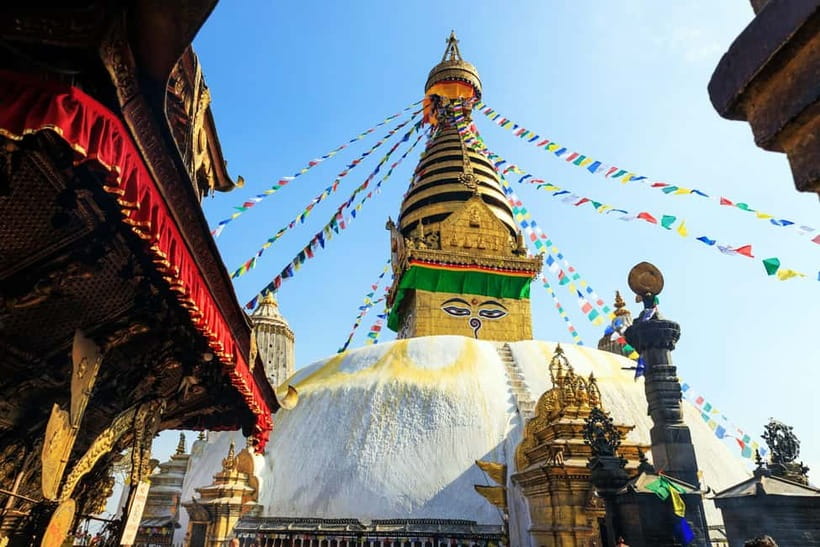
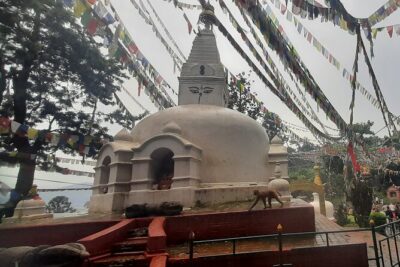
Swayambhunath, often called the Monkey Temple, changes the mood. You climb to a hilltop stupa, encounter monkeys around the complex, and look out over Kathmandu Valley from above. The Mahachaitya is the visual centerpiece, with its large white dome and painted eyes looking across the city.
The broad 360-degree view is the payoff. From the hill, Kathmandu’s size and setting become clearer than they do from street level. You will also see how Buddhist and Hindu elements sit side by side in the valley’s religious life.
There is a physical tradeoff. A hilltop temple involves steps and walking, and the activity is not suitable for wheelchair users. People with limited mobility should ask before choosing this pairing. You should also wear shoes that are easy to walk in and keep your bag small, since large luggage is not allowed.
Choose Option 1 if you want the strongest all-round introduction to Kathmandu. It gives you architecture, royal history, religious practice, a living cultural tradition, and a panorama.
Option 2: Pashupatinath and Boudhanath
This route is the most spiritual of the four. It works well if you want to understand two major faith traditions rather than focus mainly on palaces.
Pashupatinath Temple sits beside the sacred Bagmati River and is dedicated to Lord Shiva. It is one of Hinduism’s holiest sites. Depending on the timing of your visit, you may witness traditional cremation rituals along the river. This is not a staged cultural display. Approach quietly, listen to your guide, and follow local rules about where you may go and what you may photograph.
A guide is especially useful here because the site can be difficult to interpret from its buildings alone. Rituals, symbols, shrines, and river customs may not be obvious to someone seeing them for the first time. One particularly useful account describes arriving on a festival day, when Nilakantha explained the rituals and symbols taking place around the temple. Festival timing is not guaranteed, but it shows why the site can reward careful explanation.
Pashupatinath can also be emotionally demanding. Cremation grounds are part of the experience, and some people will find the setting solemn or confronting. If you prefer a lighter sightseeing stop, Kathmandu Durbar Square and Swayambhunath may feel easier.
Boudhanath Stupa offers a very different atmosphere. This enormous Buddhist monument is one of Nepal’s most important stupas and the largest mandala in the country. It once served as a key stop on the ancient trade route to Tibet. The great dome, prayer traditions, and circular form give the place a calm sense of order after the intensity of Pashupatinath.
The value of pairing these sites lies in the contrast. At Pashupatinath, the Bagmati River and Hindu worship shape the visit. At Boudhanath, the stupa and Buddhist setting offer a more contemplative experience. In three hours, you get a clear introduction to two major religious worlds in Kathmandu.
Choose Option 2 if sacred practice interests you more than palace architecture. It is also a good choice for repeat visitors who have already seen the central Durbar Square.
Option 3: Patan and Kathmandu royal squares
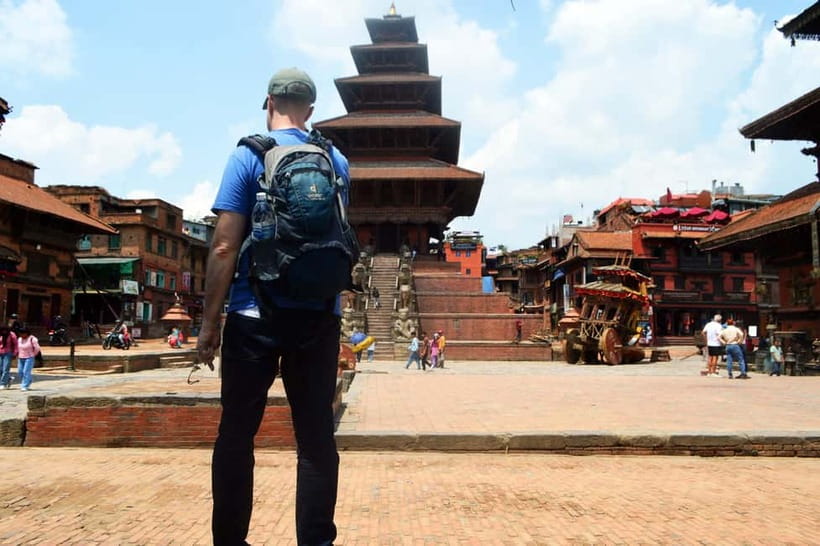
This is the route for people who care about architecture and want to compare two royal centers.
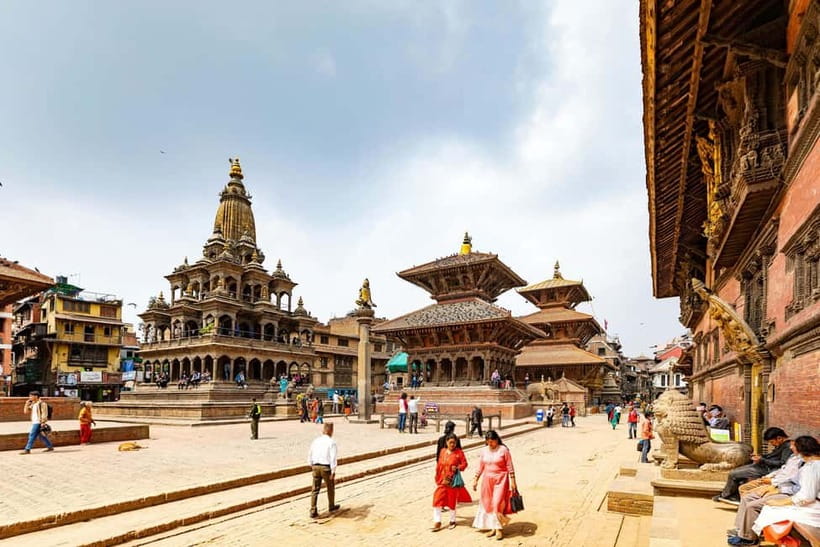
Patan Durbar Square, in Lalitpur, is known as the artistic heart of the valley. Its medieval palace, temples, statues, red brick pavement, and detailed Newari buildings create a more focused architectural visit. Look closely at the timber carving and the way the square is arranged. The beauty is in the details, not just the overall view.
The setting gives you a useful comparison with Kathmandu Durbar Square. Both sites show royal power, temple design, and Newari craftsmanship, but seeing them together helps you notice differences in scale, arrangement, and atmosphere. A guide can point out what you might otherwise walk past.
Kathmandu Durbar Square then adds the Kumari tradition and the Nautale Durbar palace complex. It also places you in the old city’s central historic area, where the heritage site connects with present-day Kathmandu.
This pairing is less varied than Option 1. You will not get the hilltop panorama of Swayambhunath or the strong religious contrast of Pashupatinath and Boudhanath. On the other hand, it is a good choice if your camera is aimed at courtyards, carved wood, temple roofs, brick façades, and royal architecture.
The two squares also give you a fuller sense of Newari building traditions than one square alone. If you are an architecture student, a photographer, or simply someone who likes comparing historic places, this may be the most satisfying option.
A few more Kathmandu tours worth comparing
- Everest Base Camp: 3 Hour Helicopter Sightseeing Tour
★ 4.4 · 17 reviews - 3 Hours Night Pashupatinath Aarati Tour
★ 4.5 · 4 reviews - Private 3-Hour Nagarkot Sunset Tour from Kathmandu
★ 3.5 · 3 reviews - Kathmandu: About 3-hour Cooking Class Experience near Thamel
★ 5.0 · 3 reviews
Option 4: Bhaktapur’s old-world square
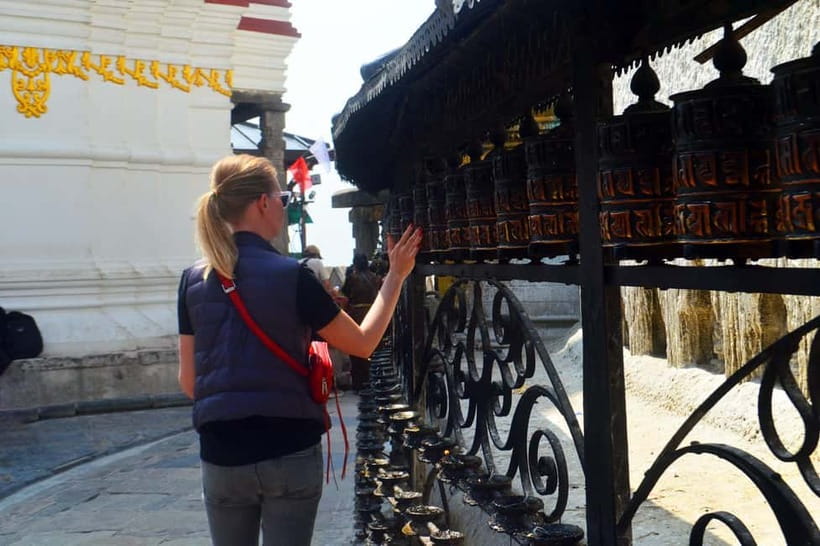
Bhaktapur offers the most concentrated step back into medieval urban design. It is the smallest district in Nepal but contains the country’s largest Durbar Square, a UNESCO-listed area made up of four connected smaller squares.
The major landmark is Nyatapola Temple, Nepal’s tallest temple, with five stories rising above the square. Its height gives the area a strong vertical focal point, while the surrounding brick buildings and temples create a broad historic setting.
Bhaktapur is a good fit if you want one major place to explore at a slower pace. It has enough detail to occupy your attention without requiring a second full monument zone. The square’s layout, temples, and Newari design can be easier to appreciate when you are not rushing from one unrelated sight to another.
There is one planning point to clarify before you confirm this choice. The supplied route description names Bhaktapur Durbar Square but does not identify a second site for Option 4, even though the experience is described as a two-site tour. Ask the operator which second stop is paired with Bhaktapur and how the three hours will be divided.
That question matters because Bhaktapur is farther from central Kathmandu than some other choices, and travel time can affect how long you spend walking around the square. The air-conditioned private vehicle helps with comfort, but it cannot remove traffic from the schedule.
Choose this option if Bhaktapur is high on your list and you want to make it the main event. Confirm the full pairing before payment.
What your three hours look like from Thamel
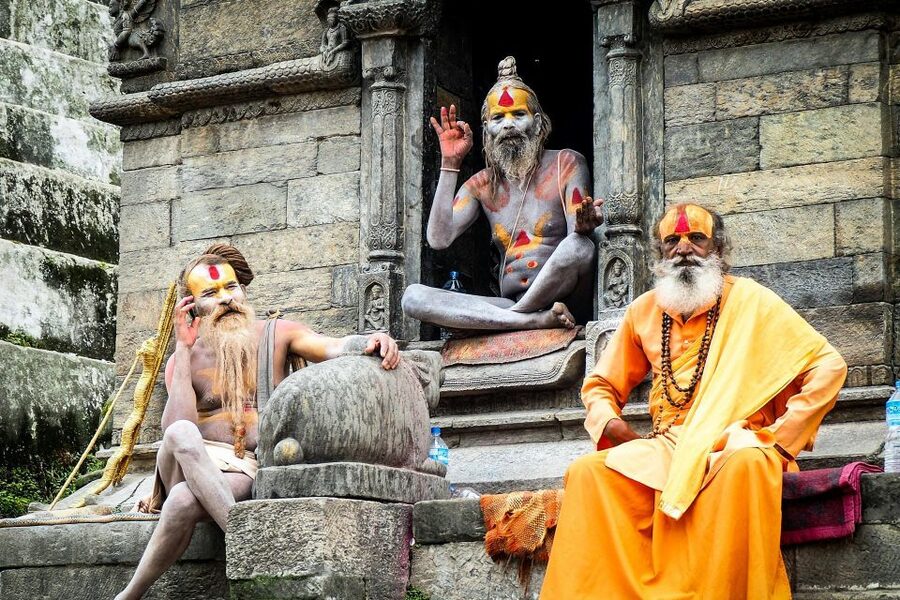
The tour begins with pickup in Thamel. You are asked to wait in your hotel lobby or at the entrance of your apartment five to ten minutes before the agreed pickup time. From there, you ride in a private air-conditioned vehicle with bottled water provided.
A private group changes the feel of the outing. You are not trying to keep up with a large crowd, and you can ask for more explanation at a temple or move on when you have had enough. Previous bookings have included the guide and driver working together, with Hari and Ram named as drivers in separate experiences.
The exact order of the stops is not given, so confirm the starting time and route when you book. The tour returns you to Thamel. Since only three hours are available, it is sensible to arrive ready: carry your passport and cash, leave large bags and luggage behind, and do not bring alcohol or drugs.
Bring comfortable footwear and keep your expectations realistic. This is a heritage walk with vehicle transfers, not a relaxed café tour. You will be moving through historic courtyards, temple areas, and possibly steps or uneven surfaces.
The guide makes the difference
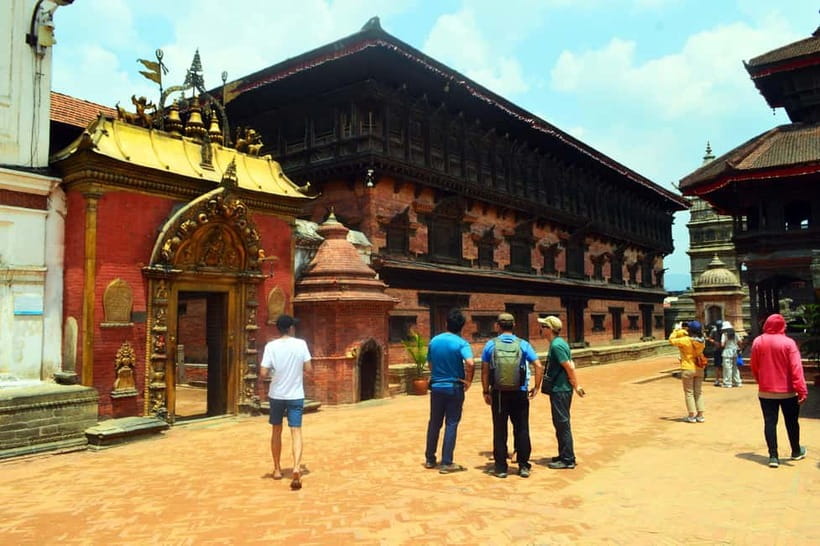
A short heritage tour rises or falls on the quality of its explanations. You can see a stupa or palace without help, but you may miss why its shape, location, or ritual use matters.
Nilakantha Acharya receives the strongest praise in the supplied feedback. He is described as patient with questions, careful with explanations, helpful with photographs, and willing to adjust the speed. One visitor had time to stop for coffee because jet lag hit between the two sites. That is a useful example of the private format at its best: the day can respond to you.
Another visitor who had already been to Nepal many times still learned new things from Nilakantha. That suggests the experience is not only for first-time visitors, though your results depend on the guide assigned to your booking.
Prakash is also praised for teaching a great deal during the tour. English and Hindi are available. If you have a particular interest, such as Newari architecture, Buddhist symbols, Hindu ritual, or the Kumari tradition, tell your guide early. Three hours is too short to cover everything, so directing the conversation helps.
What the $3.94 price really means
At $3.94 per person, the tour is remarkably inexpensive for private transport, hotel pickup and drop-off, a guide, bottled water, and two heritage stops. Even if you are traveling alone, the price makes it an easy way to get oriented without committing to a full-day tour.
The headline price is not the complete sightseeing cost. Monument entrance fees are excluded, though an add-on option is available. You should carry cash for those fees and for personal expenses. Meals and beverages are also not included.
The real value depends on how you use the three hours. If you want a quick, guided introduction and reliable transport, this is strong value. If you want to study every temple, spend long periods photographing details, or cover more than two sites, the short duration will feel limiting no matter how low the price is.
The tour includes skip-the-ticket-line service, but entrance fees still apply. That distinction is worth noting. It may save time at the entrance, but it does not make admission free.
Who should book this heritage hop
I would point this tour toward several kinds of visitors:
- You have a long layover or only one free morning or afternoon.
- You are staying in Thamel and want hotel transport arranged.
- You prefer a private group to a large scheduled coach.
- You want to choose sites based on your interests.
- You enjoy asking questions and changing the pace.
- You want a first look before deciding which places deserve a longer visit.
It is less suitable if you use a wheelchair, are bringing a baby under one year, or need a completely effortless route. The activity is also not suitable for people over 95 according to the stated conditions.
The tour may not satisfy you if you want meals included, a full-day schedule, or a broad survey of all major monuments. Three hours is a tasting menu, not the whole valley.
Simple choices for different interests
If you want the broadest first impression, choose Kathmandu Durbar Square and Swayambhunath. The Kumari’s temple, palace buildings, Newari details, monkeys, and hilltop views give you the greatest variety.
If religion and ritual are your priority, choose Pashupatinath and Boudhanath. The Bagmati River setting and Hindu cremation traditions contrast sharply with the calm Buddhist stupa.
If architecture is your main interest, choose Patan and Kathmandu Durbar Squares. Comparing the two royal centers makes the Newari design easier to understand.
If Bhaktapur is the place you most want to see, choose Option 4, but first confirm which second site is included. That detail is not clear in the supplied information.
Should you book it?
Book this tour if you want an affordable, private introduction to Kathmandu and are willing to make a firm choice between two sites. The strongest feature is not the vehicle or the bottled water. It is the chance to spend useful time with a guide who can explain what you are seeing and adjust the pace to your interests.
I would choose Option 1 for a first visit, Option 2 for religious and cultural depth, and Option 3 for architecture. Bhaktapur can be excellent, but confirm the second stop before booking.
At $3.94 per person, the risk is low. Just budget for entrance fees, keep your bag small, arrive early at the lobby, and remember that Kathmandu traffic can make a three-hour plan feel even tighter. For a short window in the capital, this is a sensible way to see two important places without surrendering an entire day.
FAQ
How long is the Kathmandu heritage tour?
The activity lasts three hours, including pickup and return to Thamel.
Where does pickup take place?
Pickup is provided at your hotel in Kathmandu. You should wait in the hotel lobby or at the entrance of your residential apartment five to ten minutes before pickup.
Which sites can I choose?
The listed choices include Kathmandu Durbar Square, Swayambhunath, Pashupatinath Temple, Boudhanath Stupa, Patan Durbar Square, and Bhaktapur Durbar Square. You should select your preferred option before confirming the booking.
Is the tour private?
Yes. The activity is arranged for a private group and includes an air-conditioned private vehicle and a live guide.
Which guide languages are available?
Guiding is available in English and Hindi.
Are entrance fees included?
No. Monument entrance fees, meals, beverages, and personal expenses are not included. An entrance-fee add-on option is available.
Recently added around Kathmandu
- Kathmandu : Swambhunath & Durbar Square Guided Half Day Tour★ 3.3 · 3 reviews
- Private Day Tour in Kathmandu Valley Rim with Bhaktapur Sightseeing★ 5.0 · 3 reviews
- Nepali Cooking training & Cultural Homestay Experience★ 5.0 · 3 reviews
- Private 3-Hour Nagarkot Sunset Tour from Kathmandu★ 3.5 · 3 reviews
- From Kathmandu / Pokhara / Chitwan: River Rafting – 1 Day★ 4.6 · 3 reviews
- From Kathmandu: Everest Base Camp Landing Helicopter Tour★ 5.0 · 3 reviews
- 4 UNESSCO World heritage sites of Kathmandu-private tour★ 5.0 · 3 reviews
- From Kathmandu Budget: 15 Day Everest Base Camp Trek★ 5.0 · 3 reviews
Historical Tours, compared.
Private Kathmandu Sightseeing Tour | UNESCO World Heritage sites
Read our review →
Kathmandu Private Sightseeing Tour | UNESCO World Heritage Sites
Read our review →
Full Day Private Top 4 UNESCO Heritage Tour W/Lunch.
Read our review →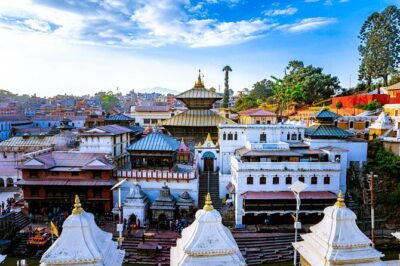
Nagarkot Sunrise & Bhaktapur UNESCO Heritage Private Tour
Read our review →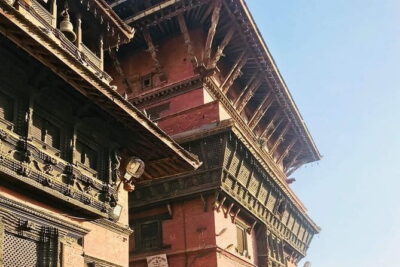
Kathmandu Top 4 or 2 UNESCO World Heritage Sites Day Tour
Read our review →Browse the lists this tour appears in