
Reviewed · BOUDHANATH STUPA TOURS
The Boudhanath Yoga Experience in Nepal
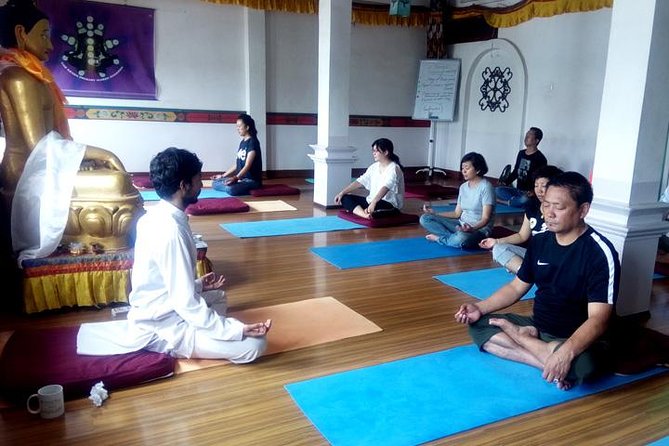
At Boudhanath, yoga takes place beside one of Nepal’s most important Buddhist pilgrimage sites, with the great white stupa just across from the yoga center. The class goes beyond stretching, bringing together postures, breathing, hand gestures, concentration, and meditation in a setting tied to Tibetan Buddhist life.
I like the easy hotel pickup and private vehicle, which spare you a morning of Kathmandu traffic and route planning. I also like the teacher’s patient, move-by-move approach, with time for questions and a calm presence that helps the busy surroundings fade into the background.
The main consideration is the price: $110 per person is fair only if you value the long class, private transport, instructor, and stupa entry as one package. This is not a quick drop-in yoga session, and people looking only for light exercise may find its spiritual teaching more than they need.
In This Review
- Key points about the Boudhanath yoga session
- Why Boudhanath changes the feel of the class
- The 9:00 am pickup and private ride
- Crossing into the yoga center
- The 2.5-hour lesson: from body to breath
- Buddhist teachings and the Eight-Fold Path
- A calm teacher and room for questions
- Is $110 a good value?
- Who will get the most from this morning?
- Practical advice before you go
- Should you book the Boudhanath yoga experience?
- FAQ
- How long does the Boudhanath yoga experience last?
- What time does the experience start?
- Is hotel pickup included?
- Is entry to Boudhanath Stupa included?
- How many people can join the class?
- What should I wear?
Key points about the Boudhanath yoga session
- A 2.5-hour hands-on class: You work through physical postures, breathing, gestures, mental focus, and meditation rather than doing a short stretch session.
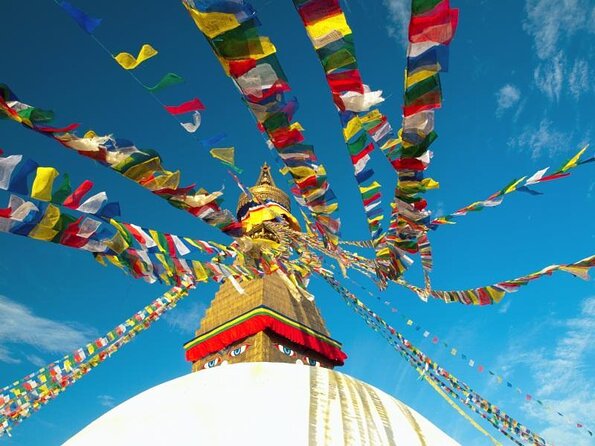
- Across from Boudhanath Stupa: The location gives the class a direct connection to one of Kathmandu’s major Buddhist pilgrimage sites.
- Hotel pickup at 9:00 am: Round-trip transport by private vehicle removes much of the morning’s practical hassle.
- A Buddhist approach to yoga: The instruction presents yoga as a whole way of working with body, breath, energy, and mind.
- Small enough for personal help: The group can include no more than 14 people, and the class allows questions.
- Loose clothing matters: Wear comfortable clothes that let you move without restriction.
Why Boudhanath changes the feel of the class
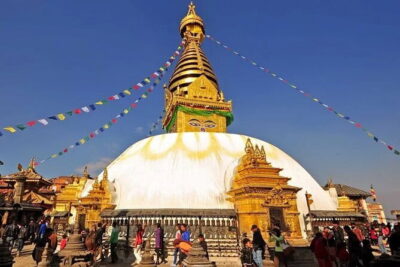
Yoga can happen almost anywhere, but the setting matters here. Boudhanath is home to the world’s largest Buddhist stupa and a large Tibetan community living in exile. The yoga center sits directly across from the stupa, so the class is linked to a place of prayer, pilgrimage, and daily religious life rather than being placed in an ordinary hotel room.
That setting gives the morning a clear sense of purpose. You are not simply following a series of exercises. The teaching connects body movement with breathing, mental control, and meditation, in line with Buddhist-inspired ideas about steady attention and liberation of the mind.
You should also set your expectations correctly. Boudhanath is a busy part of Kathmandu. You may notice activity outside the room, but the instruction is designed to keep your attention on the practice. The teacher explains each movement step by step, and you can ask questions when something feels unfamiliar.
I like this combination of place and method. The stupa is not just a backdrop for photographs. It gives the class a cultural setting that helps explain why yoga here is presented as a complete discipline rather than a fitness routine.
More time around Boudhanath stupa:
- PashupatiNath and BoudhaNath – Private/Small Group
★ 5.0 · 18 reviews - Sacred Pashupatinath: Aarati,Cremation Rites & Boudha Stupa
★ 5.0 · 18 reviews - Private Half-Day Tour of Boudhanath and Pashupatinath Temples in Kathmandu
★ 4.5 · 9 reviews
The 9:00 am pickup and private ride
The experience begins at 9:00 am with pickup from your Kathmandu hotel. Your transport is by private vehicle, and drop-off is included after the class. That is useful in Kathmandu, where finding the right entrance and judging road time can take more effort than expected.
The private vehicle does not mean the yoga class is private. The activity can have up to 14 people, and group discounts are available. The transport arrangement simply gives you a direct ride to and from the site instead of leaving you to arrange taxis or public transport.
This setup is especially handy if you are new to Kathmandu or staying away from Boudha. You can begin the morning without negotiating a fare, checking a route, or worrying about reaching a class at the right time. It also makes the four-hour schedule easier to manage.
The published duration is about four hours, including transport and the class. The yoga portion lasts 2.5 hours, so allow time for the ride, arrival, entry arrangements, and return to your hotel. Exact pickup timing can depend on where you are staying, so keeping your morning open is sensible.
Crossing into the yoga center
The most distinctive part of arrival is the location. The yoga center is across from Boudhanath Stupa, placing you close to a major religious site before the class even begins. Entry to the stupa is included, so you do not need to purchase that separately.
The stupa visit gives the morning a second purpose. You are not only attending a class; you also have a chance to see the site that gives the experience its setting and spiritual context. The supplied plan does not specify a separate guided stupa tour or a fixed amount of time there, so you should not expect a detailed sightseeing program.
That limitation is worth noting. If your main goal is learning about Boudhanath’s architecture, religious customs, or Tibetan community, you may want to arrange additional sightseeing on your own. This experience uses the stupa as part of a yoga-focused morning, not as a full historical tour.
Still, the location adds real value. A class in a generic studio could teach similar movements, but it would not provide the same link to Buddhist pilgrimage and Himalayan spirituality. The setting helps make the teaching easier to understand.
The 2.5-hour lesson: from body to breath
The class covers several parts of yoga in one long session. You begin with asanas, or physical postures. These focus on placing the body correctly and learning how to hold or move through each position.
The teacher explains the movements one at a time, which is important if you are new to yoga or unfamiliar with the vocabulary. You are encouraged to ask questions, so you do not have to copy blindly or guess whether your posture is correct.
The class also includes mudras, or hand gestures. In this teaching, mudras are used to support the flow of energy. That may feel different from a standard Western fitness class, where hand position is usually about balance or comfort rather than spiritual purpose.
Pranayama, the breathing work, is another major part. The instruction presents controlled breathing as a way to relax and purify the body and energy. This is useful for people who want more than physical movement, though you should follow the teacher’s pace and stop if any breathing technique feels uncomfortable.
The remaining elements turn attention inward. Dharana is presented as a method for controlling the mind and directing it toward positive energy. Dhyana is described as divine meditation intended to free the mind.
You do not need to treat these terms as an exam. The value is in understanding how the parts fit together. Posture prepares the body, breathing steadies it, hand gestures give movement a symbolic purpose, and concentration and meditation bring the focus to the mind.
More yoga and meditation sessions in Kathmandu:
- 200 Hours Yoga Teacher Training at Nepal Yoga Home (starts on 1st of everymonth)
★ 5.0 · 125 reviews - 3 night 4 Day Yoga & Ayurveda Retreat to Detox the Body & Mind, Nepal
★ 5.0 · 37 reviews - 10 Days Ayurveda & Yoga Retreat in Kathmandu, Nepal
★ 5.0 · 24 reviews - 21 Day Ayurveda & Yoga Retreat in the Himalayan country, Nepal
★ 5.0 · 19 reviews
Buddhist teachings and the Eight-Fold Path
The instructor presents the session through the Eight-Fold Path taught by Buddha and the Seven Disciplines. The supplied description treats these ideas as part of a full approach to living, rather than as separate facts to memorize.
That broader approach is the heart of the experience. You are being asked to think about wellness as something involving body and mind together. For some people, this makes the session more meaningful than a conventional exercise class. For others, the spiritual language may feel more serious than expected.
The class is therefore best suited to someone who is open to Buddhist-inspired instruction. You do not need to arrive as an experienced yogi, and most people can participate, but you should be comfortable with a session that includes meditation and ideas about mental liberation.
I appreciate that the experience does not reduce yoga to flexibility. A person with limited experience can still take part because the instructor explains the practice in stages. At the same time, someone seeking a hard physical workout should know that the session gives equal weight to breath, concentration, gestures, and meditation.
A calm teacher and room for questions
The strongest personal detail from the class is the instructor’s manner. The teacher is described as welcoming and calm, with an energy that helps you feel connected during meditation. That matters in a lesson lasting 2.5 hours, particularly when the subject includes unfamiliar spiritual practices.
The instruction is explained move by move. You can ask questions rather than pretending to understand, which is a useful feature for beginners. A teacher who slows down and explains the purpose of an action can make the difference between a meaningful class and a confusing one.
No individual instructor name is provided, so you should not book this expecting a named teacher. What is clear is that the instructor is trained and qualified, and the class is designed to be accessible to most people.
The setting is not silent in the way an isolated retreat might be. Boudha is an active urban area. Yet the class is arranged so the outside activity does not have to take over your attention. That balance may suit you if you want a real Kathmandu setting rather than a remote wellness retreat.
Is $110 a good value?
At $110 per person, this is not the cheapest way to try yoga in Kathmandu. The value comes from combining several services: hotel pickup and drop-off, a private vehicle, a qualified instructor, 2.5 hours of teaching, and entry to Boudhanath Stupa.
If you were to compare the cost only with a local yoga class, the price would seem high. If you value convenience and want a prepared cultural experience near one of Kathmandu’s main religious sites, the package makes more sense.
The group limit of 14 keeps the class from becoming a huge workshop. It is not one-to-one instruction, but the size should allow more attention than a mass class, especially since questions are welcomed. Group discounts may improve the value if you are traveling with companions.
Food and drinks are not included. Plan to eat before or after the activity according to your own schedule, since the listed program does not provide refreshments. Comfortable loose-fitting clothing is advised, and it is the most practical choice for bending, breathing exercises, and seated meditation.
The booking pattern also tells you something useful: the experience is booked an average of 113 days ahead. You do not have to assume every Kathmandu activity sells out, but this one is planned well in advance by many people. If the date matters to you, reserve early rather than leaving it until the last few days.
Who will get the most from this morning?
I would recommend this experience to you if you want a cultural activity with a physical and reflective side. It suits beginners who would benefit from patient instruction, as well as people already interested in yoga, Buddhist practice, breathing, or meditation.
It is also a good fit if you dislike spending part of your holiday arranging local transport. Hotel pickup and drop-off make the morning simple, and the stupa gives the class a strong sense of place.
You may want to skip it if you want a fast sightseeing stop or an intense athletic workout. The class spends a large share of its time on meditation, breathing, concentration, and spiritual ideas. Those elements are central, not optional extras.
It may also be less suitable if you prefer complete quiet. The yoga center is in a busy area, even though the class can keep your attention away from the surrounding activity.
Practical advice before you go
Wear loose-fitting clothing. This is the one clear clothing instruction, and it matters because the session includes postures, seated work, breathing, and meditation.
Keep the full morning available. The class itself lasts 2.5 hours, but the whole experience takes about four hours once pickup, transport, entry, and return are included.
Bring questions. The teacher explains the postures step by step and welcomes questions, so you will get more from the class if you speak up when a term or movement is unclear.
Do not confuse the stupa visit with a full sightseeing tour. Entry is included, but the main focus is the yoga lesson. If you want more time at Boudhanath or a detailed explanation of the site, plan that separately.
You can cancel for a full refund if you do so at least 24 hours before the 9:00 am start time. Cancellations or changes made less than 24 hours before the experience are not accepted for a refund, and the local time cutoff applies.
Should you book the Boudhanath yoga experience?
Book it if you want a thoughtful morning that connects yoga with Buddhist teaching and a major Kathmandu pilgrimage site. The 2.5-hour class, welcoming instruction, included stupa entry, and hotel transfers create a well-organized package for first-time visitors.
Think twice if you are looking for cheap exercise, a silent retreat, or a full tour of Boudhanath. At $110, the experience earns its price through convenience, setting, and the length of instruction, not through a simple stretch class.
For the right person, this is a useful way to slow down in Kathmandu without leaving the city. You get time with the body, breath, and mind, then return to your hotel with the morning’s practical details already handled.
FAQ
How long does the Boudhanath yoga experience last?
The experience lasts about four hours in total. The yoga class itself lasts 2.5 hours.
What time does the experience start?
The stated start time is 9:00 am.
Is hotel pickup included?
Yes. Hotel pickup and drop-off are included, along with transport by private vehicle.
Is entry to Boudhanath Stupa included?
Yes. The entry fee to Boudhanath Stupa is included in the price.
How many people can join the class?
The activity has a maximum group size of 14 people.
What should I wear?
Loose-fitting clothing is advised so you can move comfortably during the yoga practices.
Recently added around Kathmandu
- Kathmandu : Swambhunath & Durbar Square Guided Half Day Tour★ 3.3 · 3 reviews
- Private Day Tour in Kathmandu Valley Rim with Bhaktapur Sightseeing★ 5.0 · 3 reviews
- Nepali Cooking training & Cultural Homestay Experience★ 5.0 · 3 reviews
- Private 3-Hour Nagarkot Sunset Tour from Kathmandu★ 3.5 · 3 reviews
- From Kathmandu / Pokhara / Chitwan: River Rafting – 1 Day★ 4.6 · 3 reviews
- From Kathmandu: Everest Base Camp Landing Helicopter Tour★ 5.0 · 3 reviews
- 4 UNESSCO World heritage sites of Kathmandu-private tour★ 5.0 · 3 reviews
- From Kathmandu Budget: 15 Day Everest Base Camp Trek★ 5.0 · 3 reviews
Boudhanath Stupa Tours, compared.
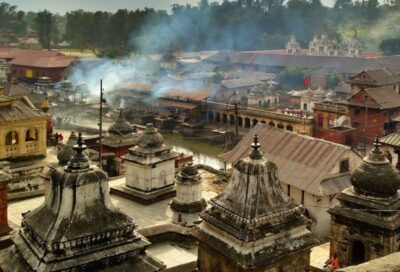
Sacred Pashupatinath: Aarati,Cremation Rites & Boudha Stupa
Read our review →
PashupatiNath and BoudhaNath – Private/Small Group
Read our review →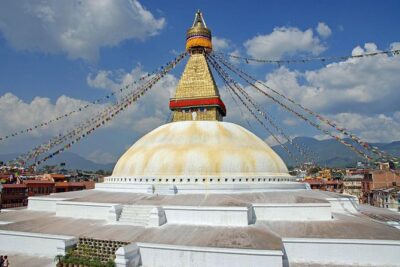
Private Half-Day Tour of Boudhanath and Pashupatinath Temples in Kathmandu
Read our review →
Kopan Monastery, Swayambhu and Boudha Nath Stupa Tour
Read our review →Browse the lists this tour appears in