
Reviewed · BOUDHANATH STUPA TOURS
PashupatiNath and BoudhaNath – Private/Small Group
Kathmandu’s two great religious centers tell very different stories. At Pashupatinath, you learn about Hindu worship and the final rites performed beside the Bagmati River. At Boudhanath, the mood shifts to Tibetan Buddhism, prayer flags, sacred geometry, and the teachings of the Buddha.
I like the small group limit of five, which gives you room to ask real questions. I also like the route between the two sites, with deer park, smaller temples, and stories about Shiva, Sati, and Guru Gorakhnath along the way. The drawback is cost clarity: the tour is advertised at $15, but entrance fees add about $13 in cash.
In This Review
- Key points to know before booking
- Why these two sites belong together
- Starting at Pashupatinath Temple
- Aryaghat and the Hindu rites of passage
- Shiva stories at Mrigasthali Deer Park
- Gorakhnath Mandir and the walk toward Boudha
- Guhyeshwari and the story of Shaktipeeth
- Understanding Boudhanath Stupa
- Guru Lhakhang Monastery and Padmasambhava
- Thangka painting, mandalas, and healing bowls
- The guide can make or break the experience
- Is $15 a good deal?
- Who should book this Kathmandu tour?
- Should you book it?
- FAQ
- How long does the Pashupatinath and Boudhanath tour last?
- What is the group size?
- Where does the tour start?
- Where does the tour end?
- Are entrance fees included?
- Can non-Hindus enter the main Pashupatinath Temple?
- What happens if I need to cancel?
Key points to know before booking
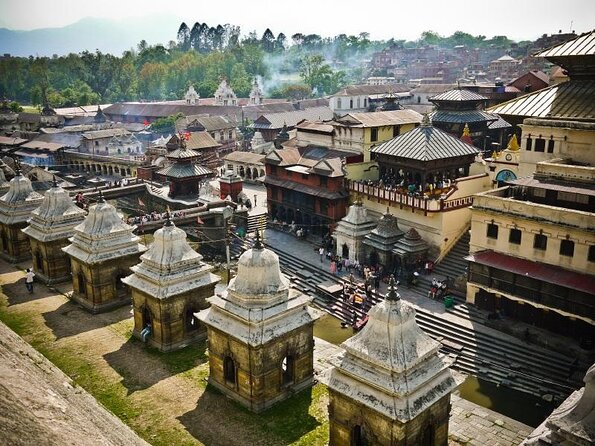
- Pashupatinath gives context for Hindu death rites, including the 16 Samskaras and cremation customs at Aryaghat.
- Boudhanath explains Tibetan Buddhism in plain terms, from the Four Noble Truths to prayer flags and the five elements.
- The group has a maximum of five people, a real advantage for questions and personal attention.
- Santosh is a strong guide choice, with praise for his clear teaching, flexibility, and background in culture, history, and archaeology.
- The tour ends at Boudhanath, not back at the starting point, so you can continue exploring the stupa area afterward.
- Entrance fees are separate, with about NRP 1,000 for Pashupatinath and NRP 400 for Boudhanath, paid in cash.
Why these two sites belong together
Pashupatinath and Boudhanath sit close enough to connect in one short outing, but they offer two distinct religious worlds. The first is a major Hindu temple complex. The second is one of Kathmandu’s best-known centers of Tibetan Buddhism.
That contrast gives the tour its purpose. You are not simply ticking off two famous places. You are learning how Hindu and Buddhist traditions live side by side in Nepal, how their ceremonies differ, and where their ideas overlap. The guide also discusses religious harmony and the way traditions have influenced local food and daily culture.
This matters because both sites can feel confusing without explanation. You may see people circling a shrine, lighting lamps, turning prayer wheels, tying flags, or gathering beside a cremation ghat without knowing what the actions mean. A good guide helps you watch respectfully instead of guessing.
The experience lasts about three hours. That is enough time for a useful introduction, but not enough for a slow, detailed study of every courtyard and shrine. Think of it as a focused cultural walk, not a full-day temple tour.
More visits to Pashupatinath:
- Kathmandu Spiritual Sites: Bodhnath & Pashupatinath Tour
★ 5.0 · 185 reviews - Kathmandu: Pashupatinath Temple Evening Aarati Tour
★ 5.0 · 36 reviews - Kathmandu: Pashupatinath Temple Aarti Night Tour
★ 4.8 · 29 reviews
Starting at Pashupatinath Temple
The meeting point is Gaushala Bus Stop on Ring Road. From there, the route enters the Pashupatinath area, the oldest Hindu temple site in Kathmandu Valley.
The main temple is especially important to Hindu devotees, but non-Hindus cannot enter the central shrine. That restriction is part of the practical reality of visiting Pashupatinath, not a flaw in the tour. Your guide instead takes you through the accessible areas and toward Aryaghat, explaining what you can see and why the site matters.
This is where having Santosh or another trained guide makes a clear difference. The buildings, icons, ceremonies, and movement of worshippers can be hard to interpret on your own. The guide can explain the setting without turning it into a dry lecture.
Expect the first stop to be more about orientation and religious meaning than photography. Dress and behave with care, follow local instructions, and remember that this is an active place of worship rather than a museum.
Aryaghat and the Hindu rites of passage
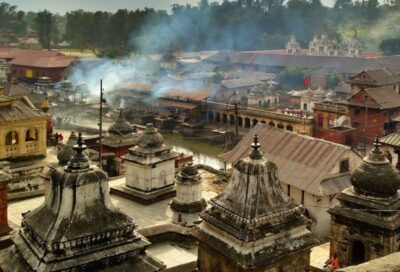
The cremation area at Aryaghat is the most serious part of the visit. Hindu cremation ceremonies take place here, and the guide explains how last rites are performed and how they fit into the larger Hindu view of life and death.
You also hear about the Shodasha Samskaras, the 16 rites of passage traditionally connected with a Hindu life. These ceremonies mark important stages, from birth and childhood through adulthood and death. The exact customs can vary, but the main idea is that life is shaped by meaningful transitions and ritual responsibilities.
The planned stop lasts about 30 minutes, which gives the subject room to breathe. Still, this is not a spectacle. You should be prepared for the possibility of seeing an active cremation and give families privacy. The best part of the explanation is not the visual drama, but the chance to understand how death is treated as part of a continuing religious cycle.
This section may not suit everyone. If you prefer to avoid cremation grounds, you should consider that before booking. If you approach it with respect, it can be one of the most thoughtful parts of the tour.
Shiva stories at Mrigasthali Deer Park
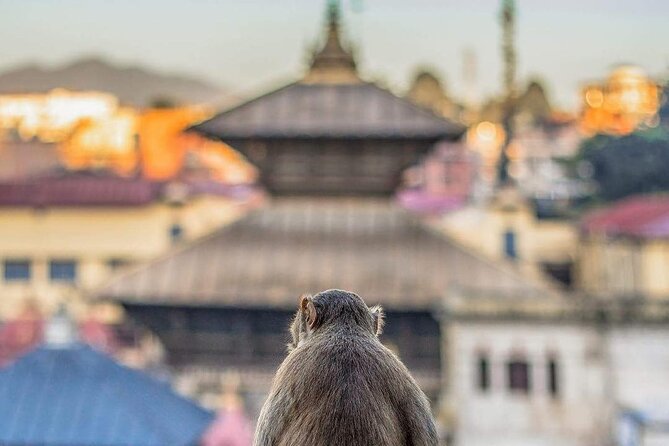
The route then moves to Mrigasthali Deer Park for about 15 minutes. Here, the guide tells the story of Lord Shiva’s connection to the area and explains how the place received its name.
This short stop offers a change of pace after Aryaghat. You get time to walk and look around while hearing how myth, place names, and sacred geography fit together. It also shows that Pashupatinath is more than a single temple building. The religious area includes paths, shrines, woodland, river edges, and smaller sites tied to old stories.
Do not expect a long wildlife visit. The value here is the story and the setting, not a major animal encounter. The stop works as a short pause before the next temples.
More time around Boudhanath stupa:
- Sacred Pashupatinath: Aarati,Cremation Rites & Boudha Stupa
★ 5.0 · 18 reviews - Private Half-Day Tour of Boudhanath and Pashupatinath Temples in Kathmandu
★ 4.5 · 9 reviews - Bhaktapur Durbar Square and Boudhanath Stupa
★ 5.0 · 7 reviews - Half Day Boudhanath Stupa Tour in Kathmandu
★ 5.0 · 5 reviews
Gorakhnath Mandir and the walk toward Boudha
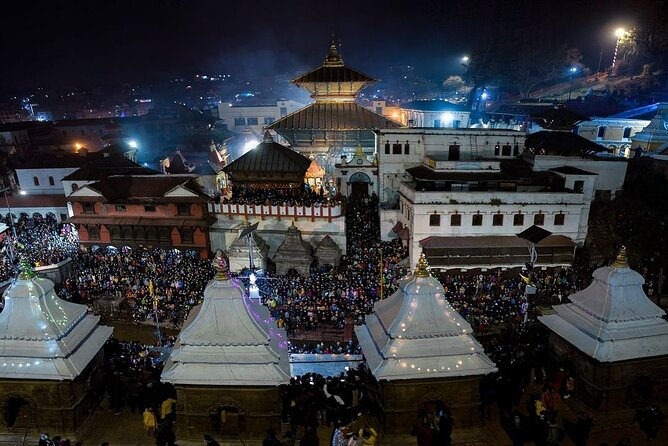
At Gorakhnath Mandir, the guide explains the story of Guru Gorakhnath. The stop lasts about 30 minutes and includes time to rest before continuing toward Boudhanath.
This is a useful part of the route because it slows the pace. Three hours can feel tight when you are moving among religious sites, so a pause helps. It also introduces another important figure and tradition connected with the area.
The tour then passes by Guhyeshwari Temple on the way to Boudhanath. This connection keeps the outing from feeling like two unrelated visits joined by a ride. You move through a chain of sacred places, hearing how the stories overlap and how different Hindu traditions give meaning to the same part of Kathmandu.
The route involves walking between stops, and the tour ends in a different part of the city from where it begins. That is convenient if you want to continue at Boudhanath, but less convenient if you expected a return transfer.
Guhyeshwari and the story of Shaktipeeth
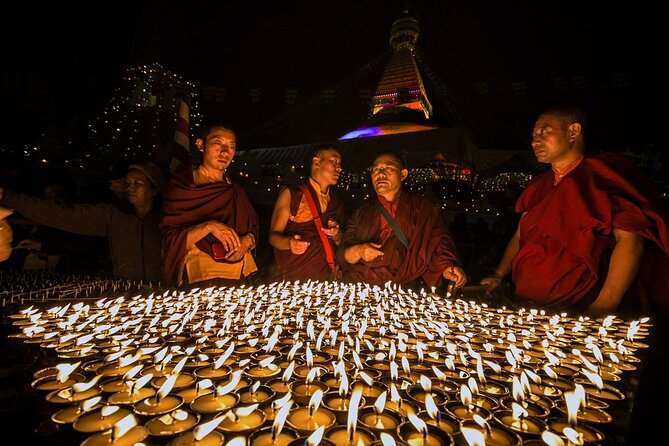
At Guhyeshwari Shaktipeeth Temple, the guide tells the story of Satidevi and explains the idea of Shaktipeeth. The planned stop is about 20 minutes, with no entrance fee listed.
This is a good example of why the tour is more useful than simply visiting the two headline sites. Smaller temples often have complex stories that are difficult to grasp from a sign or a quick online search. The guide gives you the basic framework, then helps you connect the story with the site in front of you.
You do not need prior knowledge of Hinduism. The explanations are aimed at beginners, and the private or small-group format lets you stop and ask for clarification. Santosh is especially well suited to this kind of conversation. He has been praised for answering many questions and adjusting the pace when someone was not feeling physically well.
The walk to Boudhanath takes about 20 minutes. Use that stretch to ask questions rather than treating it as dead time.
Understanding Boudhanath Stupa
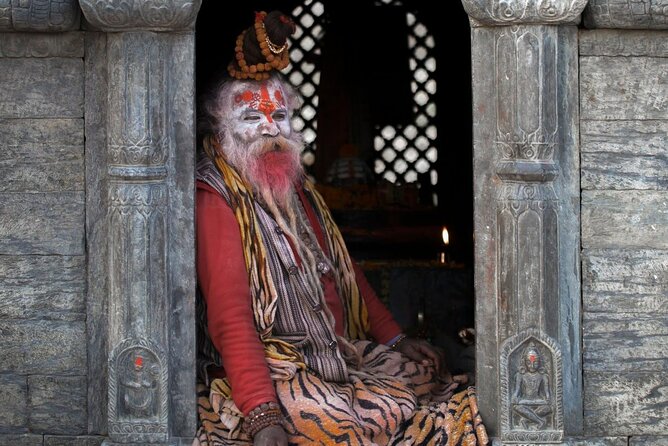
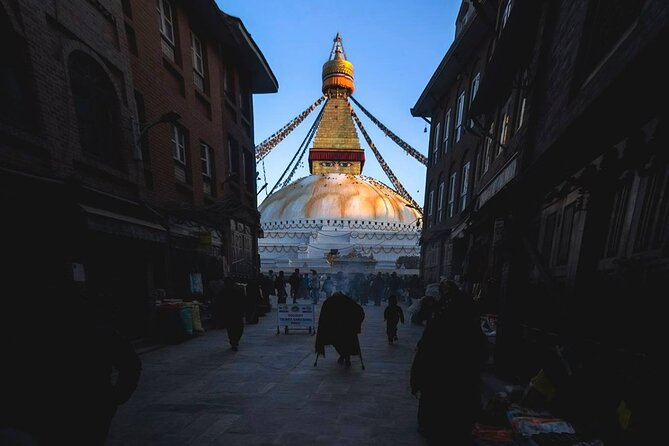
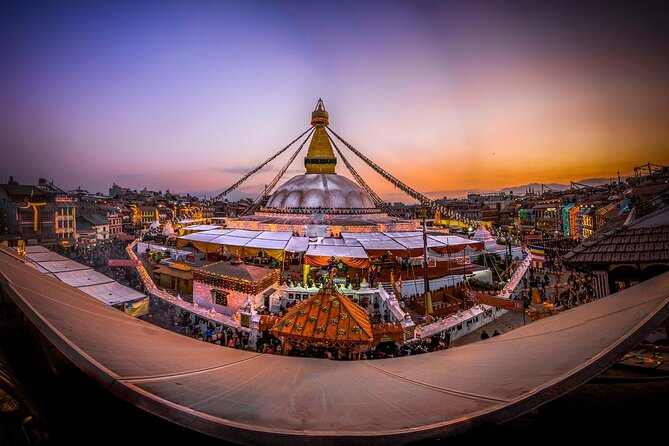
Boudhanath is the heart of the Buddhist portion of the experience. It is described as the second-largest stupa of its kind in the world and is closely associated with Tibetan, or Vajrayana, Buddhism.
The guide introduces the main ideas in a clear, basic way. These include the Four Noble Truths, the Eightfold Path, prayer flags, and the five elements. You also learn how the stupa functions as a place of prayer and movement, not just a large monument to photograph.
The distinction between Hindu and Buddhist practice becomes easier to see here. At Pashupatinath, the focus is on temple worship, rites of passage, and cremation customs. At Boudhanath, the focus shifts to Buddhist teachings, symbolic forms, monastic practice, and repeated acts of prayer.
The stop is scheduled for about 45 minutes, the longest single visit. That is sensible. Boudha has enough visual detail to occupy you well beyond a quick circuit, and the guide can explain why the eyes, levels, colors, flags, and surrounding devotional activity matter.
You may still want extra time after the tour ends. The official finish is at the Boudhanath Gate, and you are free to explore around the stupa or return to your accommodation. This is one of the experience’s practical strengths. The tour gives you a framework, then lets you continue at your own speed.
Guru Lhakhang Monastery and Padmasambhava
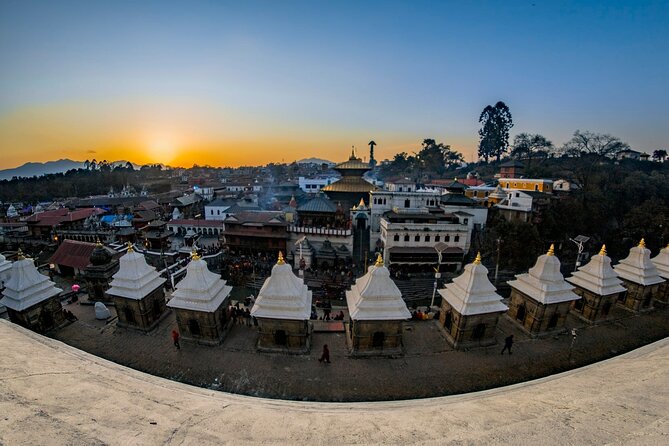
The next stop is Guru Lhakhang Monastery, planned for about 10 minutes. Here, you see what a typical Buddhist monastery looks like and hear about Guru Padmasambhava and Dharma Chakra Pariwartana.
Ten minutes is brief, so think of this as a visual introduction rather than a full monastery study. You get a chance to look at the space, understand its religious purpose, and connect it with the broader Buddhist teaching introduced at the stupa.
The guide’s role is useful here because monastery details can be easy to miss. You can ask what you are seeing and how it relates to the teachings already discussed. If Buddhist art and ritual interest you, this short stop may leave you wishing for more time.
Thangka painting, mandalas, and healing bowls
The final stop is a Boudha Stupa Thangka Center, where you learn about Thangka painting, mandalas, and the basics of healing bowls. The visit lasts about 15 minutes and is included in the tour.
Thangka painting is closely tied to Buddhist teaching. The images are not simply decorative pictures. Their layout, figures, colors, and symbols follow religious rules, while mandalas give visual form to spiritual ideas. A short introduction helps you look at Buddhist art with more care.
The center also offers a basic look at healing bowls. The information provided does not promise a full workshop or extended demonstration, so keep your expectations modest. You should expect an educational stop that rounds out the Buddhist section, not a long art class.
This is also the point where the tour ends at Boudhanath Gate. If you have a little energy left, stay in the area and continue exploring. If not, you can make your way back to your accommodation from there.
The guide can make or break the experience
The strongest praise for this tour centers on the guides, especially Santosh. He is described as friendly, attentive, and able to explain religion, history, culture, archaeology, and local food. That range matters because the tour is not limited to temple facts.
Santosh also has a reputation for answering questions patiently. One useful detail is his flexibility with timing. He adjusted the schedule for a visitor who wanted to see the aarati ceremony, and he adapted the pace when another person was feeling unwell. These are practical signs of a guide who listens rather than simply reciting a fixed script.
Shreya is another guide associated with the experience. She has been praised for explaining Kathmandu, Bhaktapur, local people, culture, and history, as well as taking personal interest in what a visitor hoped to get from a tour.
Guide assignment may vary, so you should not assume Santosh or Shreya will lead every departure. Still, the small group limit gives any guide more room to respond to your interests than a large bus tour would.
Is $15 a good deal?
At $15 per person, the guiding fee is low for a three-hour cultural tour. The small group size makes the price more appealing, especially if you value explanations and the chance to ask questions.
The real cost is higher. Entrance fees are separate: about NRP 1,000, or roughly $9, for Pashupatinath, and NRP 400, or about $4, for Boudhanath. That adds around $13 per person, paid in cash at the entrances, bringing the total to about $28 before any other personal expenses.
That is still fair value if you want religious context rather than a quick look at two monuments. It is less compelling if you only want photographs or already have a strong understanding of Hindu and Tibetan Buddhist traditions.
Group discounts are available, and the booking uses a mobile ticket. Confirmation arrives at booking. Free cancellation applies if you cancel at least 24 hours before the start time. Changes or cancellations within 24 hours are not refunded.
Who should book this Kathmandu tour?
I would recommend it to first-time visitors who want a clear introduction to Nepal’s religious traditions without committing to a full-day city tour. It also suits solo visitors and couples who prefer a small group over a crowded coach.
It is a good fit if you enjoy asking questions, listening to stories, and seeing working religious sites. The tour can also help you visit Pashupatinath respectfully, especially around Aryaghat, where context and manners matter.
You should think twice if you want an unhurried photography session, a long monastery visit, or transport back to your starting point. The schedule is compact, some stops are short, and you pay the main entrance fees separately.
The experience is near public transportation, service animals are allowed, and most people can participate. The available information does not provide a detailed accessibility assessment, so contact the provider if you need specific mobility arrangements.
Should you book it?
Book this tour if you want the meaning behind what you see. The strongest reasons are the maximum-five-person group, the thoughtful route between Pashupatinath and Boudhanath, and guides such as Santosh who can connect theology with local culture and daily life.
Skip it if you prefer to wander alone, avoid cremation areas, or want a relaxed day with long stops. For everyone else, the roughly $28 total cost is reasonable for a focused introduction to two of Kathmandu’s most important religious places. Just bring cash for entrance fees and remember that your final stop is Boudhanath, where you can continue exploring on your own.
FAQ
How long does the Pashupatinath and Boudhanath tour last?
The tour lasts approximately three hours.
What is the group size?
The tour has a maximum of five people.
Where does the tour start?
It starts at Gaushala Bus Stop, P84V+VR2, Ring Road, Kathmandu 44600, Nepal.
Where does the tour end?
It ends at the Boudhanath Gate, also listed as Buddha Stupa in Kathmandu. You can continue exploring Boudhanath or return to your accommodation from there.
Are entrance fees included?
No. You pay about NRP 1,000 for Pashupatinath and NRP 400 for Boudhanath in cash at the entrances.
Can non-Hindus enter the main Pashupatinath Temple?
No. Only Hindus may enter the main temple. The tour visits accessible areas and continues toward Aryaghat.
What happens if I need to cancel?
You receive a full refund if you cancel at least 24 hours before the experience start time. Cancellations or changes made within 24 hours are not accepted or refunded.
Recently added around Kathmandu
- Kathmandu : Swambhunath & Durbar Square Guided Half Day Tour★ 3.3 · 3 reviews
- Private Day Tour in Kathmandu Valley Rim with Bhaktapur Sightseeing★ 5.0 · 3 reviews
- From Kathmandu / Pokhara / Chitwan: River Rafting – 1 Day★ 4.6 · 3 reviews
- Nepali Cooking training & Cultural Homestay Experience★ 5.0 · 3 reviews
- Private 3-Hour Nagarkot Sunset Tour from Kathmandu★ 3.5 · 3 reviews
- From Kathmandu: Everest Base Camp Landing Helicopter Tour★ 5.0 · 3 reviews
- 4 UNESSCO World heritage sites of Kathmandu-private tour★ 5.0 · 3 reviews
- Everest Helicopter Tour★ 5.0 · 3 reviews
Boudhanath Stupa Tours, compared.
Sacred Pashupatinath: Aarati,Cremation Rites & Boudha Stupa
Read our review →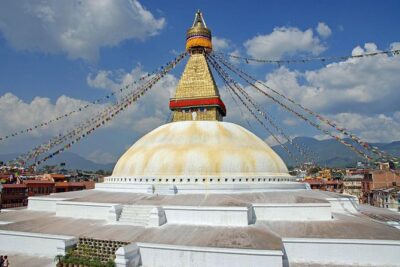
Private Half-Day Tour of Boudhanath and Pashupatinath Temples in Kathmandu
Read our review →
Kopan Monastery, Swayambhu and Boudha Nath Stupa Tour
Read our review →
Browse the lists this tour appears in