
Reviewed · ANNAPURNA TREKS
Annapurna Base Camp Trek – 11 Days
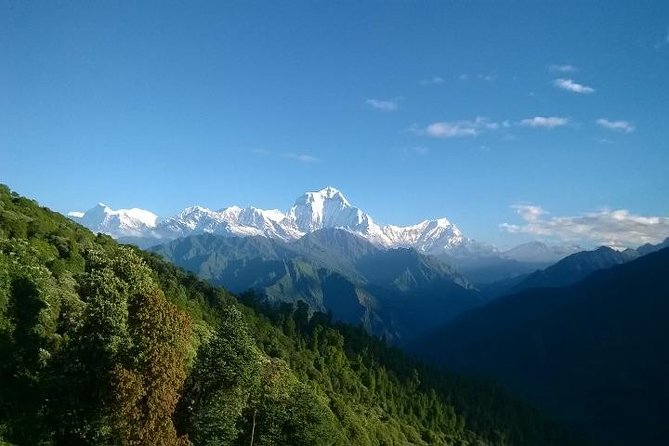
Annapurna Base Camp gives you a lot of Nepal in 11 days: terraced hills, rhododendron forest, stone stairways, ethnic villages, hot springs, and a high mountain bowl beneath Annapurna. The route also adds Poon Hill sunrise, one of the best early-morning views in the region, before leading you farther into the Modi Khola valley.
I like the practical package: permits, transport from Kathmandu, guesthouses, meals, a licensed English-speaking guide, porters’ support, a sleeping bag, down jacket, first-aid kit, and an oximeter are included. I also like the private-group setup, which gives you more say over walking pace and daily rhythm.
The main drawback is the pace. You walk uphill and downhill on many stone steps, and the itinerary repeats parts of the route after reaching base camp. At $986 per person, the price is reasonable for what is included, but you still need travel insurance, personal gear, drinks, and tips.
In This Review
- Key points to know before booking
- Why this 11-day route works so well
- Kathmandu to Pokhara: a scenic first day by bus
- Nayapul to Ghorepani: the first real test
- Poon Hill at sunrise: an early reward
- Jhinu Danda and the hot spring stop
- Forest trails from Sinuwa to Deurali
- Machhapuchhre Base Camp and Annapurna Base Camp
- Returning through the Modi Khola valley
- Nayapul to Pokhara, then back to Kathmandu
- What the $986 price includes
- Guide service and the human side of the trek
- Who should book this trek?
- Should you book the Annapurna Base Camp trek?
- FAQ
- Where does the Annapurna Base Camp trek start and end?
- How long is the experience?
- Is transport from Kathmandu included?
- What meals are included?
- What equipment is provided?
- Is this a private tour?
Key points to know before booking
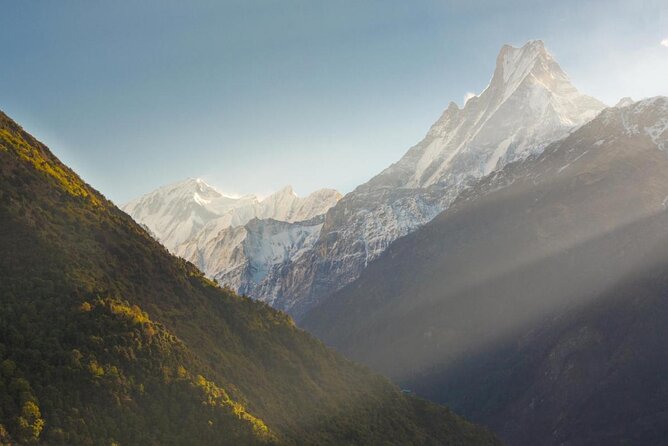
- Poon Hill comes early: You climb before sunrise for views of Annapurna, Dhaulagiri, Nilgiri, and Lamjung Himal.
- Annapurna Base Camp reaches 4,130 meters: The high point comes after Machhapuchhre Base Camp at 3,700 meters.
- Hot springs add a welcome break: Jhinu Danda appears more than once in the route plan, giving you a chance to soak tired legs.
- The package covers core trekking needs: Permits, meals, guesthouses, guide service, staff costs, sleeping bag, down jacket, and transport are included.
- You travel by road at both ends: The trip begins and ends with a tourist bus between Kathmandu and Pokhara.
- Guide names may vary: Prakash, Shiva, Naba, and Saroj Dhakal are among the guides named in arrangements connected with this trip.
Why this 11-day route works so well
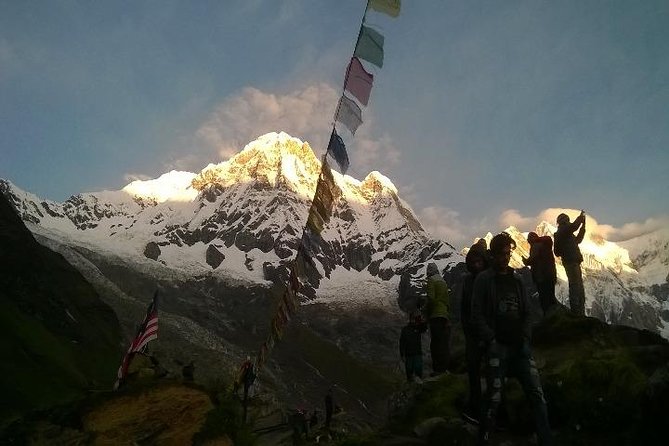
The Annapurna Base Camp route is a strong choice if you want a classic Himalayan trek without committing to a long expedition. You start among farms and villages, pass through thick forest, rise into colder mountain country, and finish below some of Nepal’s most famous peaks.
That variety matters. The trip is not only about arriving at a sign marked base camp. The route lets you see how the foothills change as you gain height, how villages serve trekkers along the way, and how a forest trail slowly gives way to rock, moraine, and snow.
The journey is also structured for a private group. That is useful if you are traveling with family or friends, or if you want a guide who can adjust the day to your group. Still, private does not mean easy. The itinerary asks you to walk for several days in a row, with steep stone stairs and repeated climbs.
You should have a moderate level of fitness. You do not need to be a mountaineer, but you should be comfortable walking uphill for hours, descending stairs, and carrying your personal day bag.
More Annapurna treks:
- Annapurna Circuit Trek with Tilicho Lake
★ 5.0 · 368 reviews - Annapurna base camp trek 5 Days
★ 5.0 · 252 reviews - Annapurna Base Camp Trek
★ 5.0 · 111 reviews
Kathmandu to Pokhara: a scenic first day by bus
The first day starts early, at 6:15 a.m., with breakfast followed by a tourist bus from Kathmandu to Pokhara. The road follows the Prithvi Highway, with views of rivers, terraced farms, villages, and small towns.
This transfer takes you from Nepal’s busy capital into the trekking region. It is not just a dull connection, though the road journey can be long and tiring. You get a useful first look at the countryside, and the changing scenery helps set the tone for the days ahead.
The activity begins and ends at the Kathmandu meeting point. Surface transport to and from Kathmandu is included, which saves you the trouble of arranging separate bus tickets or transfers. You should still expect an early start and keep your first day fairly light.
Nayapul to Ghorepani: the first real test
On Day 2, you drive from Pokhara to Nayapul, a trip of about two hours. From there, the walking begins. You cross a suspension bridge over the Modi River and continue toward Birethanti.
This opening section introduces the basic rhythm of the trek: bridges, villages, streams, stairs, and steady uphill walking. The route is not yet at its hardest altitude, but it quickly shows you that Annapurna Base Camp is a walking trip, not a sightseeing tour with short strolls.
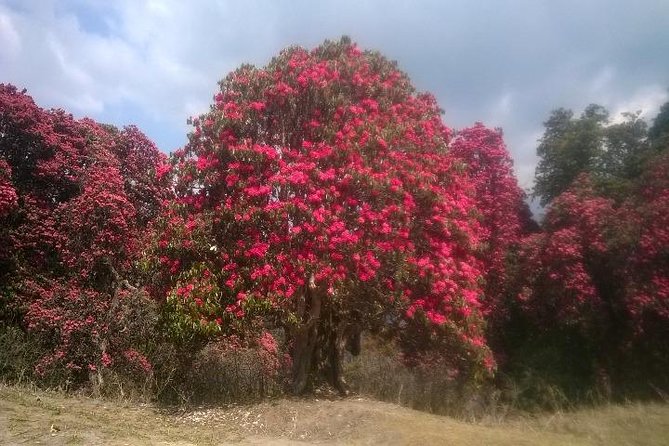
Day 3 leads through thick rhododendron forest toward Ghorepani. You pass Banthanti and Nangethanti, then climb stone stairs into the village. Rhododendron is Nepal’s national flower, and the forest becomes especially appealing when the trees are in bloom, although the exact conditions depend on the season.
Ghorepani is important because it places you near Poon Hill. The uphill finish can feel demanding after the previous day, so this is where pacing helps. Let your guide set a sensible rhythm, drink regularly, and do not burn all your energy trying to walk quickly.
Poon Hill at sunrise: an early reward
Day 4 begins with an early climb to Poon Hill. You may walk on snowy trails, depending on conditions, and the reward is a wide mountain view at sunrise.
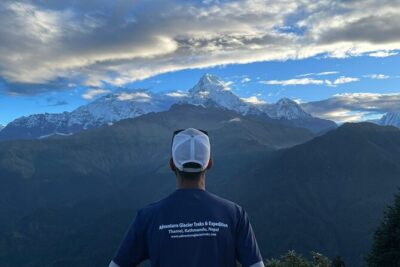
The peaks named in the route include Annapurna and Dhaulagiri, along with Nilgiri at 7,061 meters and Lamjung Himal at 6,983 meters. This is one of the most memorable visual moments of the trip because you see several major ranges together rather than waiting until base camp for your first big view.
After Poon Hill, the route continues through forest and mountain villages. You descend and climb again, so the sunrise is not the end of the day’s effort. Carry warm layers for the early start, then keep them easy to reach as the temperature changes.
Poon Hill also gives you a helpful preview of the larger trek. You see high peaks from a lower viewpoint, then spend the following days walking toward the mountain interior. If photography matters to you, keep your camera or phone protected and ready, but do not let the cold and early hour distract you from watching the light change on the peaks.
More treks starting in Kathmandu:
- Everest Base Camp Trek – 14 Days
★ 5.0 · 1,499 reviews - Everest Base Camp Trekking
★ 5.0 · 485 reviews - Nagarkot Sunrise View and Day Hiking from Kathmandu
★ 5.0 · 471 reviews - Everest Base Camp Trekking – 13 Day
★ 5.0 · 365 reviews
Jhinu Danda and the hot spring stop
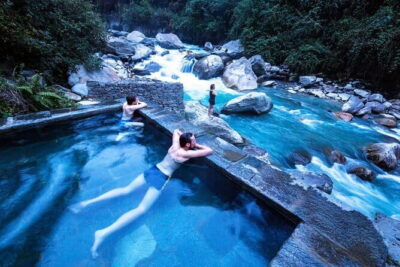
The route then heads toward Jhinu Danda. You ascend and descend through forest, cross the Kimrong Khola by suspension bridge, and reach the hot spring.
This is a smart rest point in the itinerary. After several days of stairs, a warm soak can help your legs before the route moves higher. The hot spring is not a substitute for rest, but it adds a simple local experience that breaks up the walking.
The approach to Jhinu Danda is not flat. You still need to climb and descend before reaching the water, and the trail includes stone steps. Keep your expectations realistic: the hot spring is a short stop within a demanding trek, not a full spa day.
From Jhinu Danda, the trail continues through the Chhomrong area. This section brings more village scenery and gives you a better feel for the settlements that support the route.
Forest trails from Sinuwa to Deurali
Day 6 is described as an easier walk, though easy is relative after several days in the hills. You pass through rhododendron forest with orchids and ferns, descend stone stairs, cross Chhomrong Khola, and climb toward Sinuwa.
This is a good day to pay attention to the plant life. The Annapurna route is not only a mountain-view walk. Its forests are a major part of the experience, and the changes in vegetation help you notice your rise in elevation.
The trail then continues toward Deurali. Expect more stairs and a mix of forest walking and open mountain views. The route gives you time to settle into a steady pace before the highest part of the trip.
You should ask your guide about the next day’s walking and make sure your water, warm layers, and headlamp are easy to reach. The included oximeter and first-aid kit are useful safety tools, though they do not replace good pacing or proper acclimatization.
Machhapuchhre Base Camp and Annapurna Base Camp
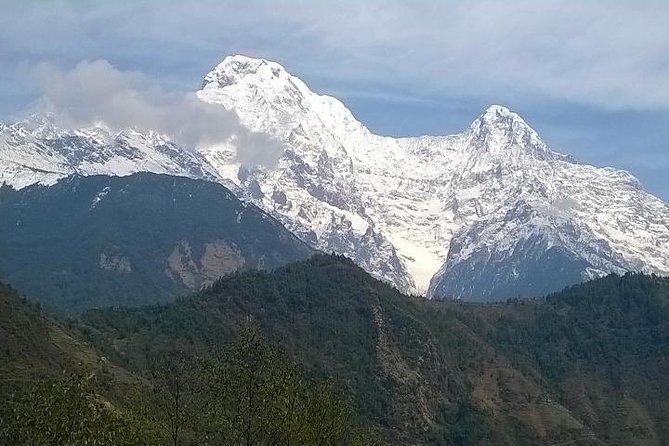
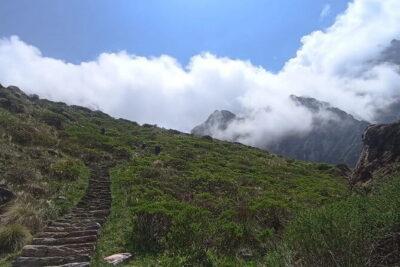
Day 7 is the main ascent toward the high mountain basin. You climb to Deurali, follow stone stairs, and reach Machhapuchhre Base Camp at 3,700 meters. From there, the trail follows the moraine toward Annapurna Base Camp.
Machhapuchhre, also called Fishtail, is one of Nepal’s most distinctive peaks. The route description places you among snow-capped mountains and rocky high-country terrain, a clear change from the forested lower trail.
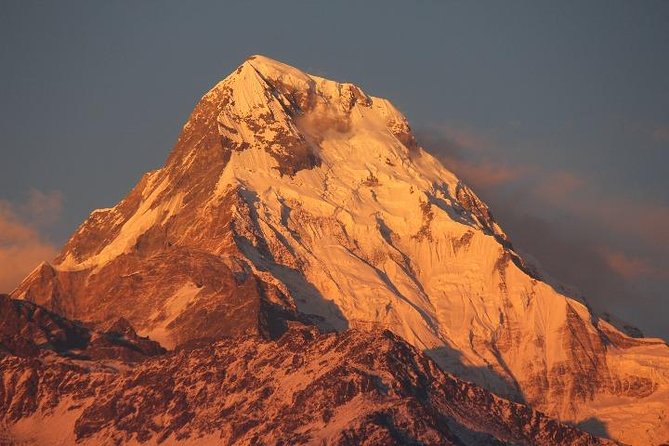
Annapurna Base Camp sits at about 4,130 meters. This is the highest and most exposed part of the itinerary, so the day deserves respect. The air is thinner, the weather can change, and the walk can feel slower than the distance suggests.
Your guide’s role matters most here. Guides named in the trip arrangements include Prakash, Shiva, Naba, and Saroj Dhakal, but your assigned guide may be different. The company provides a government-licensed English-speaking guide, trekking staff support, medicine, insurance for staff, and an oximeter to check oxygen saturation and heart rate.
You should not treat reaching base camp as a race. Take short breaks, watch for signs that you are struggling, and follow the guide’s instructions. The route is designed as a trek, not a technical climb, but altitude still makes the high section physically serious.
Returning through the Modi Khola valley
Day 8 begins with a descent from Machhapuchhre Base Camp through the moraine route. You follow the Modi Khola, passing back into rhododendron and fir forest.
The return is not simply an anticlimax. Descending lets you notice details you may have missed while climbing, and the scenery changes quickly as you leave the high rocks behind. It is also easier to appreciate the scale of the valley when you are moving back through it.
You continue toward Sinuwa, then on Day 9 climb through forest, descend to Chhomrong Khola, and climb the stone stairs to upper Chhomrong. After that, you descend to Jhinu Danda for another possible hot spring stop.
This repeated up-and-down pattern is one of the route’s less glamorous features. You gain and lose height several times, and tired knees may find the stairs harder on the way down than on the way up. Trekking poles would be useful, but personal trekking equipment is not included, so you need to bring or arrange your own.
Nayapul to Pokhara, then back to Kathmandu
On Day 10, you descend to Nayapul along the Modi Khola and drive to Pokhara. This closes the walking part of the trek and gives you an evening in the city, though the schedule says you may either rest or make your own plans.
That flexibility is welcome after the high route. Still, do not pack too much into the evening. The next morning begins early, with a tourist bus back to Kathmandu.
Day 11 repeats the highway journey in reverse, with greenery, villages, and river views along the way. On arrival in Kathmandu, the activity ends back at the meeting point.
The bus transfers are included, which improves the package value. They also mean the total trip is not 11 full days of walking. You have two substantial road-transfer days at the beginning and end, plus the drive between Pokhara and Nayapul.
What the $986 price includes
At $986 per person, this is a fairly complete trekking package rather than a bare guiding service. You receive:
- Surface transport to and from Kathmandu
- Guesthouse accommodation during the trek, mainly in twin-sharing rooms
- Nine lunches, eight dinners, and ten breakfasts
- Trekking permits and entry fees
- A licensed English-speaking guide
- Staff food, accommodation, salary, equipment, medicine, transport, and insurance
- A down jacket, sleeping bag, and duffel bag
- A route map
- An oximeter and first-aid medical kits
That list removes several costs that can quickly add up on a Himalayan trek. It also means you do not need to buy or carry a sleeping bag and down jacket, though you still need personal trekking equipment.
The exclusions are clear. Alcoholic drinks, hot and cold drinks, laundry, international airfare, airport departure tax, travel insurance, tips, and any unlisted expense are yours. You should budget for these before deciding that the headline price is your full trip cost.
Accommodation is mainly twin-sharing guesthouses, so do not book this expecting private hotel rooms throughout. The focus is practical shelter along the route, not luxury.
Guide service and the human side of the trek
The guide can shape the whole experience. The package includes an English-speaking local guide, and several names connected with the company’s trip arrangements include Prakash, Shiva, Naba, and Saroj Dhakal.
Prakash is repeatedly named in the supplied trip comments as a friendly and helpful guide, while Shiva and Naba are praised for handling the route to base camp and back. One solo trek arrangement specifically names Saroj Dhakal as the guide. These names are useful when you communicate with the operator, but they do not guarantee a particular assignment.
The company also provides porters and covers their food, accommodation, salary, equipment, medicine, transport, and insurance. That support matters on a route where a lighter day pack can make the stairs much easier.
There is one reason to keep your expectations balanced. A separate complaint describes an unprofessional guide, followed by a company response saying the trip was posted on the wrong company page and that the company had not organized that solo trek in the stated period. I would not treat that complaint as a clear judgment of this itinerary, but I would still confirm your guide’s name and the service details before departure.
Who should book this trek?
You should consider it if you want a private, guided Himalayan trek with a classic route, a clear 11-day structure, and many major costs bundled together. It suits people who value mountain scenery but also want villages, forest, suspension bridges, and a hot spring stop.
It is a good fit for first-time long-distance trekkers who have moderate fitness and want organized support. The guide, permits, staff, medical kit, and included equipment remove much of the planning work.
You may want a different trip if you dislike early mornings, long bus rides, shared guesthouses, repeated stairs, or basic mountain accommodation. You should also think carefully if you need a flexible schedule, since the itinerary is packed and weather can affect the plan.
Confirmation is provided at booking. The activity depends on good weather, and a weather cancellation offers a different date or full refund. You can cancel for a full refund up to 24 hours before the start time, but changes or cancellations inside that window are not accepted.
Should you book the Annapurna Base Camp trek?
I would book this trek if you want a well-supported route that combines Poon Hill sunrise with Annapurna Base Camp and you are comfortable with a demanding walking schedule. The $986 price has good value because it includes transport, meals, lodging, permits, guide service, staff support, and useful cold-weather gear.
Before paying, confirm the exact meeting arrangements, guide assignment, room setup, what personal equipment you must bring, and the likely transport schedule. If you prepare for stone stairs, high altitude, early starts, and simple guesthouses, this trip gives you a strong first taste of Nepal’s Himalayan trails.
FAQ
Where does the Annapurna Base Camp trek start and end?
The activity starts in Kathmandu at the listed meeting point at 6:15 a.m. It ends back at the same Kathmandu meeting point after the return bus from Pokhara.
How long is the experience?
The trek lasts approximately 11 days. The schedule includes road transfers between Kathmandu and Pokhara, plus drives between Pokhara and Nayapul.
Is transport from Kathmandu included?
Yes. Surface transfer from and to Kathmandu is included. The itinerary uses tourist buses for the Kathmandu to Pokhara and Pokhara to Kathmandu journeys.
What meals are included?
The package includes 10 breakfasts, nine lunches, and eight dinners. Alcoholic drinks and hot and cold drinks are not included.
What equipment is provided?
A down jacket, sleeping bag, duffel bag, route map, first-aid medical kit, and oximeter are provided. Personal trekking equipment is not included.
Is this a private tour?
Yes. Only your group participates in the activity. A local government-licensed English-speaking trekking guide accompanies the trek.
Recently added around Kathmandu
- Kathmandu : Swambhunath & Durbar Square Guided Half Day Tour★ 3.3 · 3 reviews
- Private Day Tour in Kathmandu Valley Rim with Bhaktapur Sightseeing★ 5.0 · 3 reviews
- From Kathmandu / Pokhara / Chitwan: River Rafting – 1 Day★ 4.6 · 3 reviews
- Nepali Cooking training & Cultural Homestay Experience★ 5.0 · 3 reviews
- Private 3-Hour Nagarkot Sunset Tour from Kathmandu★ 3.5 · 3 reviews
- From Kathmandu: Everest Base Camp Landing Helicopter Tour★ 5.0 · 3 reviews
- 4 UNESSCO World heritage sites of Kathmandu-private tour★ 5.0 · 3 reviews
- Kailashnath Mahadev, Panauti and Namo Buddha Monastery Sightseeing★ 5.0 · 3 reviews
Annapurna Treks, compared.
Kathmandu to Annapurna Base Camp (ABC) 5-Day Trek
Read our review →
Browse the lists this tour appears in