
Reviewed · ANNAPURNA TREKS
12 days Annapurna Circuit Trek
The big draw here is the full Annapurna Circuit in 12 days, from river valleys and rhododendron forest to the dry high country of Manang and Mustang, then down to hot springs and the sunrise at Poon Hill. I like the useful mix of trekking, local villages, and road transport, and I like that permits, meals, lodging, and most transfers are bundled into the price.
I also like the private format. Your group travels with its own guide, and the trip can be adjusted to suit your needs. Guides connected with the operator include Bhim, Manit, and Kumar, though you should confirm who will lead your departure.
The main concern is the pace. Several days are listed at 10 to 12 hours, and the Thorong La crossing begins around 3 a.m. Porters cost extra, insurance is not included, and the first and last road journeys can be long and tiring.
In This Review
- Key points to know before booking
- A full circuit from Dharapani to Poon Hill
- Day 1: Kathmandu to Dharapani by road
- Day 2: Dharapani to Chame
- Day 3: Chame to Upper Pisang at 3,300 meters
- Day 4: Upper Pisang to Manang through Geru
- Day 5: Acclimatization around Manang
- Day 6: Manang to Yak Kharka
- Day 7: Yak Kharka to Thorung Phedi
- Day 8: Thorong La to Muktinath
- Day 9: Muktinath to Tatopani
- Day 10: Tatopani to Ghorepani
- Day 11: Poon Hill and Pokhara
- Day 12: Pokhara to Kathmandu
- What the $1,100 price really covers
- Guides, group style, and practical fit
- Should you book this Annapurna Circuit Trek?
- FAQ
- How long is the Annapurna Circuit Trek?
- How much does the trek cost?
- Is transportation included?
- Are meals included?
- Is accommodation included?
- Is a porter included?
- Are permits and insurance included?
- What fitness level is required?
Key points to know before booking
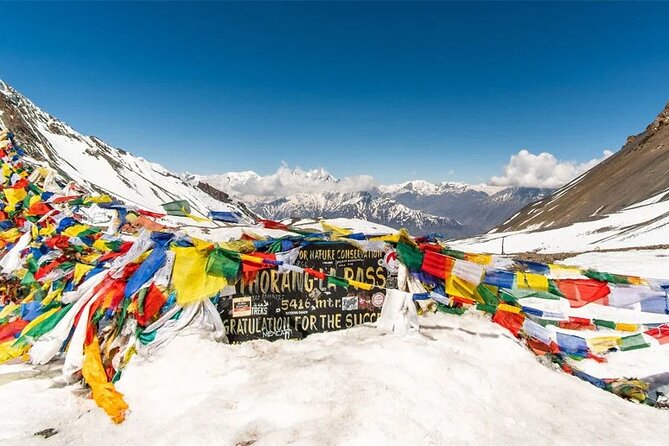
- Thorong La is the high point: You cross the 5,416-meter pass on Day 8 after staying at Thorung Phedi.
- The scenery changes fast: Expect green river valleys, pine and rhododendron forests, dry mountain country, and the Kali Gandaki region.
- Acclimatization is built in: Day 5 is spent around Manang, with an optional walk toward Ice Lake.
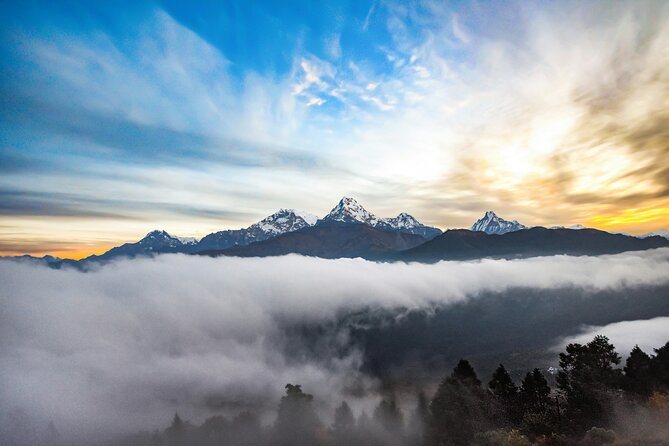
- Poon Hill adds a sunrise finish: The 3,210-meter viewpoint brings views of Dhaulagiri, Annapurna, and Machhapuchhre.
- The $1,100 price covers much of the basics: Lodging, most meals, permits, guide costs, and stated transportation are included.
- You need reasonable fitness: Long walking days, high altitude, rough roads, and an early pass crossing are part of the deal.
A full circuit from Dharapani to Poon Hill
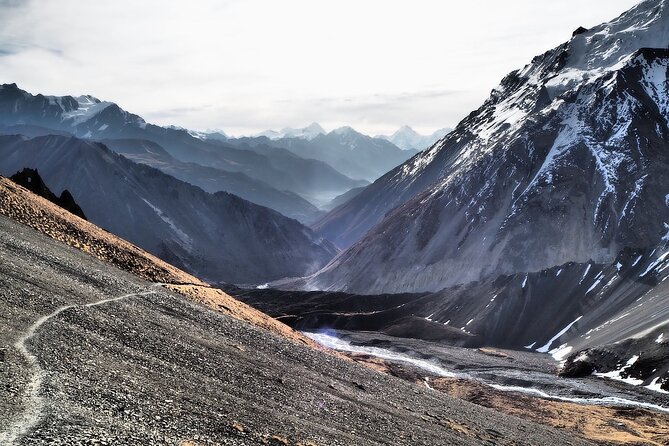
This is not a short scenic walk with a few mountain viewpoints. It is a serious high-altitude trek that also includes long road transfers. In 12 days, you travel from Kathmandu to Dharapani, walk through the Manang side of the Annapurna range, cross Thorong La, descend through Muktinath and Tatopani, then climb again to Ghorepani and Poon Hill before reaching Pokhara.
That route gives you a strong sense of Nepal’s changing regions. You see Buddhist-influenced mountain villages around Manang and Muktinath, Thakali settlements near Tatopani and Ghorepani, and the sharp contrast between the wet southern slopes and the dry country north of the pass.
The private setup matters. You are not tied to the needs of a large group, and the operator says the itinerary can be customized. Group discounts are also available. Still, customization should not be confused with a relaxed schedule. The fixed route packs a lot into 12 days.
More Annapurna treks:
- Annapurna Circuit Trek with Tilicho Lake
★ 5.0 · 368 reviews - Annapurna base camp trek 5 Days
★ 5.0 · 252 reviews - Annapurna Base Camp Trek
★ 5.0 · 111 reviews
Day 1: Kathmandu to Dharapani by road
The opening transfer is a long one. You drive from Kathmandu toward Besishahar beside the Trishuli River, then change to a jeep for the rougher road to Dharapani. The total day is listed at about 12 hours.
This arrangement gets you farther into the circuit on the first day, saving walking time later. It also means your first taste of the route is more road than trail. The switch from public transportation to jeep is practical because the road beyond Besishahar is less straightforward.
The listed start time is 12:15 a.m., which is unusually early. Confirm the exact pickup arrangement before departure, including where you meet and which section of the journey uses public transportation. A day this long is easier if you know the plan in advance.
Day 2: Dharapani to Chame
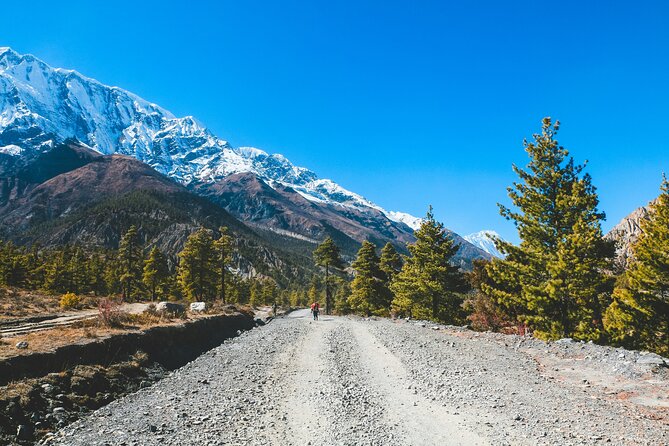
The walk to Chame brings the first clear change in altitude and scenery. You pass through rhododendron forest and begin to see the mountains more closely as the trail follows the upper Marshyangdi area.
Chame is the administrative center of Manang District. Reaching it gives the trek a practical milestone, but the value of this day is the gradual shift from lower river country toward the high valleys ahead.
The itinerary again allows about 12 hours. That figure may include stops and transport details, but you should still treat this as a demanding day. Keep your daypack light, carry water, and do not assume every walking day will feel like a gentle village stroll.
Day 3: Chame to Upper Pisang at 3,300 meters
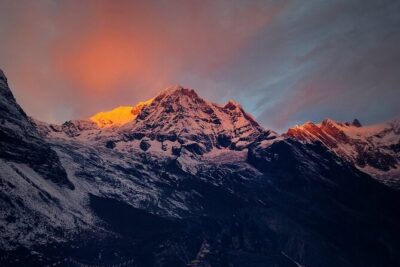
Upper Pisang is listed at about 3,300 meters, and this is where altitude becomes a real part of the trip. The route offers views of Lamjung Himal, including the first light on the peak, and the setting becomes more open as you gain height.
Upper Pisang is especially appealing if you want the mountain villages to feel like part of the trip rather than just overnight stops. You are beginning to move into the high section of the circuit, where the air is colder and drier and the peaks feel much closer.
This day is listed at about 10 hours. Because the schedule rises steadily, follow the guide’s advice on pace. The point is not to race uphill. A steady walk gives your body a better chance to adjust before Manang and the pass.
More treks starting in Kathmandu:
- Everest Base Camp Trek – 14 Days
★ 5.0 · 1,499 reviews - Everest Base Camp Trekking
★ 5.0 · 485 reviews - Nagarkot Sunrise View and Day Hiking from Kathmandu
★ 5.0 · 471 reviews - Everest Base Camp Trekking – 13 Day
★ 5.0 · 365 reviews
Day 4: Upper Pisang to Manang through Geru
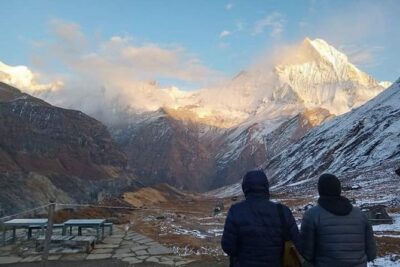
The route passes through Geru, where the views open toward Annapurna II, Annapurna III, Annapurna IV, Gangapurna, Tilicho, and Pisang Peak. This is one of the strongest mountain-view days on the itinerary.
The change in air is part of the story. It becomes colder and drier, and the route moves farther from the lower valley feel of the opening days. Manang is a key stop because it is both a substantial mountain settlement and the base for acclimatization.
The day is listed at about 10 hours. You should expect a full day on foot, with the reward of a high mountain setting at the end. Manang is not simply a place to sleep before the pass. It is where the schedule gives you time to adjust.
Day 5: Acclimatization around Manang
The fifth day stays in Manang. The plan suggests a walk toward Ice Lake to help with acclimatization, with views toward Annapurna III and Gangapurna.
This rest day is one of the smartest parts of the program. At altitude, staying put does not mean wasting time. A moderate outing followed by a night at the same elevation can be more useful than pushing higher every day.
The description lists up to 12 hours, but the exact effort depends on how far you walk. Ask the guide how the day will be handled for your group. The schedule calls it an acclimatization day, so you should not feel pressured to turn it into a race.
Day 6: Manang to Yak Kharka
You leave Manang and pass Tenki before moving northwest into the Jarsang Khola valley. The trail crosses a stream and continues upward, leaving the Marshyangdi Valley behind.
Yak Kharka is a high stopping point before Thorung Phedi. This day may look short on a map, but altitude changes the effort. The route is listed at about 12 hours, so it deserves a careful pace and warm layers.
The value of this section is the transition into the pass approach. Villages become fewer, the air is thinner, and the following day brings you to Thorung Phedi. You are no longer simply walking between settlements. You are preparing for the hardest part of the crossing.
Day 7: Yak Kharka to Thorung Phedi
The route rises to a ridge, drops toward the Marsyangdi River, crosses a wooden bridge, and climbs again to Thorung Phedi, the base of Thorong La Pass.
This is a preparation day rather than a summit day. The short descent and later climb can feel frustrating, but mountain routes do not always go directly upward. Arriving at Thorung Phedi gives you the best position for an early crossing the next morning.
Again, the day is listed at about 12 hours. Keep your essentials close, since you may need warm clothing, water, snacks, and a headlamp for the next morning. The operator does not list personal snacks or drinks as included, so budget for those separately.
Day 8: Thorong La to Muktinath
This is the defining day. You wake at about 3 a.m. and climb to Thorong La, one of the highest pass crossings in the world, at roughly 5,416 meters. From the top, you descend toward Muktinath.
The early start is meant to help you cross before later conditions become more difficult, but it also makes this the most demanding day of the trek. The route combines thin air, cold, darkness at the start, and a long descent. You need a moderate level of fitness at minimum, and personal travel insurance is strongly advisable, though it is not part of the package.
Muktinath gives you a major change of setting after the pass. It is associated with both Hindu and Buddhist traditions, and the move from the high pass into the Mustang side makes this day feel like more than a physical achievement.
Day 9: Muktinath to Tatopani
After the pass, you take a jeep for roughly three hours from Muktinath to Tatopani. The road transfer saves your legs after the hardest day, though road travel in the mountains can be less comfortable than walking.
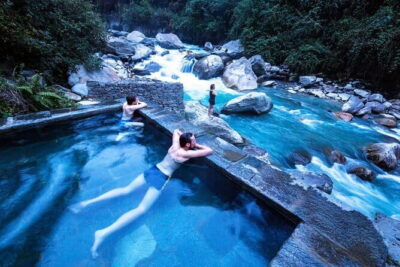
Tatopani is known for its hot springs, and the plan leaves time to rest at the lodge or swim. This is a welcome recovery stop. If you have spent the previous day climbing and descending for many hours, a slower afternoon can make the rest of the route more enjoyable.
Transport is included for this section, but drinks and personal expenses are not. Bring cash for small purchases, laundry, telephone use, tips, and similar costs.
Day 10: Tatopani to Ghorepani
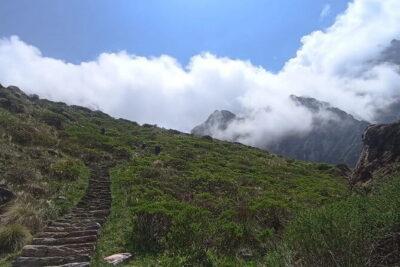
The trail climbs from Tatopani through the Thakali settlements of Sikha and Chitre before reaching Ghorepani. You cross toward the east side of the Kali Gandaki River and return to a more forested mountain setting.
This is a demanding reversal after the road ride and hot springs. You are descending from the high pass region, but the route to Ghorepani climbs again. The reward is a classic ridge walk toward one of Nepal’s best-known sunrise viewpoints.
The day is listed at about 12 hours. If your knees are tired after Thorong La, the combination of stairs and uphill walking may be a surprise. This is one reason the 12-day schedule suits fit trekkers more than people looking for a leisurely mountain holiday.
Day 11: Poon Hill and Pokhara
The early morning walk to Poon Hill reaches 3,210 meters. From the viewpoint, you can see Dhaulagiri, the Annapurna range, Machhapuchhre, and other major peaks at sunrise.
The viewpoint visit itself is listed as about one hour, but you should count the approach and return to Ghorepani as part of the morning. Sunrise requires another early start, yet it provides a strong final mountain moment after the pass crossing.
Later, you trek from Ghorepani to Birethanti and take a bus to Pokhara. One night in Pokhara with breakfast is included. This is a useful end point because you get a proper city stop after days in lodges, along with the chance to enjoy Pokhara’s lake setting before returning to Kathmandu.
Day 12: Pokhara to Kathmandu
Breakfast is followed by a tourist bus to Kathmandu. The package also allows you to choose a 25-minute flight, but that flight is not included and costs extra.
The bus keeps the listed price lower, while the flight saves time. Ask about the current flight cost before deciding. Either way, this final transfer means the tour ends with transportation rather than another trek day.
What the $1,100 price really covers
At $1,100 per person, the package has good value if you want the main costs handled in advance. It includes teahouse or lodge accommodation during the trek, breakfast, lunch, and dinner while trekking, a night in Pokhara with breakfast, the stated transportation, an English-speaking government-licensed guide, and guide expenses such as salary, lodging, meals, insurance, and transport.
The Annapurna Conservation Area Permit and TIMS card are included, as are government and local taxes. A farewell dinner in Kathmandu is also part of the package.
You still need to allow money for:
- Alcoholic and non-alcoholic drinks
- Tips and personal purchases
- Laundry, telephone, and camera or video fees
- Nepal visa fees
- Personal travel insurance
- Porter service, listed at $20 per day for up to 20 kilograms
- The optional flight from Pokhara to Kathmandu
The porter charge is worth considering. Carrying your own gear for long days and at altitude can change the feel of the trek. If you use a porter, clarify how the 20-kilogram limit applies and what luggage arrangement is provided.
Guides, group style, and practical fit
This is a private tour, so only your group participates. That is useful for couples, families, and small friend groups who want more control over pace and stops. The operator presents the trip as customizable and offers group discounts.
The company team includes Bhim, Manit, and Kumar. Manit is associated with detailed online planning and quick replies to questions about equipment and the itinerary, while Bhim is involved in guiding and hosting. Confirm the name and role of your own guide before you pay, since the information does not promise a particular person on every departure.
The tour requires moderate physical fitness. That phrase should be taken seriously. You face multiple 10 to 12-hour days, steep gains and descents, altitude above 5,000 meters, an early start, and road transfers that may be tiring in their own way.
The package says service animals are allowed and that the route is near public transportation. Those details do not make the trek easy or fully accessible. The terrain and altitude remain the main practical factors.
Should you book this Annapurna Circuit Trek?
I would choose this trip if you want the classic circuit in a tight 12-day format, prefer a private guide, and value having permits, meals, lodging, and major transport included. The route gives you the pass, Manang, Muktinath, Tatopani, Ghorepani, and Poon Hill rather than focusing on only one section.
I would hesitate if you want short walking days, guaranteed comfort, or a slow acclimatization schedule. Ask specific questions about the 12:15 a.m. start, guide assignment, road conditions, porter arrangements, and options for adjusting the pace.
For a fit trekker who wants a practical package with a strong mix of mountain scenery and village life, this is a sensible choice. Just budget beyond the headline price, carry proper insurance, and treat Thorong La as a serious mountain crossing rather than a sightseeing stop.
FAQ
How long is the Annapurna Circuit Trek?
The experience lasts approximately 12 days, beginning with travel from Kathmandu to Dharapani and ending with transport from Pokhara back to Kathmandu.
How much does the trek cost?
The listed price is $1,100 per person. Group discounts are available.
Is transportation included?
Yes. The package includes Kathmandu to Dharapani by public transportation, Muktinath to Tatopani by jeep, Nayapul to Pokhara transportation, and a tourist bus from Pokhara to Kathmandu. A 25-minute flight from Pokhara to Kathmandu is optional and costs extra.
Are meals included?
Breakfast, lunch, and dinner are included during the trek, along with breakfast at the included Pokhara accommodation. Drinks are not included.
Is accommodation included?
Yes. Teahouse or lodge accommodation with meals is included during the trek, plus one night in Pokhara with breakfast.
Is a porter included?
No. Porter service is available for $20 per day and carries up to 20 kilograms.
Are permits and insurance included?
The Annapurna Conservation Area Permit and TIMS card are included. Guide insurance is covered, but personal travel insurance is not included.
What fitness level is required?
The activity states that you should have a moderate physical fitness level. The route includes several 10 to 12-hour days, high-altitude walking, and the Thorong La crossing, which begins around 3 a.m.
Recently added around Kathmandu
- Kathmandu : Swambhunath & Durbar Square Guided Half Day Tour★ 3.3 · 3 reviews
- Private Day Tour in Kathmandu Valley Rim with Bhaktapur Sightseeing★ 5.0 · 3 reviews
- From Kathmandu / Pokhara / Chitwan: River Rafting – 1 Day★ 4.6 · 3 reviews
- Nepali Cooking training & Cultural Homestay Experience★ 5.0 · 3 reviews
- Private 3-Hour Nagarkot Sunset Tour from Kathmandu★ 3.5 · 3 reviews
- From Kathmandu: Everest Base Camp Landing Helicopter Tour★ 5.0 · 3 reviews
- 4 UNESSCO World heritage sites of Kathmandu-private tour★ 5.0 · 3 reviews
- From Kathmandu Budget: 15 Day Everest Base Camp Trek★ 5.0 · 3 reviews
Annapurna Treks, compared.
Kathmandu to Annapurna Base Camp (ABC) 5-Day Trek
Read our review →
Browse the lists this tour appears in