
Reviewed · ANNAPURNA TREKS
Annapurna Base Camp Trekking
Annapurna Base Camp is the prize here, but the best part is the gradual change from Kathmandu’s sacred sites to stone steps, rhododendron forests, glacial valleys, and high mountain views. You get the big Himalayan experience without arranging every hotel, permit, meal, transfer, and porter yourself.
I like the private guide setup, which gives your group room to adjust the pace and itinerary. I also like the smart route design: Poon Hill adds an early mountain viewpoint, while Jhinu Danda’s hot spring gives your legs a pleasant break near the end.
The main caution is that this is sold as roughly 14 to 15 days, and a few itinerary details do not line up perfectly. You should confirm the exact overnight stops, departure times, and what is covered before paying, especially since city lunches and dinners, drinks, hot water, and some fees are extra.
In This Review
- Key points to know before you book
- Kathmandu begins with sacred places, not a rushed checklist
- The six-hour coach ride to Pokhara sets the pace
- Nayapul to Ulleri introduces the Annapurna trail
- Ghorepani and Poon Hill deliver the first great mountain view
- Tadapani to Chhomrong brings steep steps and village life
- Bamboo, Dovan, and Deurali mark the high valley
- Annapurna Base Camp is the trip’s high point
- The return route uses Bamboo and Jhinu for recovery
- What the $899 price really covers
- Who will enjoy this private trek most
- Should you book the Annapurna Base Camp Trek?
- FAQ
- How long does the Annapurna Base Camp tour last?
- What fitness level is required?
- Are meals included?
- Is transportation included?
- Are guides and porters included?
- Which permits are included?
- What is not included in the trek price?
Key points to know before you book
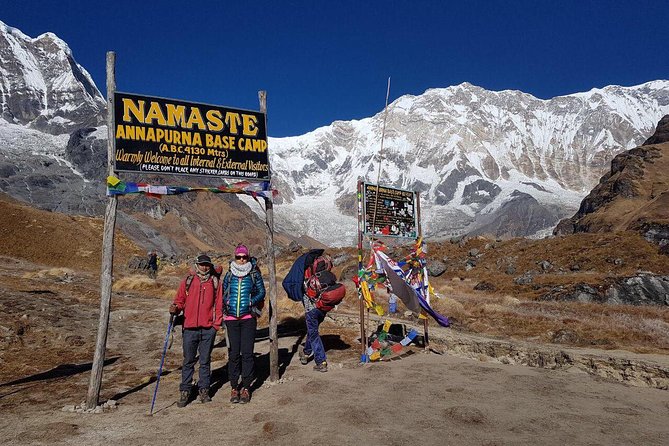
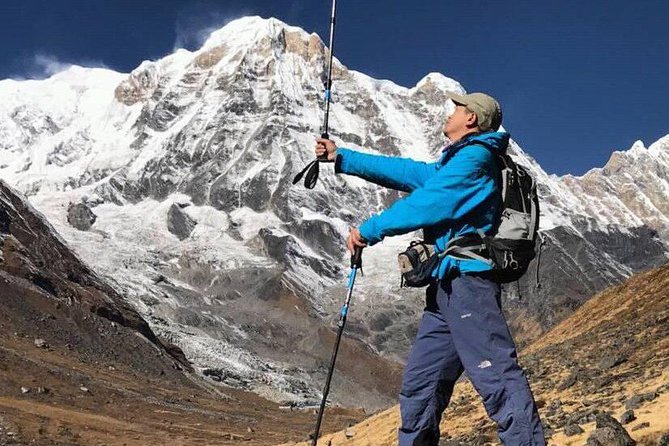
- Annapurna Base Camp at about 4,130 meters: The trek reaches the high mountain amphitheater after several days of steady walking and altitude gain.
- Poon Hill sunrise at 3,210 meters: An early uphill walk from Ghorepani adds wide views of the Annapurna and Dhaulagiri ranges.
- Four UNESCO World Heritage sites in Kathmandu: You visit Pashupatinath, Boudhanath, Patan Durbar Square, and Swayambhunath before heading into the mountains.
- Private support from airport to trail: Transfers, an English-speaking guide, porters, permits, and tourist-coach transport are arranged.
- Teahouse nights and local meals: Breakfast, lunch, and dinner are included during the trek, while hotel stays in Kathmandu and Pokhara include breakfast.
- A moderate fitness test: Expect several hours of walking most days, with steep stone steps, descents, cold forest sections, and a high-altitude finish.
Kathmandu begins with sacred places, not a rushed checklist
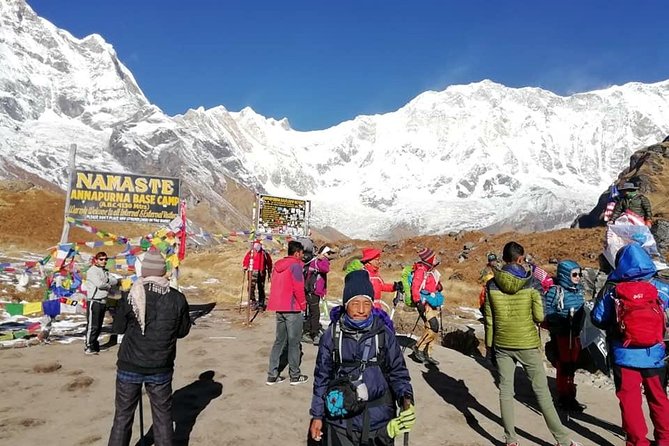
Your first day is simple. A representative meets you at Tribhuvan International Airport and takes you to your hotel in Kathmandu, at about 1,300 meters. That airport pickup matters after a long flight, since it removes one of the first hassles of arriving in Nepal.
Day two covers four major sights. At Pashupatinath, you see one of the country’s most important Hindu temples beside the Bagmati River. Non-Hindu visitors cannot enter the main temple, but the surrounding complex still offers a close look at ritual life and religious architecture.
Boudhanath Stupa is a different experience. Its large white dome and watchful Buddha eyes create a calmer setting, with Buddhist practice visible around the monument. The supplied description places it about six kilometers east of central Kathmandu and notes its height of roughly 36 meters.
Patan Durbar Square brings carved palace buildings, courtyards, pagoda temples, and a museum of bronze statues and religious objects. The stone Krishna Temple is a particular highlight. Swayambhunath, often called the Monkey Temple, sits on a hill above the valley and gives you a strong city view along with Buddhist shrines and plenty of monkeys.
You also use this day to prepare for the trek. That is useful, since the next morning starts early. Entrance fees for sightseeing are not included, so keep extra Nepalese rupees available.
More Annapurna treks:
- Annapurna Circuit Trek with Tilicho Lake
★ 5.0 · 368 reviews - Annapurna base camp trek 5 Days
★ 5.0 · 252 reviews - Annapurna Base Camp Trek
★ 5.0 · 111 reviews
The six-hour coach ride to Pokhara sets the pace
On day three, staff escort you from your hotel to the tourist bus station. The bus is scheduled to leave around 7:00 or 7:30 in the morning, and the drive to Pokhara takes about six to eight hours depending on the stated schedule.
Pokhara is a welcome change from Kathmandu. It sits beside Phewa Lake and is known for views toward Annapurna, Machapuchare, Dhaulagiri, Lamjung Himal, and Manaslu. The town serves as the staging point for the trek, not just a place to sleep.
The tourist coach keeps the price down, but it is not the fastest way to cross Nepal. If you dislike long road days, this is the first major tradeoff. The tour provides tourist-coach transport between Kathmandu and Pokhara, so the arrangement is clear, but the ride will take a substantial part of your day.
The package includes a three-star category hotel in Pokhara with breakfast. Lunch and dinner in Pokhara are not included, giving you freedom to choose, but adding a small cost that is easy to overlook when comparing tour prices.
Nayapul to Ulleri introduces the Annapurna trail
On day four, a private vehicle takes you from Pokhara to Nayapul, where the walking begins. The first section follows the Modi Khola toward Birethanti, a large village at about 1,015 meters with shops and teahouses.
The route then follows the Bhurungdi Khola toward Hille and Tikhedhunga. The stated walking time is about five to seven hours, though the stop description also calls the day closer to six hours. Either way, this is a manageable opening day, with the trail gradually preparing you for the harder climbs ahead.
The route reaches Ulleri, a large Magar village, at about 2,070 meters. The climb includes many stone steps, and this is where the trek begins to feel like a real physical undertaking rather than a scenic walk.
Ghorepani and Poon Hill deliver the first great mountain view
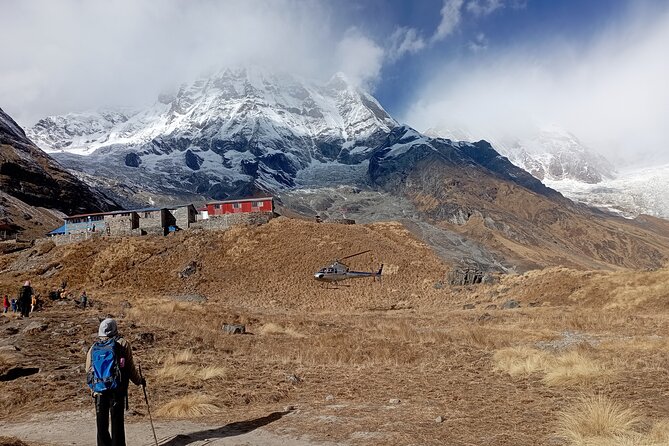
Day five takes you from Ulleri toward Ghorepani. The trail climbs through oak and rhododendron forest, passing Banthanti and Nangethanti before reaching Ghorepani at roughly 2,750 to 2,840 meters, depending on the itinerary figure used.
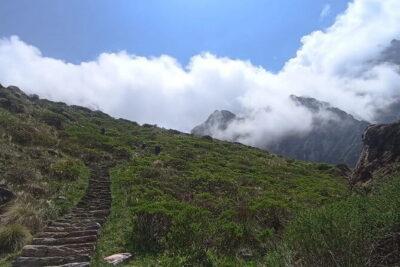
The day lasts about four to five hours. The forests are a major part of the appeal, especially in spring when rhododendrons may flower. The uphill work is steady rather than technical, but the earlier stone steps can make your legs feel the altitude.
Day six begins early with the climb to Poon Hill, at 3,210 meters. You go up in time for sunrise, then return to Ghorepani for breakfast before continuing to Tadapani.
Poon Hill is one of the most rewarding viewpoints on this route because it gives you a broad mountain scene without requiring a separate high pass crossing. The route description names Annapurna, Dhaulagiri, Mustang, Pokhara, and more than 20 high peaks among the views.
You should take the early start seriously. It is about an hour uphill before sunrise, followed by a six to seven-hour day that includes the return to Ghorepani and the walk through forest, waterfalls, and ridges to Tadapani. This is a full day, not just a sunrise outing.
More treks starting in Kathmandu:
- Everest Base Camp Trek – 14 Days
★ 5.0 · 1,499 reviews - Everest Base Camp Trekking
★ 5.0 · 485 reviews - Nagarkot Sunrise View and Day Hiking from Kathmandu
★ 5.0 · 471 reviews - Everest Base Camp Trekking – 13 Day
★ 5.0 · 365 reviews
Tadapani to Chhomrong brings steep steps and village life
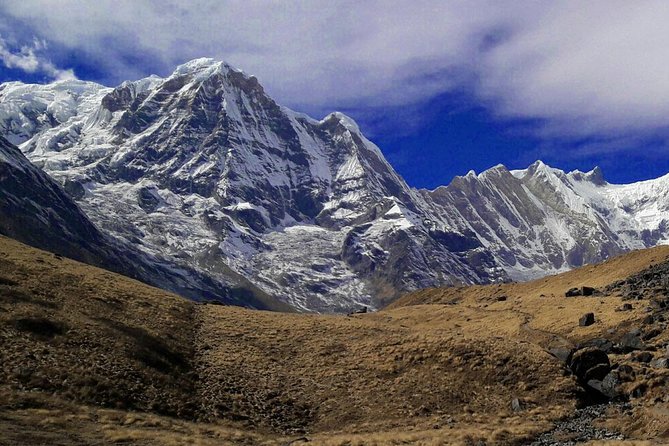
The trail from Tadapani to Chhomrong descends through rhododendron forest, then opens onto terraced fields. You pass waterfalls and a suspension bridge before tackling more uphill and downhill sections.
Chhomrong sits at about 2,170 meters beneath the Annapurna massif. It is one of the route’s key villages, and the five to six-hour day gives you time to settle in before the path enters the narrower Modi Khola valley.
This section shows why moderate fitness is required. The walking is not described as technical mountaineering, but repeated steps and changes in grade can be tiring. A private guide can help set a pace that works for your group, which is a real advantage over a fixed large-group departure.
Bamboo, Dovan, and Deurali mark the high valley
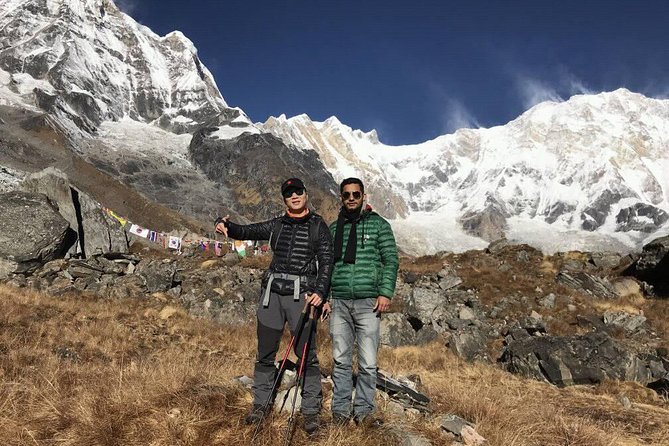
From Chhomrong, the route heads through damp bamboo forest toward Dovan. The forest can feel cold and shaded, and the trail rises and falls through sections that are sometimes steep.
After Himalaya Hotel, the forest opens and you get views toward the river and surrounding cliffs. The route continues through drier woodland and past Hinku Cave before descending to a river and climbing again to Dovan.
The planned walking time is five to six hours. Vegetation becomes thinner as you gain altitude, while waterfalls, cliffs, and the glacial river become more prominent. This is a quieter, more enclosed part of the trek, with fewer broad village views but a stronger sense of entering the high valley.
Day nine continues toward Deurali in about five to six hours. The path follows the valley, sometimes beside a rocky cliff, and climbs steadily. The trail description says the route becomes steep in places and later reaches Machhapuchhre Base Camp before the final approach.
The schedule has a labeling problem here. One version lists Deurali as the stop for both day nine and day ten, while the detailed plan clearly intends day ten to be the Annapurna Base Camp day. Ask for the final accommodation plan before departure.
Annapurna Base Camp is the trip’s high point
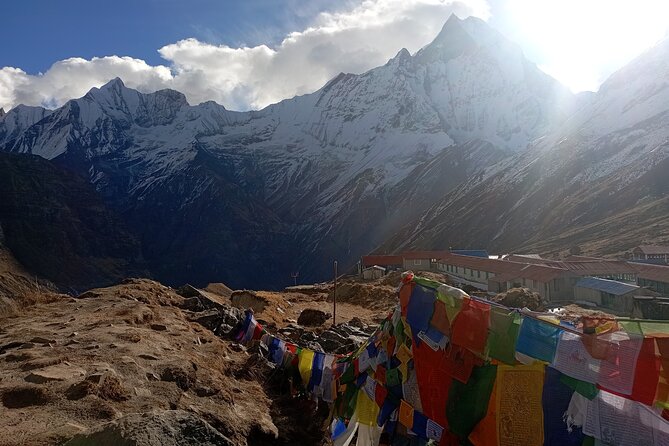
The approach to Annapurna Base Camp is the part most people are coming for. From Deurali, the route climbs toward Machhapuchhre Base Camp and then continues to Annapurna Base Camp, with an estimated walking time of five to seven hours.
At about 4,130 meters, Annapurna Base Camp is high enough for altitude to matter. The itinerary calls for a moderate fitness level, but that phrase should not be read as easy. You need to handle long uphill sections, cold conditions, thinner air, and several consecutive days on foot.
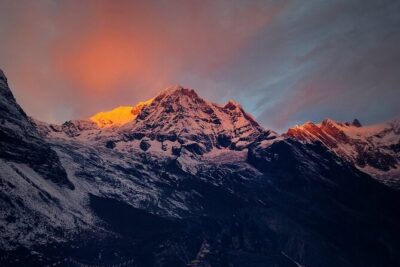
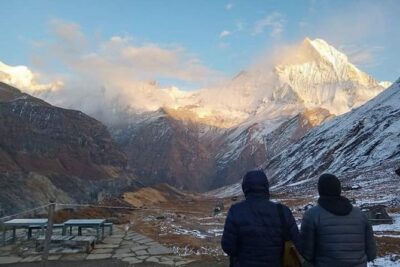
The setting changes quickly as the trail leaves the thicker forest behind. Rock, snow, glacier views, and the surrounding mountain walls become the focus. Annapurna I is the world’s tenth-highest mountain, and the base camp gives you a close mountain setting rather than a distant viewpoint.
The itinerary does not list a separate acclimatization day at altitude. That makes pacing important. Follow your guide’s advice, walk slowly, drink regularly, and tell the guide at once if you feel unwell. The package includes guide support, porter support, permits, and teahouse lodging, but it does not list bottled or boiled water as included.
The return route uses Bamboo and Jhinu for recovery
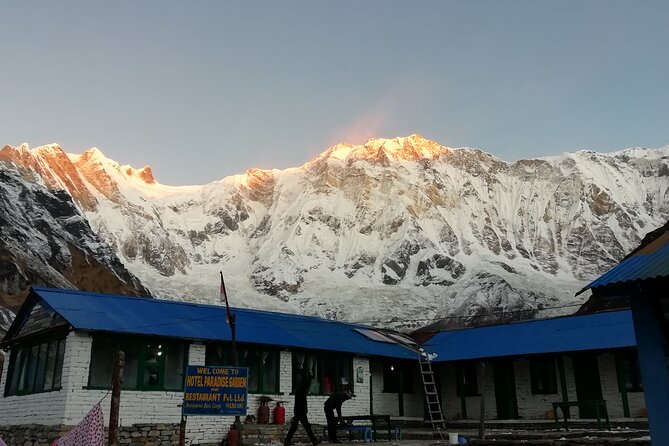
Day eleven retraces the trail toward Bamboo, taking about five to seven hours. The descent is usually easier on the lungs than the ascent, but it can be hard on knees, especially after the high point.
The route passes back through the Himalayan area and stops for lunch before continuing downhill. Teahouse accommodation includes breakfast, lunch, and dinner during the trek, but drinks, hot water, showers, battery charging, tea, coffee, and bottled or boiled water cost extra.
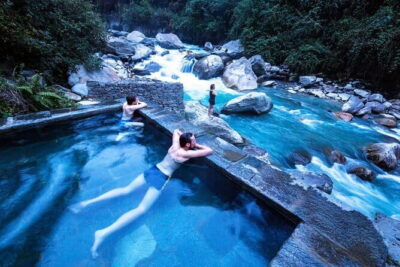
Day twelve leads to Jhinu Danda in about five hours. The key attraction is the hot spring, where you can rest while looking across the western Nepal hills. This is a well-placed comfort stop after the highest part of the trek.
Day thirteen continues toward Nayapul, followed by a drive back to Pokhara. The supplied schedule describes both a trek to Nayapul and a five-hour day, though exact walking and driving times can vary. You spend the night in Pokhara.
Day fourteen is the return to Kathmandu by tourist coach after breakfast. The ride is expected to take seven to nine hours. The tour is therefore not a short base-camp hike with a quick exit. It is a full Nepal trip, with a long road return built into the final day.
What the $899 price really covers
At $899 per person, the price is attractive for a private 14-day Nepal program if you value having the main logistics handled. The package includes airport pickup, hotels in Kathmandu and Pokhara with breakfast, teahouse lodging, trek meals, tourist-coach transport, an English-speaking guide, porters, permits, paperwork, and government and local taxes as described.
The porter arrangement is listed as one porter for every two trekkers. Porter salaries, insurance, equipment, food, lodging, and transport are included. That is a meaningful part of the value, both for comfort and for reducing the weight you carry each day.
The price is not all-inclusive in the everyday sense. You pay for sightseeing entrance fees, city lunches and dinners, drinks, showers, hot water, laundry, phone calls, charging, bar bills, and tips. Extra hotel nights are also excluded if you arrive early, leave late, return from the mountain early, or need to extend the trip.
There is also a wording conflict around fees and taxes. The included section says government and local taxes are covered, while the exclusions mention all fees and taxes. I would ask the operator to clarify exactly which charges are included before booking.
Who will enjoy this private trek most
I would recommend this trip to someone who wants a first Himalayan trek with a clear route and personal support, but does not want to arrange every detail independently. It suits you if you can walk for four to seven hours on repeated days and manage steep steps, descents, and high-altitude conditions.
The private format is especially helpful for mixed-ability groups, older hikers with good fitness, or anyone who wants to adjust the pace. Several positive accounts describe guides taking close care of food, comfort, and difficult moments. Guides named Bishnu Bhatta and Vishnu are associated with particularly warm, attentive departures, though you should confirm who will lead your own group.
This is less suitable if you want luxury lodging, short transfer days, or a relaxed holiday with only occasional walking. Teahouses are practical rather than plush, and the route demands real effort. Monsoon departures can bring lush greenery and a magical wet-season feel, but rain may affect conditions and visibility.
The operator offers free cancellation up to 24 hours before the local start time. Changes or cancellations inside that window are not accepted for a refund.
Should you book the Annapurna Base Camp Trek?
Book it if you want a well-supported Himalayan route that combines Kathmandu’s major sacred sites, Pokhara, Poon Hill, Annapurna Base Camp, and Jhinu hot spring in one trip. The strongest value comes from the private guide, porter support, permits, trek meals, and airport-to-trail planning included in the $899 price.
Before booking, get the day-by-day plan in writing. Confirm whether the trip is 14 or 15 days, where you sleep on the Deurali and base-camp nights, which fees are covered, and the exact guide assigned to you.
If those details are settled, this is a practical way to reach Annapurna Base Camp without giving up the personal feel of a private trek. You will still work for the views, but the company handles much of the paperwork and daily machinery that can distract from the mountains.
FAQ
How long does the Annapurna Base Camp tour last?
The tour is advertised as approximately 14 days, while the overview also refers to 15 days. The detailed schedule runs from arrival in Kathmandu on day one through the return from Pokhara to Kathmandu on day fourteen, so confirm the exact duration before booking.
What fitness level is required?
A moderate level of physical fitness is required. Walking days generally last four to seven hours, with steep climbs, stone steps, descents, forest trails, and a high-altitude section to Annapurna Base Camp.
Are meals included?
Breakfast is included at the Kathmandu and Pokhara hotels. During the trek, breakfast, lunch, and dinner are included at teahouses. Lunch and dinner in Kathmandu and Pokhara are not included.
Is transportation included?
Yes. Airport pickup is included, along with tourist-coach transportation between Kathmandu and Pokhara. A private vehicle is used for the drive from Pokhara to Nayapul, and the itinerary includes transport back to Pokhara after the trek.
Are guides and porters included?
Yes. The package includes an experienced English-speaking trekking guide and porters, with one porter listed for every two trekkers. Their salary, insurance, equipment, food, lodging, and transport are included.
Which permits are included?
The necessary paperwork and permits listed are the Annapurna Conservation Area Permit, known as ACAP, and TIMS. Government and local taxes are also listed as included, though another section mentions fees and taxes among exclusions, so ask for clarification.
What is not included in the trek price?
Drinks, bottled or boiled water, hot water, showers, tea, coffee, laundry, phone calls, battery charging, bar bills, sightseeing entrance fees, city meals, extra hotel nights, and tips for guides and porters are not included.
Recently added around Kathmandu
- Kathmandu : Swambhunath & Durbar Square Guided Half Day Tour★ 3.3 · 3 reviews
- Private Day Tour in Kathmandu Valley Rim with Bhaktapur Sightseeing★ 5.0 · 3 reviews
- Nepali Cooking training & Cultural Homestay Experience★ 5.0 · 3 reviews
- Private 3-Hour Nagarkot Sunset Tour from Kathmandu★ 3.5 · 3 reviews
- From Kathmandu / Pokhara / Chitwan: River Rafting – 1 Day★ 4.6 · 3 reviews
- From Kathmandu: Everest Base Camp Landing Helicopter Tour★ 5.0 · 3 reviews
- 4 UNESSCO World heritage sites of Kathmandu-private tour★ 5.0 · 3 reviews
- From Kathmandu Budget: 15 Day Everest Base Camp Trek★ 5.0 · 3 reviews
Annapurna Treks, compared.
Kathmandu to Annapurna Base Camp (ABC) 5-Day Trek
Read our review →
Browse the lists this tour appears in