
Reviewed · ANNAPURNA TREKS
Annapurna Circuit Trek
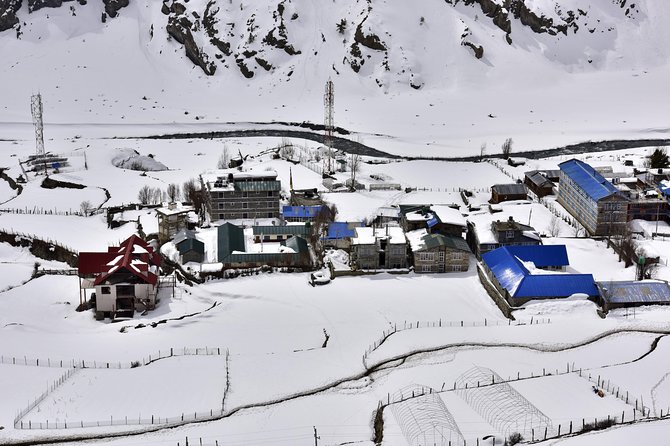
The big draw here is the Thorung La crossing at 5,416 meters, reached after walking through the Manang Valley and high mountain villages. You get a classic Annapurna route without having to arrange permits, rooms, meals, transfers, or a safe plan for the high-altitude sections yourself.
I like the private format, since your group can adjust the pace and tailor parts of the trek. I also like the practical setup: airport pickup, Kathmandu and Pokhara hotels, tea-house lodging, most meals, permits, entrance fees, and first-aid medicine are included.
The main caution is the schedule. It packs a major high-altitude crossing into 14 days and includes several long road journeys. You need moderate fitness, patience for basic mountain lodging, and a clear understanding that Wi-Fi, hot showers, bottled water, charging, porter service, and some meals cost extra.
In This Review
- Key points at a glance
- Why this Annapurna route still earns its place
- Kathmandu arrival and the first briefing
- The road to Syange takes most of a day
- Dharapani, Chame, and the changing valley
- Pisang and the approach to Manang
- Higher country beyond Manang
- Thorung La, the hardest day of the trek
- The long road from Muktinath to Pokhara
- Returning to Kathmandu and heading home
- What the $1,150 price covers
- Who should book this trek
- Should you book the Annapurna Circuit Trek?
- FAQ
- How long is the Annapurna Circuit Trek?
- Where does the trek start?
- Is this a private tour?
- Is a trekking guide included?
- Are meals included?
- Is accommodation included?
- Are trekking permits and entrance fees included?
- Is porter service included?
- Can I cancel for a full refund?
Key points at a glance
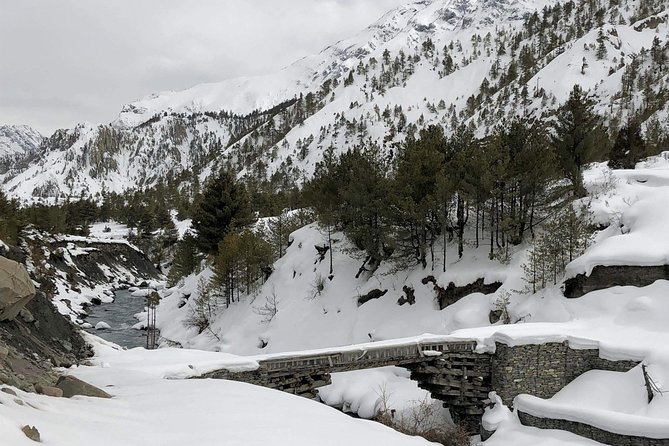
- Thorung La at 5,416 meters: The trek’s toughest and most memorable day, with an early start and about eight hours of walking.
- A true private trek: Only your group participates, and the plan can be adjusted to suit your needs.
- Manang acclimatization day: You get a rest day with short hikes to places such as Gangapurna Lake or Bonjo Gumba.
- Mustang and Muktinath: The route changes from green mountain valleys to a drier, Tibetan-influenced region.
- Full board on the trail: Breakfast, lunch, dinner, and tea are provided during the trekking section.
- Road travel is part of the deal: Expect an eight to nine-hour ride toward the trailhead and about ten hours from Muktinath to Pokhara.
Why this Annapurna route still earns its place
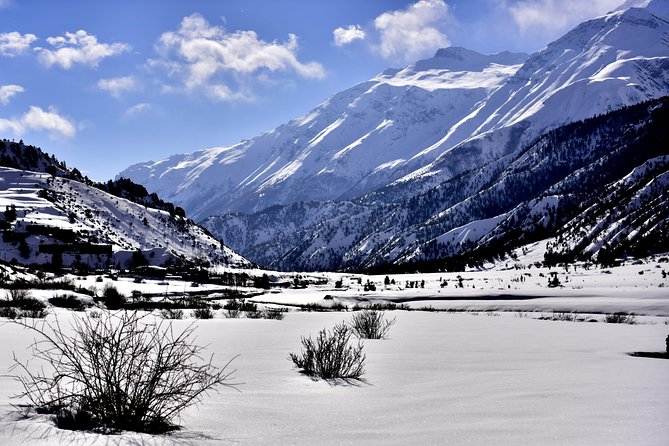
The Annapurna Circuit gives you a satisfying change of scenery over two weeks. You begin with city hotels and long road transfers, then walk through wooded valleys, mountain villages, high desert country, and one of Nepal’s best-known mountain passes.
I like that this is not simply a high-altitude walk from start to finish. The circuit builds gradually. You have time in Manang before the final climb, and the route finishes at Muktinath before the long journey to Pokhara.
The trip costs $1,150 per person. That is a useful price to judge against what you would have to arrange yourself: airport transfers, four nights of city hotels, a private trekking guide, tea-house accommodation, meals on the trail, transport, permits, entrance fees, and a first-aid kit.
You still pay for international flights, your Nepal visa, porter service, meals in Kathmandu and Pokhara, drinks, Wi-Fi, charging, hot showers, and bottled water. The price is therefore strongest for someone who wants a supported trek but does not need a porter or luxury mountain rooms.
The private arrangement matters. On a large group trek, you often follow a fixed walking speed. Here, your guide can help your group manage the harder sections at a more sensible pace, especially near Thorung La. The word customizable should not be taken to mean that every day can be changed without limits, though. The altitude and available lodging still control the practical shape of the trek.
More Annapurna treks:
- Annapurna Circuit Trek with Tilicho Lake
★ 5.0 · 368 reviews - Annapurna base camp trek 5 Days
★ 5.0 · 252 reviews - Annapurna Base Camp Trek
★ 5.0 · 111 reviews
Kathmandu arrival and the first briefing
Your trip begins at Tribhuvan International Airport in Kathmandu. A company representative meets you there and takes you to your hotel by private vehicle.
This is a small but valuable service after an international flight. You do not need to find a taxi, explain a hotel address, or sort out the first transfer on your own. After some rest, you receive a briefing about the Annapurna Circuit.
You stay two nights in Kathmandu with breakfast included. Lunch and dinner are not included during the city stay, so you should budget separately for those meals and for drinks or other personal costs.
The briefing is your chance to confirm the route, ask about the day-by-day walking times, check the duffel bag and sleeping bag options, and make sure you understand what your guide carries. First-aid medicine is carried by the local guide, which is useful on a route where altitude and long walking days deserve careful attention.
One point deserves direct attention: the supplied material gives no guide names or detailed guide qualifications. The guide is central to this experience, so ask who will lead your group and how the company handles altitude symptoms before departure.
The road to Syange takes most of a day
After breakfast, you leave for Syange. The drive takes about eight to nine hours.
This is not a throwaway transfer. It is a major part of the first trekking day, and road travel in the mountains can be tiring even when you are sitting down. You should treat this as a full travel day rather than expecting to arrive ready for a long walk.
The benefit is that you reach the lower section of the circuit without arranging a separate bus or jeep yourself. The package includes long-range tourist bus transport for the Kathmandu to Besishar journey, with the route description continuing toward Syange.
Once at Syange, the walking begins in earnest. The route follows the Marsyangdi Valley toward Dharapani, with river crossings and mountain scenery. The walking time is described as roughly six to eight hours, so you should expect a demanding day early in the trip.
Dharapani, Chame, and the changing valley
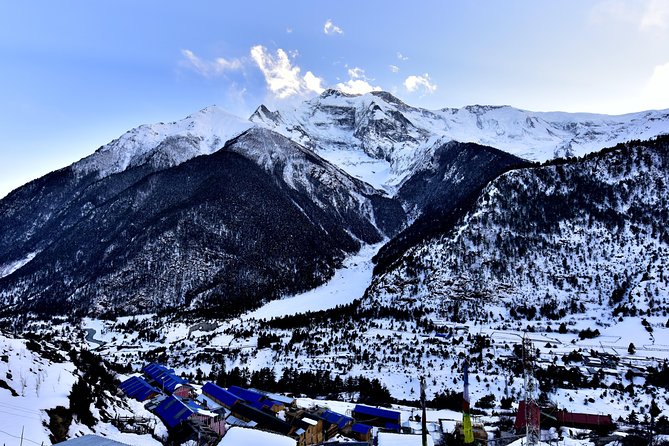
The walk toward Dharapani brings you properly onto the trail. You cross a bridge and continue through the valley, with the landscape becoming more enclosed and wooded.
Dharapani is an important stopping point because the trip begins to feel like a mountain trek rather than a road journey. The day can take six to eight hours, so comfortable boots and a steady rhythm matter more than speed.
The next section continues to Chame. The route passes steep ridges, green woods, and areas affected by landslides. You need to watch your footing while still making time to look toward the mountains.
Chame is the administrative center of Manang District, though this tour description focuses more on the walking route than on sightseeing in town. Your reward is the gradual shift in scenery and altitude. You are gaining height, but not yet facing the hardest part of the circuit.
The route then narrows in places and becomes steeper. A notable sight is Paungda Danda, a curved rock formation rising about 1,500 meters above the river. This is the sort of feature that gives the trail its character. You are not just walking from lodge to lodge; you are moving through a valley shaped by cliffs, water, and changing vegetation.
More treks starting in Kathmandu:
- Everest Base Camp Trek – 14 Days
★ 5.0 · 1,499 reviews - Everest Base Camp Trekking
★ 5.0 · 485 reviews - Nagarkot Sunrise View and Day Hiking from Kathmandu
★ 5.0 · 471 reviews - Everest Base Camp Trekking – 13 Day
★ 5.0 · 365 reviews
Pisang and the approach to Manang
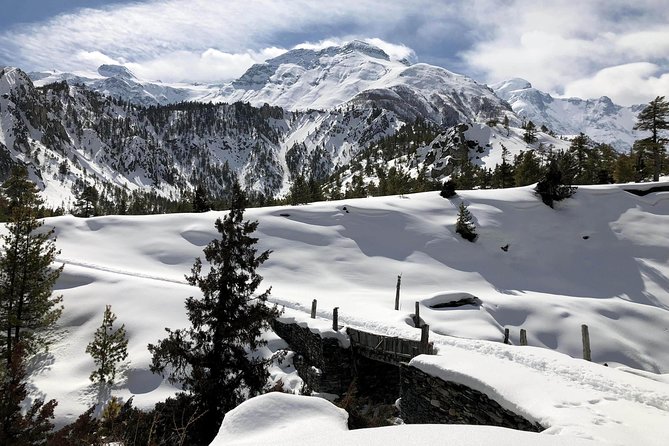
The journey continues through the valley toward Manang, with the route passing through Upper Pisang. The walk takes about six to seven hours, depending on the exact route and your group’s pace.
Upper Pisang is one of the more memorable points on the circuit because the route is beginning to look and feel higher, drier, and more open. The mountains become the main event, while the trail continues to gain altitude.
Manang is the key pause in the itinerary. You do not simply arrive and leave the next morning. Day seven is set aside for rest and short exploration, which is one of the most sensible parts of the schedule.
You may take a short hike toward Gangapurna Lake or Bonjo Gumba. The plan also allows for a possible walk toward Vraga, though the exact outing should depend on how you feel. At this height, an easy acclimatization walk is more useful than proving how far you can go.
Your guide should help you judge the day. Tell the guide clearly if you have a headache, nausea, unusual tiredness, or trouble sleeping. Do not treat a rest day as an excuse to push harder. The purpose is to prepare your body for the higher sections ahead.
Higher country beyond Manang
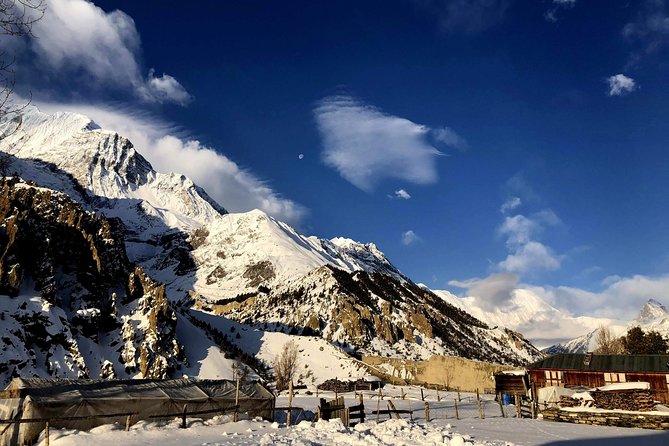
After the rest day, you continue upward through Tenki and along the upper Marsyangdi Valley. The route passes juniper trees, a small stream, and Ghunsa Village before reaching higher settlements.
The walking time is listed at about four hours, which sounds manageable. At altitude, though, a shorter day can still feel strenuous. I would plan to walk slowly, drink regularly, and keep warm during stops.
The trail then continues toward Thorung Phedi. You cross a suspension bridge to reach Letdar and pass through sections bordered by cliffs. This day also takes about four hours, but it serves a serious purpose: positioning you for the pass crossing.
Thorung Phedi is the point where the trip changes from a steady mountain walk to a high-altitude challenge. The next morning requires an early start, and the weather can affect the crossing. You should listen closely to the guide’s instructions and avoid treating the pass as a race.
The itinerary mentions Thorung La in several day headings, so the wording is not perfectly tidy. The route itself is clear: you acclimatize in Manang, continue to higher villages, reach Thorung Phedi, cross Thorung La, and descend toward Muktinath.
Thorung La, the hardest day of the trek
The pass day is the central test of the circuit. Thorung La reaches 5,416 meters, making this an intense day even for a fit walker.
You begin with the ascent from the high lodges, then cross the pass before descending on the western side. The complete day takes about eight hours. The challenge is not just the distance. You are walking at an altitude where the air is thin, weather can change quickly, and every uphill step takes more effort.
This is where the private format is most useful. Your group can maintain a controlled pace, stop when needed, and avoid being pushed by a larger party. The guide also carries first-aid medicine and should monitor the group closely.
You should pack light for the walking day but keep essential warm layers, water, snacks, sun protection, and any personal medicine close at hand. The operator does not include bottled water, so plan to buy or refill water along the way. Hot showers, Wi-Fi, charging, and other lodge extras also cost extra.
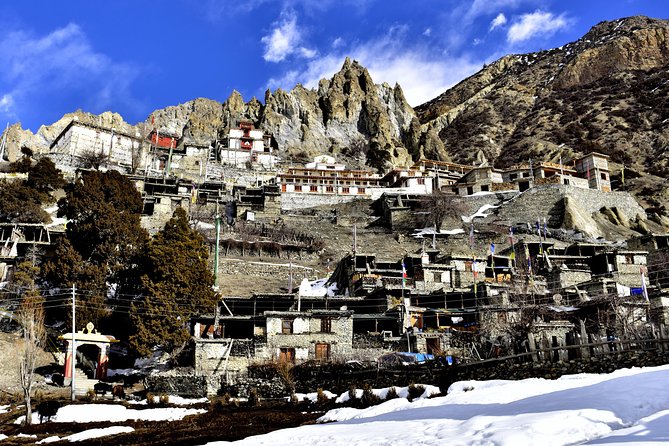
The descent leads to Muktinath, where the mood and scenery change. The area has strong religious importance, and the route introduces you to the Tibetan-influenced culture of Mustang. Muktinath Temple is included as a stop, giving the day a cultural focus after the physical effort of the pass.
The long road from Muktinath to Pokhara
The trek ends on foot at Muktinath, but your travel day is not over. You take a shared local bus or jeep to Pokhara, a journey of about ten hours.
This is the itinerary’s biggest comfort compromise. After crossing the highest point of the trek, a ten-hour road ride can feel rough on the body, especially if you are tired or prone to motion sickness. On the other hand, the shared vehicle keeps the package price down and connects the high route with Pokhara without another complicated booking.
Two nights of hotel accommodation in Pokhara include breakfast. Lunch and dinner are on your own, which gives you freedom to choose how you spend the recovery evening.
Day twelve is a rest day in Pokhara. You can explore the valley independently, or simply give your legs a quiet day. That flexibility is welcome after the pass and the long ride.
Returning to Kathmandu and heading home
You return to Kathmandu by tourist bus after breakfast, with a journey of about seven hours. A flight from Pokhara to Kathmandu is available for an additional charge.
The bus option is included and keeps the advertised price straightforward. The flight option may be worth asking about if you value time more than cost, but the supplied details do not give a flight price or schedule.
Your final Kathmandu hotel night includes breakfast. Airport transfer is included on departure, with a private vehicle taking you to Tribhuvan International Airport.
The trip ends with a completion certificate after the trek. It is a small extra, but some people like having a formal record of the route and pass crossing.
What the $1,150 price covers
The package has solid practical value if you want a guided trek with the main arrangements handled. Included services are:
- A professional trekking guide
- Private airport and hotel transfers
- Tourist bus transport for the long Kathmandu and Kathmandu return journeys
- Local bus or jeep transport from Muktinath to Pokhara
- Four hotel nights in Kathmandu and Pokhara, with breakfast
- Tea-house or lodge lodging during the trek, normally in twin-sharing rooms
- Full-board meals during the trekking section
- Trekking permits and entrance fees
- First-aid medicine carried by the guide
- Government and local taxes
- A company duffel bag and sleeping bag when needed
- A trip completion certificate
The word full board is important, but it applies while trekking. Kathmandu and Pokhara lunches and dinners are not included. Drinks and lodge services are also separate.
Porter service is not included. If you want someone to carry your main bag, ask about the extra cost before you book. The supplied price is best for a person who can manage a trekking pack or arrange porter support separately.
Who should book this trek
I would recommend this trip to you if you want the classic Annapurna route but do not want to manage permits, lodging, meals, airport transfers, and mountain transport alone.
It suits people with moderate physical fitness who can handle several six to eight-hour walking days and one especially demanding pass day. You should be comfortable with tea-house accommodation, twin-sharing rooms, paid hot showers, limited access to Wi-Fi, and extra charges for charging and bottled water.
It is less suitable if you want private transport throughout, upscale mountain hotels, a porter included in the price, or a relaxed schedule with many spare days. The road transfers are long, and the pass crossing is a real physical challenge.
The trip is also a good match for a small group of friends or family members who want control over their walking pace. Group discounts are offered, which may improve the value for a larger private party.
Booking is available with free cancellation up to 24 hours before the start time. Poor weather can cause a cancellation, in which case you are offered another date or a full refund.
Should you book the Annapurna Circuit Trek?
Book it if you want a well-organized, private version of one of Nepal’s best-known routes and you accept the basic comforts and long road days that come with it.
The strongest features are the private guide, the Manang rest day, the included permits and meals, and the hotel and airport arrangements in Kathmandu and Pokhara. The main weaknesses are the demanding altitude, the ten-hour ride to Pokhara, and the list of everyday extras that are not covered.
Before paying, confirm the guide’s name and experience, ask how altitude problems are handled, clarify the exact transport from Kathmandu to the trailhead, and decide if you need a porter. If those points suit you, $1,150 is a fair package price for a two-week Annapurna Circuit experience with the major planning work already done.
FAQ
How long is the Annapurna Circuit Trek?
The experience lasts approximately 14 days, including arrival and departure in Kathmandu, the trekking section, time in Pokhara, and transport between destinations.
Where does the trek start?
The experience starts with airport pickup at Tribhuvan International Airport in Kathmandu, Nepal.
Is this a private tour?
Yes. Only your group participates, and the trek can be customized to suit your needs.
Is a trekking guide included?
Yes. One professional trekking guide is included for the trek.
Are meals included?
Breakfast is included at the Kathmandu and Pokhara hotels. Breakfast, lunch, dinner, and tea are included during the trekking section. Lunch and dinner in Kathmandu and Pokhara are not included.
Is accommodation included?
Yes. The package includes two hotel nights in Kathmandu, two hotel nights in Pokhara, and twin-sharing lodge or tea-house accommodation while trekking.
Are trekking permits and entrance fees included?
Yes. The essential trekking permits and area entrance fees are included.
Is porter service included?
No. Porter service is not included in the stated price.
Can I cancel for a full refund?
Yes, if you cancel at least 24 hours before the experience start time. Cancellations made less than 24 hours before the start time are not refunded. If poor weather causes the experience to be canceled, you are offered another date or a full refund.
Recently added around Kathmandu
- Kathmandu : Swambhunath & Durbar Square Guided Half Day Tour★ 3.3 · 3 reviews
- Private Day Tour in Kathmandu Valley Rim with Bhaktapur Sightseeing★ 5.0 · 3 reviews
- From Kathmandu / Pokhara / Chitwan: River Rafting – 1 Day★ 4.6 · 3 reviews
- Nepali Cooking training & Cultural Homestay Experience★ 5.0 · 3 reviews
- Private 3-Hour Nagarkot Sunset Tour from Kathmandu★ 3.5 · 3 reviews
- From Kathmandu: Everest Base Camp Landing Helicopter Tour★ 5.0 · 3 reviews
- 4 UNESSCO World heritage sites of Kathmandu-private tour★ 5.0 · 3 reviews
- From Kathmandu Budget: 15 Day Everest Base Camp Trek★ 5.0 · 3 reviews
Annapurna Treks, compared.
Kathmandu to Annapurna Base Camp (ABC) 5-Day Trek
Read our review →
Browse the lists this tour appears in